
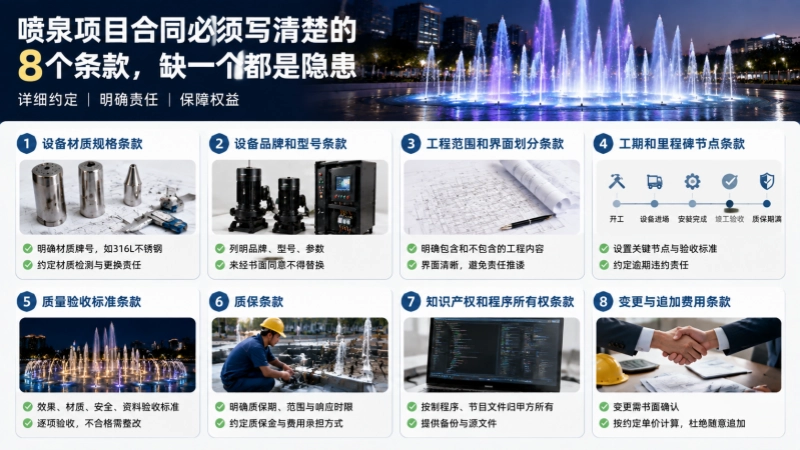
The terms of a fountain contract are the most important tool for Party A to safeguard its rights and interests during the project delivery phase. Bottom line: The biggest difference between a fountain construction contract and a standard procurement contract is that fountains are custom-made products; once installed, they are difficult to dismantle or replace. Every ambiguous clause in the contract can become a source of dispute during the acceptance phase or within the warranty period. This article breaks down, one by one, the eight core clauses that must be clearly specified in fountain project contracts, with specific wording recommendations provided for each clause that can be directly applied.
Fountain Contract Clause 1: Provisions Regarding Equipment Materials and Specifications
This is the clause in fountain contracts that is most likely to be worded vaguely and to give rise to disputes. The clause specifying the material specifications for the equipment must be precise down to the material grade; it is not sufficient to simply list the material category.
The contract should clearly specify the following material specifications:
- Nozzle Material:It must be specified whether 304 stainless steel or 316L stainless steel is to be used. In chlorine-containing water, 316L stainless steel is the only suitable option and must be explicitly specified in the contract.
- Underwater Light Fixture Housing Material:You must also specify 304 or 316L, as well as the lens material (tempered glass or PC) and the seal material (silicone rubber or standard rubber).
- Pipe Material:Specify the material (304 stainless steel, galvanized steel pipe, UPVC) and wall thickness specifications.
- Waterproofing Materials for Pools:Specify the brand, model, and number of coats of the waterproofing material (e.g., ”polyurethane waterproof coating, applied in 3 coats, with a dry film thickness of no less than 1.5 mm”).
Suggested wording:“All metal components in this project that come into contact with water (spray heads, light fixture housings, pipe fittings) shall be made of 316L stainless steel. Upon acceptance, the Client shall have the right to commission a third-party organization to conduct material testing on the aforementioned components. If the test results do not comply with the provisions of this clause, the Contractor shall complete the replacement within 30 days, and the costs of replacement shall be borne by the Contractor. ”
Fountain Contract Clause 2: Equipment Brand and Model Clause
The contract must list the brand, model, and key specifications of all major equipment in an appendix and explicitly stipulate that no substitutions may be made without the written consent of Party A.
| Equipment Category | Items That Should Be Specified in the Contract | Unacceptable Statements |
|---|---|---|
| Water Pump | Brand, Model, Power, Head, Flow Rate | “Well-known brands” ”Comparable products” |
| Variable Frequency Drive (VFD) | Brand, Model, Rated Power, Control Interface Type | “Imported Variable Frequency Drives” ”Brand TBD” |
| DMX Controller | Brand, Model, Number of Channels, Compatible Protocols | “Professional Controller” |
| LED Lighting Fixtures | Brand, Model, Power, Color Temperature, LED Chip Brand, IP Rating | “IP68 Waterproof Light” ”Well-Known Chip” |
| PLC Controller | Brand, Model, Number of I/O Points, Communication Interfaces | “Industrial-Grade PLC” |
Suggested wording:“The brands and models listed in the equipment inventory for this Contract (see Exhibit 1) constitute the terms of this Contract, and Party B shall not replace them without authorization. If it is absolutely necessary to replace a brand or model due to supply issues, Party B must notify Party A in writing in advance and provide proof that the substitute brand has equivalent technical specifications. The replacement may only be made after Party A’s written confirmation; otherwise, it shall be deemed a breach of contract.”
Fountain Contract Clause 3: Scope of Work and Interface Definitions
The fountain contract must clearly list, in the form of a checklist, the scope of work included and excluded from this contract to avoid any attempts to shirk responsibility by claiming, ”That’s not within our scope.”
The following items must be explicitly stated in the contract to indicate whether they are included:
- Pool Civil Engineering:Excavation, subbase, pool wall masonry, waterproofing, and finishing—please specify separately for each item whether it is included.
- Trench Excavation and Backfilling:Excavation depth, width, and backfill standards for pipeline trenches.
- Cable Installation:Should the cables running from the distribution panel to the various electrical devices be included or excluded? Should they be run through conduit or buried directly?
- Electrical Panel Installation:Will the distribution box be provided by Party A or supplied by Party B? Who is responsible for the installation?
- Control Room Renovation:Who is responsible for ventilation, air conditioning, and moisture control in the control room?
- Debugging and Programming:Does the programming include several programs? Does it include labor hours for on-site debugging?
- Operations Training:Does this include operational training for Party A’s staff, and have the training content and duration been specified?
Suggested wording:“The scope of work under this Contract shall be as set forth in Appendix II, ”List of Scope of Work.’ Any work not specified in the list is excluded from the scope of this Contract. If, during construction, it is determined that additional work is required, both parties shall execute a written change order. The volume of such additional work shall be calculated in accordance with Appendix III, ‘Comprehensive Unit Price Schedule.’ Any changes not confirmed in writing shall not be recognized.”
Clause 4 of the Fountain Contract: Provisions on Construction Schedule and Milestone Deadlines
The construction schedule provisions in a fountain contract cannot simply specify a total project duration; they must include key milestones and stipulate the acceptance criteria for each milestone, as well as the consequences for delays.
| Milestone | Acceptance Criteria | Relationship to Payment |
|---|---|---|
| Start Work | Construction plan approval completed; material delivery schedule confirmed | Pay the down payment (contract price: 30%) |
| Equipment Arrival | Physical Verification of Major Equipment (Brand, Model, Quantity, Material) | Payment of the Second Installment (Contract Price: 30%) |
| Installation Complete | All equipment has been installed, connected to water and power, and undergone preliminary testing. | Payment of the Third Installment (Contract Price: 30%) |
| Final Inspection | Functional testing of the entire project; results are in line with the design specifications. | Payment of the Fourth Installment (Contract Price: 5%) |
| Warranty Period Expired | There are no unresolved quality issues during the warranty period. | Refund of Security Deposit (Contract Price: 5%) |

Suggested wording:“For each milestone that Party B delays by more than 7 calendar days, Party A shall be entitled to deduct a liquidated damages amount equal to 0.1% of the total contract price per day, provided that the cumulative liquidated damages shall not exceed 10% of the total contract price. If the delay exceeds 30 days, Party A shall have the right to terminate the contract, and Party B shall refund all amounts received and compensate Party A for any losses incurred.”
Fountain Contract Clause 5: Quality Acceptance Standards
Many fountain contracts include quality acceptance clauses that simply state ”accepted as satisfactory,” but what does “satisfactory” actually mean? Without standards, there is no basis for enforcement. Quality acceptance standards must be specified separately across three dimensions: performance, materials, and safety.
- Performance Acceptance Criteria:Compare the 3D renderings and technical specifications in the design proposal to verify, item by item, the water feature height (tolerance: ±10%), the type of water feature (as specified in the contract), the lighting colors (as specified in the design), and the music synchronization accuracy (error not exceeding 20 milliseconds).
- Material Acceptance Criteria:Party A reserves the right to commission a third party to conduct material testing on key components, such as spray heads and light fixtures, during the acceptance inspection phase. The costs of such testing shall be borne by Party B. If the test results do not meet the contractual requirements, Party B must replace the components and undergo a new acceptance inspection.
- Safety Acceptance Standards:All underwater electrical equipment operates at a voltage not exceeding 24 V DC; the trip current of the ground-fault circuit interrupter does not exceed 30 mA; the grounding resistance does not exceed 4 ohms; and a third-party electrical safety inspection report is available.
- Document Acceptance Criteria:At the time of final acceptance inspection, the as-built drawings, equipment documentation, backup copies of control programs, operation and maintenance manuals, and material test reports must be submitted simultaneously; failure to provide all required documents will result in the acceptance inspection being deemed unsuccessful.
Suggested wording:“Final acceptance shall be based on the ”List of Acceptance Criteria” in Annex IV to this Contract. Acceptance shall be conducted through item-by-item verification, and the entire project shall be deemed accepted only if each item meets the criteria. For items that fail acceptance, Party B must complete corrective actions within 15 days, after which a re-inspection will be conducted; if there are still non-compliant items after a cumulative total of more than three acceptance inspections, Party A has the right to require Party B to pay compensation equivalent to 10% of the total contract price.”
Clause 6 of the Fountain Contract: Warranty Provisions
Warranty provisions are a core safeguard of Party A’s rights following project delivery. They must clearly specify the following five elements; the absence of any one of them will weaken the practical enforceability of the warranty provisions:
- Warranty Period:Specify the start date (recommended to be the date of successful final acceptance, not the date of installation completion) and the end date of the warranty period. The warranty period for equipment should be no less than 1 year, and the warranty period for the project should be no less than 2 years.
- Warranty Coverage:Clearly define which situations are covered by the warranty (material defects, manufacturing defects, and quality issues with the equipment itself) and which are not (deliberate damage and wear and tear resulting from use beyond the intended scope). The definitions of ”normal wear and tear” and ”deliberate damage” should be as detailed as possible to avoid future disputes.
- Response Time:For general malfunctions, on-site response must occur within 48 hours; for emergency malfunctions (such as the fountain completely ceasing to operate or the presence of safety hazards), on-site response must occur within 24 hours. If the response time exceeds the agreed-upon period, Party A shall have the right to engage a third party to perform repairs at its own discretion, and Party B shall bear the associated costs.
- Performance Bond:5% of the total contract price shall be retained as a retention deposit following successful completion and acceptance of the project; it shall be refunded upon expiration of the warranty period provided there are no unresolved quality issues. The retention deposit shall not accrue interest.
- Out-of-Town Service Fees:It is hereby clarified that Party B shall bear the travel expenses incurred for on-site repairs during the warranty period and shall not charge Party A any additional fees.
Suggested wording:“During the warranty period, Party B shall provide free repairs for any defects caused by material or workmanship issues, with the following response times: 48 hours for general defects and 24 hours for emergency defects. If Party B fails to respond within the agreed-upon timeframe, Party A may independently engage a third party to address the issue, and the resulting costs shall be deducted from the warranty deposit. Upon expiration of the warranty period, Party A shall refund the warranty deposit within 30 days.”
Clause 7 of the Fountain Contract: Provisions on Intellectual Property and Ownership of Procedures
This is a clause that many clients completely overlook when signing contracts, but which is extremely important during subsequent operations. The control programs for musical fountains (PLC programs and DMX show programs) are a form of software asset. If the contract does not explicitly stipulate ownership of the programs, the contractor may refuse to provide the program files on the grounds of intellectual property rights, resulting in the client being entirely dependent on the original contractor for future maintenance.
The contract should clearly stipulate:
- Upon final acceptance, Party B must submit to Party A the complete source files (unencrypted versions) of the PLC control program and the original project files of the DMX show program.
- The intellectual property rights to the aforementioned program files belong to Party A (or Party A has obtained a perpetual license to use them), and Party A has the right to commission a third party to modify and maintain the program based on the original version.
- Party B shall not refuse to provide the program documentation for any reason; such refusal shall be deemed a fundamental breach of contract, and Party A shall have the right to withhold payment of the final installment.
Suggested wording:“Upon completion of the final acceptance inspection, Party B shall submit to Party A all program documentation for the project’s control system, including PLC source code, DMX show files, and operating instructions. The rights to use the aforementioned documents shall belong to Party A, which may use, modify, and maintain them either on its own or through a third party; Party B shall not restrict such use for any reason.”
Clause 8 of the Fountain Contract: Dispute Resolution Clause
Many contracting parties view the dispute resolution clause in a contract as a mere formality, but in reality, this clause directly determines the cost of resolving a dispute should one arise.
Elements of dispute resolution that must be specified in the contract:
- Court of Jurisdiction:It is agreed that the court in Party A’s location shall have jurisdiction over the first instance, to avoid litigation in Party B’s location (as litigation in another location is costly and disadvantageous to Party A).
- Evidentiary Value:Written notices from both parties (including emails and screenshots of WeChat messages) may be used as valid evidence, thereby reducing the difficulty of gathering evidence.
- Penalty Standards:Clarify the calculation methods and maximum limits for liquidated damages corresponding to various types of breaches (construction delays, non-conforming materials, failure to respond to warranty claims) to avoid situations where there is no basis for resolution in the event of a dispute.
- Mediation as a Prerequisite:The parties agree that in the event of a dispute, they will first attempt to resolve it through negotiation and mediation (within 15–30 days); if mediation fails, they will then proceed to litigation, thereby reducing unnecessary legal costs.
Suggested wording:“Any disputes arising from this Contract shall first be resolved through negotiation between the parties. If such negotiations fail, the matter shall be submitted to the People’s Court with jurisdiction in Party A’s place of business for resolution through litigation. The parties acknowledge that written confirmations sent via email and instant messaging tools (such as WeChat, DingTalk, etc.) have the same legal effect as paper documents.”
Comprehensive Checklist Before Signing a Fountain Contract
- Are the material specifications for the equipment specified down to the grade (316L / 304 / copper), and is the right to third-party inspection stipulated?
- Are the brands and models of major equipment listed in an attachment, and is written approval required for replacements?
- Is the scope of work clearly defined in the form of a bill of quantities, and is a comprehensive unit price schedule attached to govern the pricing of changes?
- Should milestone milestones be established, and should each milestone have acceptance criteria and penalties for late completion?
- Are the quality acceptance criteria specified separately for each of the four dimensions—performance, materials, safety, and documentation?
- Do the warranty terms include the warranty period, scope, response time, warranty deposit, and out-of-area service fees?
- Is ownership of the control program clearly assigned to Party A, and does Party B undertake to provide the complete source code?
- Does the dispute resolution clause specify jurisdiction at Party A’s place of business? Is electronic evidence admissible?
Frequently Asked Questions (FAQ)
Can we use the standard contract provided by the contractor for the fountain project?
It is not recommended to use the standard contract template provided by the contractor directly. The contractor’s standard contract is typically designed to protect its own interests and often favors the contractor in provisions regarding materials, warranties, and dispute resolution. It is recommended that the Client use the key terms of this contract as a basis, requiring the contractor to negotiate within the contractual framework provided by the Client, or to amend the contractor’s contract text clause by clause and mark the changes in red to ensure that all key terms align with the Client’s interests. For projects with a contract value exceeding 500,000 yuan, it is recommended to engage a professional attorney to review the contract text prior to signing.
The contractor says that certain terms are ”industry practice.” Should the client accept them?
“Industry practice” is a common phrase used in negotiations, but from a legal standpoint, contract terms are binding as long as both parties sign them voluntarily; there is no such thing as ”Party A must accept this because it is industry practice.” For clauses that are clearly disadvantageous to Party A (such as full payment upon delivery of equipment, no retention deposit, or failure to provide program documentation), Party A has every right to request amendments. If the contractor insists that certain clauses cannot be modified, Party A should regard this as a red flag and consider whether to replace the contractor, rather than passively accepting unreasonable terms.
The contractor's verbal promises are more favorable than what's in the contract. Should they be added to the contract?
This must be included in the contract. Verbal promises are not legally enforceable, especially in the event of personnel changes on the contractor’s side (such as the departure of a project manager) or in the event of a dispute between the parties, as verbal promises cannot be substantiated. The correct approach is to document all commitments made by the contractor during negotiations—including material upgrades, additional services, and extended warranty periods—in writing as contract attachments or supplemental agreements. These become binding only after both parties have signed and confirmed them. Screenshots of WeChat chat records can serve as supporting evidence, but formal written documents carry greater legal weight.
Regarding the retention deposit in the fountain contract, the contractor says it can be replaced with a bank guarantee. Is that acceptable?
This is appropriate, and in some cases, a bank guarantee offers greater security than a cash warranty deposit. A bank guarantee is a credit guarantee issued by a bank; if the contractor defaults (such as by failing to respond to repair requests during the warranty period), the client can file a claim directly with the bank without first going through litigation, resulting in faster resolution. For the contractor, a bank guarantee can reduce the amount of cash tied up in the project. When accepting a bank guarantee, it is important to note the following: Ensure the guarantee is ”on demand” (the bank pays unconditionally upon the client’s claim) rather than ”conditional” (requiring a court judgment to claim); ensure that the guarantee’s validity period covers the entire warranty period and includes a sufficient grace period (it is recommended to extend the validity by 30–60 days beyond the end of the warranty period).
Huiqi Fountains has been deeply involved in the fountain industry for 19 years. For all projects, we provide standardized contract templates and complete equipment lists as attachments, with material specifications and brand models listed item by item. During acceptance, we support the client’s request to have a third party conduct material testing, and upon project completion, we provide a full set of documentation, including the source files for the control programs. www.huiqi-china.com, Phone: 13826128838.
 Chinese
  English