
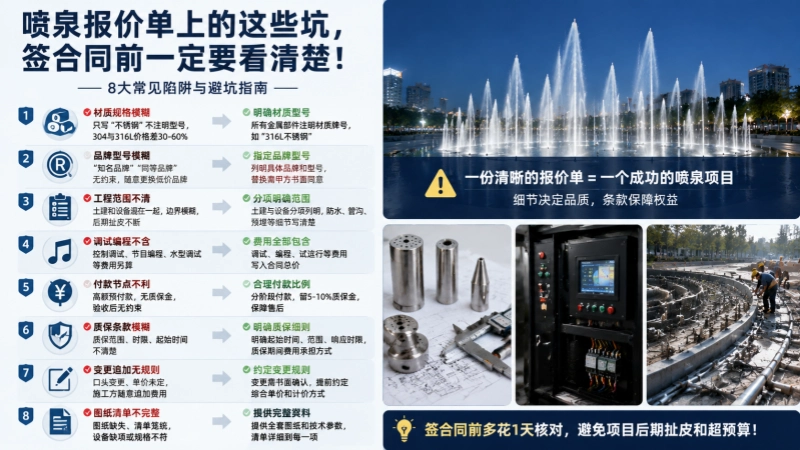
Traps in fountain quotations have long been a persistent problem in the industry; many clients see one figure when signing a contract but end up with a completely different product upon delivery. The bottom line: The problem with fountain quotes isn’t the total price itself, but whether the details are clear—specifically, the five key areas of material specifications, brand and model, scope of work, payment milestones, and warranty terms. If any of these is vague, it will inevitably lead to disputes down the line. This article breaks down the eight most common pitfalls in fountain quotes item by item to help clients identify risks before signing a contract.
Trap No. 1 in Fountain Quotations: The material specifications only list ”stainless steel” without specifying the model number
This is the most common—and most subtle—pitfall in fountain quotes. A quote that lists ”stainless steel nozzles” may seem fine at first glance, but there’s a price difference of 30–60% between 304 stainless steel and 316L stainless steel, and the difference in corrosion resistance is several times greater.
In fountains with chlorinated water, 304 stainless steel nozzles typically develop pitting and perforations within 1–2 years, whereas 316L stainless steel can last 10–15 years. When contractors specify ”stainless steel” in their quotes but use 304 upon delivery, they are not in breach of contract and save a significant amount of money.
The same issue arises with underwater lighting fixtures: the quote specifies ”IP68 waterproof lights,” but since IP68 is merely a protection rating, there are absolutely no specifications regarding whether the housing is made of 304 or 316L stainless steel, or whether the lens is tempered glass or PC acrylic.
Solutions:All metal components listed on the quotation must specify the exact material grade (e.g., 316L stainless steel); all lighting fixtures must specify the materials used for the housing, lenses, and seals; and the contract appendix must clearly outline the material testing methods to be used during acceptance inspection.
Trap No. 2 in Fountain Quotes: Equipment Brands Listed as ”Well-Known Brands” or ”Equivalent Brands”
“Well-known brand pumps” is one of the most vague phrases on a quote. What constitutes a “well-known brand”? There are no standards—it is entirely up to the contractor to interpret. While the client may consider Grundfos or New World to be well-known brands, the contractor can simply use any small, well-known domestic brand to fulfill the requirement, and there is no basis for a breach of contract in the agreement.
Other equally problematic phrases include ”imported brand” (with no restrictions on the country of origin), ”equivalent product” (who determines what constitutes ”equivalent”?), and “brand to be determined” (which implies that Party A has completely relinquished control over the brand).
| Common Phrases in Quotations | Risk Level | Changed as requested |
|---|---|---|
| Well-Known Pump Brands | High Risk | Grundfos / New Territories / Nanfang Pump Industry (Designated Brands) |
| The same brand or the same product | High Risk | For specified brands, any substitution requires the written consent of Party A. |
| Imported Brand Variable Frequency Drives | Moderate risk | Siemens / Danfoss / ABB (specified brands and countries of origin) |
| Brand to be determined | Extremely High Risk | We do not accept this; we require the brand to be confirmed before signing the contract. |
| Internationally Renowned LED Chips | High Risk | Cree / Osram / Bridgelux (specified chip brands) |
Solutions:The quotation must specify the exact brands and models of all major equipment (pumps, variable-frequency drives, controllers, and lighting chips). The contract must state that brands or models may not be changed without the written consent of Party A; failure to comply shall be deemed a breach of contract.
Trap No. 3 in Fountain Quotes: Vague Scope of Work, with Civil Engineering and Equipment Mixed Together
Fountain projects are typically divided into two parts: civil engineering (pool excavation, waterproofing, trench work, and cable conduit installation) and equipment installation (pumps, nozzles, lighting fixtures, and control systems). Many quotes bundle these two components into a single total price, without breaking them down into separate items or specifying the scope of work for each.
This method of packaging often leads to a great deal of controversy during construction:
- Excessive Excavation and Depth in Civil Engineering:The contractor is demanding that Party A pay civil engineering costs exceeding the budget, citing ”differences in actual geological conditions”; however, since the contract does not itemize civil engineering costs separately, it is impossible to verify whether this demand is reasonable.
- Missing pre-installed piping:The quote did not explicitly include the pre-installation of conduit for cables. After construction was completed, the Client discovered that the cables had been buried directly in the ground (which is not in accordance with standards). When the Client requested corrective action, the contractor stated, ”This is not covered by the contract.”
- Unclear Standards for Pool Waterproofing:It was not clearly specified whether the waterproofing layer was to be made of polyurethane or acrylic, or how many coats were to be applied, which led to a dispute over the quality of the waterproofing during the final inspection.
Solutions:The quotation must itemize civil engineering and equipment installation work separately. For the civil engineering portion, specify the brand of waterproofing materials and the number of application coats, as well as the dimensions and burial depth of utility trenches and the specifications of cable conduits. Open-ended clauses such as ”civil engineering costs to be settled based on actual expenses” will not be accepted.
Fountain Quote Trap #4: Commissioning and Programming Fees Are Not Included in the Quote
This pitfall is extremely common in musical fountain projects. The quote lists the equipment and installation costs and appears to be complete, but it does not include the following:
- Control System Commissioning Fee:The commissioning of a DMX512 control system requires professionals to use specialized software, and labor costs typically range from 5,000 to 20,000 yuan; many quotes do not include this expense.
- Music Program Programming Fees:Programming a single musical fountain show takes 3–7 days, and the cost is typically 3,000–30,000 yuan per show. This is a separate service fee in addition to the cost of purchasing equipment, which many quotes fail to mention at all.
- Water-based system commissioning fee:The spray head angles, flow distribution, and switching logic for each spray pattern require repeated on-site testing and adjustment; this work typically takes 2–5 days, and the associated costs are often overlooked.
- On-site engineer fees during the trial operation period:Some complex projects require engineers to be on-site for 1–2 weeks; while these costs are not included in the equipment quote, they have a significant impact on the overall budget.
Solutions:The quotation must clearly list the commissioning fees, program programming fees (including the number of songs in the initial repertoire), and trial operation support fees, and the contract must stipulate that these fees are all included in the total contract price and will not be charged separately.
Fountain Quote Trap No. 5: Payment Schedule Designed to the Client’s Disadvantage
The payment terms included in fountain quotation documents often provide excessive protection for the contractor’s interests while failing to adequately safeguard the client’s rights. The following payment arrangements pose extremely high risks to the client:
| Payment Arrangements | Risks | Reasonable Alternatives |
|---|---|---|
| Pay a deposit of 50% or more upon signing the contract | After receiving payment, the contractor’s motivation waned, and the project fell behind schedule. | Pay 30% upon signing the contract; pay 30% upon delivery of the equipment. |
| Payment upon delivery of the equipment | The arrival of equipment does not mean installation is complete; quality has not yet been verified. | Payment is due after installation is complete and initial testing has been passed. |
| Full payment will be made upon successful acceptance. | No performance bond; after acceptance, there is no way to ensure a timely after-sales response. | Pay 951 TP3T upon acceptance; withhold 51 TP3T as a warranty deposit, to be paid upon expiration of the warranty period. |
| No Security Deposit Clause | During the warranty period, the contractor faces no financial pressure and is unresponsive to after-sales service requests. | 5–10% of the total contract price will be held as a retention deposit and refunded upon the expiration of the warranty period, provided there are no issues. |

Recommended Payment Schedule: Pay 30% upon signing the contract (Advance payment for material preparation upon project commencement) → Pay 30% after equipment delivery and acceptance (following material verification) → Pay 30% after installation, commissioning, and preliminary acceptance → Pay 5% upon successful final acceptance → Pay the remaining balance of 5% after the warranty period expires with no issues.
Fountain Quote Trap #6: Vague Warranty Provisions
The quote states ”one-year warranty,” which seems fine, but if the following key details are not clearly specified, the warranty terms are effectively meaningless:
- Warranty start date unknown:Should the warranty period begin on the date of installation completion, the date of final acceptance, or the date the Client actually begins using the project? If project acceptance is delayed by three months, will the warranty period be extended accordingly?
- Unclear scope of warranty:“Free repairs are offered for ”equipment quality issues,” but who decides what constitutes ”normal wear and tear” versus ”improper use”? Without a clear definition, every repair could turn into a dispute.
- Missing response time limit:If a malfunction occurs during the warranty period, within how many days must the contractor respond, and within how many days must they complete the repair? Without a time limit, ”We’ll take care of it when we have time” will become the norm.
- Service Capabilities for Remote Projects:If the contractor is located out of town, who is responsible for the travel expenses associated with on-site repairs during the warranty period? In the absence of a specific agreement, the client may be required to bear these costs or advance the funds.
Solutions:The contract should clearly specify the start date of the warranty period (recommended: the date of successful completion and acceptance), a specific definition of the scope of the warranty, response times for malfunctions (recommended: response within 48 hours for general malfunctions and within 24 hours for emergency malfunctions), and the method for bearing the costs of repairs during the warranty period.
Fountain Quote Trap No. 7: No Agreed-Upon Rules for Changes and Additional Fees
Design changes and on-site variances during construction are among the most common causes of budget overruns in fountain projects. If the quotation and contract do not specify rules for changes, the contractor has leeway to arbitrarily add costs:
- Verbal changes without documentation:Party A verbally approved a certain change on-site, but after construction was completed, the contractor issued an invoice for a substantial additional charge, and Party A was unable to verify whether the scope of work and unit prices were reasonable.
- Unit price not specified:The contract does not include a schedule of unit prices, so when changes occur, the contractor sets the prices on its own, leaving the client without a basis for verifying those prices.
- “Addition regarding ”unique geological conditions”:Encountering ”unexpected geological conditions” during civil engineering excavation is one of the most common grounds for cost increases; however, since the contract does not specify rules for handling such situations, the Client finds it difficult to determine whether the cost increase is justified.
Solutions:The contract stipulates: All changes must be signed and confirmed in writing by Party A before construction may proceed; changes in the scope of work that exceed the scope of the contract shall be calculated based on the contract’s comprehensive unit prices (the comprehensive unit price schedule is attached to the contract); changes not confirmed in writing shall not be recognized.
Fountain Quote Trap No. 8: Delivery of Documents and Materials Is Not Included in the Contract
The as-built documentation serves as the foundation for the Client’s independent operation and maintenance of the project following handover; however, many quotes and contracts make no mention whatsoever of the scope of documentation to be delivered. After signing off on the acceptance, the Client is unable to obtain the following documents:
- As-Built Drawings:Pipe routing, equipment installation locations, and electrical wiring diagrams—without these drawings, the cost of future maintenance will be extremely high.
- Equipment Records:The brand, model, serial number, and date of manufacture for each piece of equipment—this information is essential for future spare parts purchases.
- Control Program Backup:Without backups, the electronic files for PLC programs and DMX show programs cannot be recovered if the control system fails; they must be reprogrammed, which is extremely costly.
- Operation and Maintenance Manual:For daily operation instructions and maintenance procedures, facilities without manuals often have no choice but to rely on the contractor, who holds all the leverage.
- Material Test Report:Material inspection reports for spray heads and light fixtures serve as the sole basis for asserting one’s rights should material defects be discovered later.
Solutions:The contract shall clearly specify a list of documents to be delivered upon project completion (as-built drawings, equipment records, backup copies of control programs, operation and maintenance manuals, and material test reports) and stipulate that the complete delivery of the above documents is one of the prerequisites for the payment of the final installment.
Final Checklist Before Signing the Contract
- Are the specific material grades (304 / 316L / copper) listed for all metal components on the quote?
- Are the specific brands and models of all major equipment listed, and does the contract specify an approval process for brand changes?
- Are civil engineering and equipment installation projects quoted separately, and are their respective scopes of work clearly defined?
- Are the debugging fees and program development fees (including the number of tracks) included in the total contract price?
- Is a retention deposit included in the payment schedule? (Recommended: 5–10%, to be paid upon expiration of the warranty period)
- Do the warranty terms clearly specify the start date, response time, and scope?
- Does the contract specify change management procedures and a schedule of unit prices?
- Is the handover checklist for completion documents included in the contract and linked to the final payment?
Frequently Asked Questions (FAQ)
How Can You Spot Pitfalls in Fountain Quotes? Does a Low Total Price Always Mean There’s a Problem?
A low total price isn’t necessarily a problem, but when a low total price is combined with a quote that lacks details, the two factors together are a clear warning sign. Common tactics used to achieve low quotes include: downgrading materials (e.g., using 304 instead of 316L, or polycarbonate instead of tempered glass), downgrading brands (e.g., using products from small manufacturers instead of well-known brands), reducing the scope of work (e.g., excluding commissioning and programming), and shortening the warranty period or narrowing the scope of the warranty. How to identify this: Request that the contractor list the material specifications and brand models item by item on the quote, then verify the costs of each item against market prices to determine whether the total price falls within a reasonable range. If the contractor refuses to provide these details, this in itself is the strongest risk signal.
I’ve already signed the contract but discovered an issue with the quote. Is there still a way to fix this?
Once a contract has been signed, the scope for corrective action depends on the project’s progress. Before equipment procurement and installation begin, you can negotiate with the contractor to sign a contract amendment specifying material specifications and brand requirements; If equipment has been delivered but installation is not yet complete, you may request a material verification of the delivered equipment (such as using an alloy analyzer to test the material of spray nozzles) and immediately demand corrective action if any non-compliance with the agreement is found; if installation is complete but acceptance has not yet taken place, you may request material testing during the acceptance process and use the test results as the basis for deciding whether to sign off and make payment. The most challenging scenario is when acceptance and payment have already taken place. In such cases, proving material non-compliance requires a professional testing report, and the cost of legal recourse is relatively high. It is recommended to preserve evidence promptly upon discovering the issue and consult a professional attorney.
Can a fountain project require the contractor to provide a performance bond?
Yes, and for projects with large contract amounts (over 500,000 yuan), requiring the contractor to provide a bank performance bond is a reasonable safeguard. A performance bond typically amounts to 5–10% of the total contract price and is issued by the contractor’s primary bank. In the event of a breach by the contractor (including non-conforming materials, delays in the construction schedule, or failure to respond during the warranty period), the client may directly claim compensation from the bank without first going through litigation. The contractor bears the handling fee for the performance bond, and the premium rate is typically 1–3% of the bond amount per year; this cost is acceptable for legitimate contractors. If a contractor refuses to provide a performance bond for any reason, this in itself is a red flag.
If Party A procures the equipment on its own and has the contractor handle only the installation, can this mitigate these risks?
This partially mitigates the risk but introduces new risks. When Party A procures equipment on its own (Party A-supplied materials), it can ensure control over the brand and material specifications of key equipment, thereby avoiding equipment-related pitfalls. However, it is important to note that the contractor typically does not assume joint liability for the quality of Party A-supplied equipment; if a system failure results from quality issues or parameter mismatches in such equipment, the contractor may invoke this to exempt itself from liability; At the same time, the Client must possess a certain level of expertise in equipment selection to ensure that the purchased equipment’s specifications (head, flow rate, power) align with the design plan; otherwise, the equipment may be unusable or fail to meet performance standards. It is recommended that the client supply the major equipment (pumps, variable-frequency drives, and control systems). Since lighting fixtures and spray heads come in a wide variety of types with complex specifications, the contractor may be required to procure them, but the specifications must be strictly stipulated in the contract.
Huiqi Fountains has been deeply involved in the fountain industry for 19 years. All project quotations itemize equipment brands, models, and material specifications. Contracts include a comprehensive list of materials to be delivered upon project completion, and we support the client’s request to engage a third party to verify materials during the equipment delivery phase. We provide a complete set of material test reports upon project acceptance and guarantee a 24-hour response time during the warranty period. www.huiqi-china.com, Contact Number: 13826128838.
 Chinese
  English