
Fountain safety for children is a practical concern faced by every parent who takes their children to public squares, shopping malls, or parks. To put it simply: not all fountains are suitable for children to play in; the key lies in three factors: fountain type, design standards, and maintenance conditions. Interactive dry fountains are safe for children to come into brief contact with, provided that design standards and water quality maintenance are properly enforced; at traditional landscape fountains with reservoirs, children are prohibited from entering the water, and adult supervision is required when they are watching nearby; in mist fountain areas, children with weaker immune systems should avoid staying for long periods. This article clearly explains the safety boundaries for children at each type of fountain, as well as the specific criteria parents need to assess on-site.
Children's Safety at Fountains: Risk Classification for 4 Types of Fountains
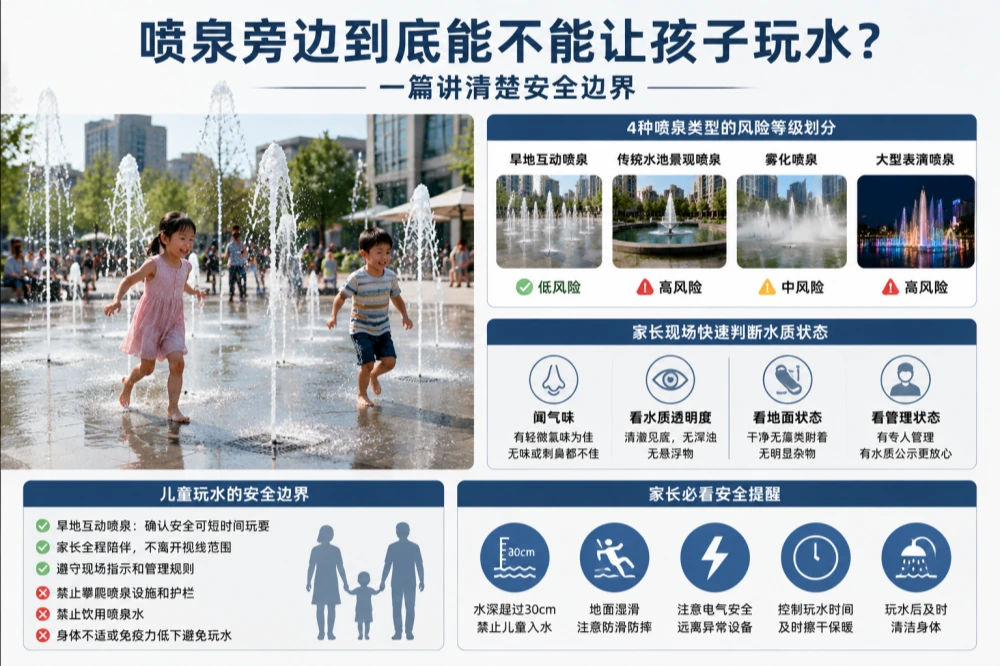
Safety guidelines for children vary significantly depending on the type of fountain. Before allowing children to approach any fountain, parents should first determine which type it is:
| Types of Fountains | Key Features | Risk of Exposure for Children | Recommendations for Parents |
|---|---|---|---|
| Interactive Fountain on Dry Land | No visible water reservoir; the nozzles are flush with the floor, and the area is walk-in. | Low (at the time of design specification) | Once the water quality has been confirmed, swimming is permitted, but supervision is required. |
| Traditional Pond Landscape Fountains | There is a distinct reservoir with a water level of 30–150 cm; it is primarily for ornamental purposes. | High (Risk of Drowning) | Children are prohibited from entering the water; adults must supervise children at all times when they are near the water. |
| Mist Fountain | Produces an ultra-fine water mist (3–5 micrometers) with no visible water stream | Medium (Respiratory Risk) | It's okay to pass through briefly, but avoid staying in the fog for a long time. |
| Large-Scale Musical Fountain Show | It has a water basin, a high main spray height, and a strong impact from the falling water. | High (Risk of Impact and Drowning) | View from outside the safety fence; do not climb over the fence. |

Why Are Dry Fountains Relatively Safe, but Caution Is Still Needed?
Dry fountains (interactive dry fountains) are designed primarily for public interaction, especially by children. With the ground level flush with the nozzles and no water basin, there is theoretically no risk of drowning. However, the premise that ”dry fountains are relatively safe” depends on three conditions: design and construction in compliance with standards, proper water quality management, and regular equipment maintenance. If any one of these three conditions is lacking, the safety parameters will change significantly.
Standard design requirements for dry fountains include: gaps in nozzle covers must not exceed 10 millimeters (to prevent children’s fingers from getting stuck); covers must pass load-bearing tests (they must withstand an adult stepping on them without deforming); the ground must be treated to prevent slipping (wet, slippery surfaces are the leading cause of falls among children); and water quality must be disinfected and filtered in accordance with swimming pool standards.
Key Safety Risk No. 1 for Children at Fountains: How to Assess the Risk of Drowning
For landscape fountains with water basins, drowning is the most serious safety risk. Children drown much more quickly than adults anticipate—children aged 1–3 can drown in water as shallow as 5 centimeters because their heads make up a large proportion of their body size, and once their faces are submerged, they are unable to lift their heads on their own.
Four drowning risk indicators that parents should assess on-site:
- Pool depth:Children under 3 years of age are not permitted in pools deeper than 30 centimeters; children under 6 years of age are not permitted in pools deeper than 60 centimeters, regardless of whether they can swim.
- Pool Wall Slope and Slip Resistance:The pool walls are steep and smooth, so once a child slips into the water, they cannot climb out on their own. Pools with a gently sloping entry area are relatively safer, but children still require constant supervision.
- Safety Enclosures:Properly designed landscape pools should be equipped with guardrails at least 1.2 meters high or a sufficiently wide safety barrier to prevent children from accidentally falling in. For open pools without any protective barriers, children must be supervised at all times and kept within arm’s reach.
- Water Flow and Pump Suction:In the area near the suction inlet of a submersible pump, the suction force of the water flow can create a dangerous pull on children’s hair and limbs. International pool safety standards require the installation of protective grates over pump inlets, but many landscape fountains do not comply with this requirement.
Core Risk No. 2 for Children’s Safety at Fountains: On-Site Assessment of Water Quality Risks
Children's skin is more sensitive than that of adults, and their immune systems are not yet fully developed; therefore, the same water quality conditions have a far greater impact on children's health than on adults.
On-Site Methods for Assessing Water Quality in Dry-Land Fountains
Before allowing children to play in a dry fountain, parents can use the following methods to quickly assess on-site whether the water quality is generally safe:
- Smell:Properly disinfected water in dry fountains will have a slight chlorine odor (similar to the smell of a swimming pool), which is a sign that the disinfectant is working as intended. If the water has no chlorine odor at all, it may not have been disinfected, and the bacterial concentration may exceed safe levels; if the chlorine odor is extremely pungent, it indicates that too much disinfectant has been added, which can irritate the skin and eyes.
- Check the water's clarity:The water in properly maintained dry fountains should be crystal clear, with no visible suspended particles, and free of cloudiness or discoloration. If the water is cloudy or has a yellowish or greenish tint, it indicates that water quality has clearly exceeded acceptable standards and is unsuitable for children to come into contact with.
- Check the ground conditions:The surface of a dry fountain should be clean, free of visible algae growth (green slime), and free of accumulated debris and foreign objects. The presence of green slime on the surface indicates a clear lack of water quality management, and the surface will be very slippery, posing a high risk of falls.
- Check the management status:Dry fountains that are professionally maintained and display water quality test results generally have better-assured water quality than those that are unmanaged. Check to see if there are maintenance staff on site and safety signs posted.
Reference Water Quality Standards for Dry-Land Fountains
For properly managed interactive fountains on dry land, water quality requirements shall comply with the "Hygiene Standards for Swimming Facilities" (GB 9667):
| Test Parameters | Standard Requirements | Health Effects of Excessive Levels |
|---|---|---|
| pH | 7.2–7.8 | If the concentration is too low, it may irritate the skin and eyes; if it is too high, the disinfecting effect decreases. |
| Free Chlorine | 1.0–3.0 mg/L | Below 1.0 mg/L, bacterial growth is uncontrolled; above 3.0 mg/L, it causes skin irritation. |
| Total Colony Count | ≤200 CFU/mL | Excessive levels pose a risk of infection from pathogenic bacteria, and children are particularly susceptible. |
| Turbidity | <0.5 NTU | Exceeding the limit indicates elevated concentrations of particulate matter and microorganisms. |
| Coliform bacteria | Must not be detected in 100 mL | Test results indicate fecal contamination; there is a high risk of gastrointestinal infection. |
It is important to emphasize that even if the water quality fully meets the required standards, the water from dry fountains is not safe to drink, and children should not be allowed to intentionally catch the water from the fountain with their mouths. The water quality standards refer to ”safety for contact” and do not constitute drinking water standards.
Core Risk No. 3 for Children's Safety Around Fountains: Electrical Safety
This is the safety risk that is hardest for parents to detect with the naked eye, yet it carries the most serious consequences. When an electrical leak occurs in water, it can trigger a phenomenon known as ”Electric Shock Drowning” (ESD)—the leakage current travels through the water, causing muscle paralysis and making it impossible to swim on one’s own. Even if the current is not strong enough to directly cause cardiac arrest, loss of muscle control can still lead to drowning.
Design Requirements for Electrical Safety in Fountains
A properly designed fountain electrical system must meet the following safety requirements. Parents can make a preliminary assessment by checking the condition of the control box:
- Low-Voltage Power Supply:All underwater lighting fixtures and electrical equipment must operate at a low-voltage DC of 12V or 24V (Safety Extra-Low Voltage, SELV); underwater equipment powered directly by 220V is not permitted. Approved fountain control boxes must contain an isolation transformer to step down the mains voltage to a safe level before supplying power to the underwater equipment.
- Ground Fault Protection:All underwater electrical circuits must be equipped with residual current devices (RCDs) with a trip current not exceeding 30 mA (10 mA in areas accessible to children); these devices must immediately cut off the power supply in the event of a ground fault, with a response time of less than 0.1 seconds.
- Equipotential bonding:All underwater metal components (nozzles, light fixture housings, pump housings) must be connected to the same grounding system via equipotential bonding conductors to eliminate potential differences between metal components and prevent the formation of loop currents when different metal components are touched.
How Can Parents Determine If a Fountain Poses an Electrical Safety Hazard?
The following signs, which can be observed on-site, indicate that this fountain may have electrical safety issues:
- A slight tingling sensation in the water:If you feel any tingling or electric shock in the water (even if it’s very mild), immediately take your child out of the water and notify the staff. Do not assume that ”a mild tingling sensation is not serious.” A tingling sensation indicates an electrical leak in the water, and the intensity may change at any time.
- The control panel and equipment show visible signs of rust:Heavily corroded control boxes and equipment indicate a long-term lack of maintenance; the electrical insulation may have deteriorated, significantly increasing the risk of electrical leakage.
- Cables left exposed to water or damp ground:Unprotected cables that are directly submerged in water pose a high risk of electrical leakage.
- Damaged or missing light fixtures:A damaged underwater light fixture not only indicates a failure of the seal but can also cause live parts inside the fixture to come into direct contact with water, which is extremely dangerous.
Core Risk No. 4 for Children’s Safety Around Fountains: Respiratory Risks from Mist-Producing Fountains
The ultrafine water mist (particle size 3–5 micrometers) produced by misting fountains can penetrate directly into the deep respiratory tract (alveolar region) rather than being intercepted in the upper respiratory tract. If the mist contains pathogenic bacteria, the probability of infection through the respiratory tract is significantly higher than through skin contact.
The most noteworthy pathogen isLegionella. Legionella bacteria multiply most actively in water temperatures ranging from 25–45°C; when inhaled through water droplets in mist, they can cause Legionnaires’ disease (a severe form of pneumonia), with children, the elderly, and people with weakened immune systems at higher risk of developing severe illness. The incubation period for Legionnaires’ disease is 2–10 days; early symptoms resemble those of the common cold, making the disease easy to overlook and leading to delayed treatment.
Child Safety Recommendations for Mist Fountains:
- Brief exposure to the misting fountain area (less than 1–2 minutes) is generally considered low-risk.
- Avoid letting children stay in misting fountains for long periods of time (more than 10 minutes), especially during periods of high temperatures in the summer.
- Children with asthma, respiratory diseases, or compromised immune systems should completely avoid areas with misting fountains.
- If you experience symptoms such as coughing, headache, or fever while near a misting fountain, seek medical attention as soon as possible and inform the healthcare provider that you were exposed to the misting fountain.
Checklist for Parents After Their Children Play in the Fountain
After your child has played at a dry fountain, follow these steps to minimize the risk of subsequent infection:
- Wash your hands immediately:Wash your hands thoroughly with running water and hand soap, especially before eating, to prevent the transmission of intestinal bacteria through the hand-to-mouth route.
- Rinse your eyes (if water gets in):If fountain water gets into your eyes, rinse them with plenty of clean running water for at least 15 seconds. Pseudomonas aeruginosa keratitis is a common eye infection caused by contact with fountain water. Symptoms include redness, a stinging sensation, and increased discharge. If these symptoms appear, seek medical attention immediately; do not treat the condition yourself with eye drops and then wait to see if it improves, as the condition may worsen rapidly.
- Change out of wet clothes:If you wear clothes that have been wet by fountain water for an extended period, bacteria may multiply rapidly on the skin’s surface in the warm, humid environment, especially in the diaper area. Change into clean clothes promptly and rinse the skin with clean water.
- Observe for 24–48 hours:Watch for symptoms such as a skin rash, abdominal pain, diarrhea, eye discomfort, or fever. If any of these symptoms appear, seek medical attention promptly and inform the doctor that the child has been in contact with water from a public fountain.
- Advance Notice of Special Circumstances:If a child has broken skin (wounds, eczema), has recently had an infection, or has a weakened immune system, they should avoid contact with fountain water before playing, rather than treating the area afterward.
Frequently Asked Questions (FAQ)
Are there any mandatory water quality testing requirements for dry fountains?
Although there is a legal basis, enforcement varies widely. Relevant regulations from the Ministry of Housing and Urban-Rural Development require that interactive dry fountains (water features with which children can come into direct contact) manage water quality in accordance with hygiene standards for swimming facilities. However, dry fountains are typically not included in the routine supervision and inspection scope of health authorities, so actual water quality management relies primarily on the self-regulation of operators. Since parents cannot verify water quality test records on-site, it is recommended to use the on-site observation methods mentioned above (odor, clarity, and ground conditions) to make a preliminary assessment and choose dry fountains that show signs of being maintained by dedicated staff.
My child played in the fountain. Should I give them a bath when they get home?
It is recommended to rinse the entire body with clean water; there is no need to use special disinfectant bath products. Pathogens that may be present in ordinary fountain water can be largely removed by rinsing with running water; overuse of disinfectant products may actually disrupt the protective layer of normal skin flora on children’s skin. The key areas to clean are the hands (wash thoroughly with soap), the eyes (rinse with running water if water gets in), and the genital area. If a child has played in a fountain with obvious water quality issues (such as cloudiness or an unusual odor), washing the entire body once with children’s body wash is a reasonable preventive measure.
When taking kids to Fountain Square, what’s the best age for them to play in the water?
From a safety perspective, the most appropriate age range for children to use dry-land interactive fountains is 3–12 years old. Children under 3 years old react slowly to the impact of water jets, have limited ability to get up on their own after falling, and are prone to putting their hands in their mouths, posing a choking hazard. They require close adult supervision at all times and should not be allowed to play independently in dry-land fountains; Children aged 3–6 must be supervised by an adult who is within arm’s reach; children aged 6 and older have a basic sense of self-protection and can play with relative freedom as long as they remain within their parents’ line of sight. Children of any age should not play in the fountain area alone without adult supervision.
What should I do if my child drinks water from a fountain?
Treatment for accidental ingestion of a small amount (a few sips or less): Rinse the mouth with clean water, have the child drink plenty of clean boiled water, and monitor the child for 12–24 hours. If abdominal pain, diarrhea, nausea, vomiting, or fever occurs, seek medical attention promptly and inform the doctor that the child drank water from a public fountain. In cases of accidental ingestion of a large amount (such as a toddler choking on water) or if any symptoms of discomfort appear, seek medical attention immediately; do not wait and observe. It is important to note that while water from dry fountains is not safe to drink, accidental ingestion of small amounts (the level of exposure that is difficult to avoid during normal play) usually does not cause acute problems. Parents should not panic unnecessarily, but they should also not neglect to monitor the child afterward.
Are indoor fountains in shopping malls safer than outdoor plaza fountains?
Not necessarily; safety depends on the quality of water management rather than location. Indoor dry fountains pose a potential additional risk: because indoor ventilation is generally poor, if water quality issues arise (such as bacterial levels exceeding standards or excessive disinfectant), the concentration of harmful substances in the indoor space may be higher than in an open outdoor environment; at the same time, the mist produced by indoor fountains is more likely to accumulate in enclosed spaces. Outdoor dry fountains, on the other hand, are exposed to ultraviolet radiation (which has a certain natural sterilizing effect) and are diluted by wind, so pollutant concentrations are typically lower than indoors. Overall, the safety of both types depends primarily on the quality of water management and cannot be simply determined by whether they are indoors or outdoors.
Huiqi Fountains has been deeply rooted in the fountain industry for 19 years. All our dry-land fountains and interactive water feature projects comply with child safety standards from the design phase: nozzle cover gaps ≤ 10 millimeters, slip-resistant flooring, 12V or 24V low-voltage power supply, ground fault circuit interrupters (GFCIs), and a complete circulation, filtration, and disinfection system. A water quality management manual is provided upon project delivery to assist operators in establishing standardized daily water quality testing procedures. Our products are exported to over 50 countries. Please feel free to contact our engineering team at 18818738142.
 Chinese
  English