
A courtyard water feature is the type of water feature you live closest to—you eat, drink tea, and sleep right next to it. Proximity magnifies everything: attractive details are highlighted, but so are noise and water stains. Therefore, the two most crucial aspects of a courtyard project are getting the scale right and ensuring long-term peace of mind, rather than the variety of water features.
Founded in 2007 · Nanhai, Foshan · Projects spanning more than 50 countries
Three Distinctive Features of the Courtyard Project
Viewing from an extremely close distance
Up close, the details of the craftsmanship become apparent. Whether the edge of the weir is smooth, whether the welds have been finished, and whether the material stands the test of time—these are things that go unnoticed in a public square but are immediately apparent in a private courtyard.
Maintained by the owner
Without a professional property management company, maintenance is typically handled by the homeowners or domestic staff. The simpler and easier the system is to maintain, the better the long-term experience will be.
Integrated with the Building
A courtyard water feature is an extension of the home and should be considered in conjunction with the architectural style, paving, and landscaping; when designed in isolation, it often clashes with the overall design.
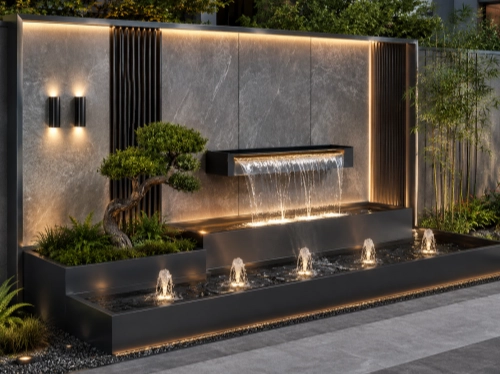
Recommended Water-Based Combinations
| Water-based | Why It's Ideal for Gardens | Suggested Location |
|---|---|---|
| Landscape Fountains | Sculptural fountains, spouting fountains, and mirror-like pools—available in a variety of sizes—are the most reliable choice for gardens. They operate quietly and are easy to maintain. | Center of the courtyard, entrance |
| Waterfall Feature | A feature wall or cascading water feature serves as the visual focal point of the garden, and the sound of flowing water can also mask outside noise. The height difference should be adjusted to suit close-up viewing. | Next to the accent wall and the lounge area |
| Rippling Fountain | A small array placed by the pool or next to a water feature creates a lovely atmosphere at night. Since the courtyard is small, use it sparingly to avoid letting it overshadow the main features. | By the pond, along the trail |
| Mirrored Pool | A calm water surface reflects the building and the sky, offering a relatively low cost while significantly enhancing the aesthetic quality. It requires high precision in water level control and overflow outlet design. | Terrace and Courtyard Features |
Six Design Principles
Striking the Right Balance
The size of the water feature should be proportionate to the size of the house and the yard. If it is too large, it will make the space feel oppressive; if it is too small, it will seem cramped. Typically, you first determine the primary vantage point and then work backward to determine the size of the water feature.
Noise
When listened to up close over a long period of time, the sound of water can be either pleasant or annoying. You should first decide whether you want a ”quiet background” or a ”distinct sound of flowing water,” and then determine the drop and flow rate.
Easy to maintain
Since the owner will be managing the system themselves, it needs to be simple. The filtration method, cleaning channels, and drain outlets should all be easy to operate—if something can be done in one step, don’t design it to take three.
Water Stains and Scale
Up close, water stains and mineral deposits are very noticeable. In areas with hard water, it is recommended to install a water softening system and to choose finishes that do not easily show water stains.
Waterproofing and Structure
Any leaks in water features adjacent to a building can affect the main structure. The waterproofing method and access requirements for maintenance must be clearly confirmed with the civil engineering contractor before construction begins.
Operating Costs
The efficiency of the pump system determines long-term electricity costs. Since garden water features operate year-round, the initial cost difference for a high-efficiency pump system is typically recouped within a few years.
Key Technical Specifications
| Parameter Items | Standard Configuration |
|---|---|
| Circulation Pump Unit | Low-noise, high-efficiency pump sets, selected based on water volume |
| Nozzle Material | 304 / 316L stainless steel, copper alloys |
| Underwater Lights | IP68 rating for permanent submersion; primarily low-power applications |
| Electrical Safety | Ground Fault Circuit Interrupter (GFCI) + Equipotential Bonding |
| Water Treatment | Filtration + Disinfection; add water softening measures in areas with hard water |
Frequently Asked Questions
Need a garden water feature design?
Provide us with the size of your yard, the architectural style, and the atmosphere you’re looking for, and we’ll provide a preliminary design and material recommendations.
Get a Proposal and Quote Chinese
 English