
Fountains are admired for their water patterns during the day and their lighting at night. Underwater lights are the only electrical equipment designed to operate while permanently submerged in water; they determine both the visual impact of the nighttime display and the long-term maintenance costs—if a light fails due to water ingress, draining the water is often necessary to replace it. Huiqi Fountains has been manufacturing fountain equipment since 2007, and its underwater lights are selected and installed specifically for permanent submersion.
Founded in 2007 · Nanhai, Foshan · Projects spanning more than 50 countries
The Location of Underwater Lights in a Fountain System
Underwater lights are a type ofClient-side devices, working in conjunction with the nozzles and the control system: the nozzles determine the shape of the water, the underwater lights determine the color and brightness of the water, and the control system synchronizes the two according to the program. The unique nature of underwater lights lies in their operating conditions—the combined effects of long-term submersion, day-night temperature fluctuations, water corrosion, and biofouling. Therefore, selection must be based on the criteria for permanently submerged fixtures, rather than standard outdoor lighting fixtures.
| Segment | Major Equipment | Relationship with Underwater Lights |
|---|---|---|
| Power Supply Side | Transformers, Distribution Panels, Ground Fault Circuit Interrupters | Determining the Voltage Rating and Safety Protection Methods for Lighting Fixtures |
| Control End | DMX512 Decoder, Control Unit | Capabilities for dimming, color mixing, and synchronization with shows |
| End | Underwater Lights | Convert electrical signals into underwater light output and couple them with water |
| Collaboration Endpoint | Sprinkler heads, underwater light brackets | The relative position of the light source and the water directly determines how effectively light travels through the water column. |
Common Types of Underwater Lights
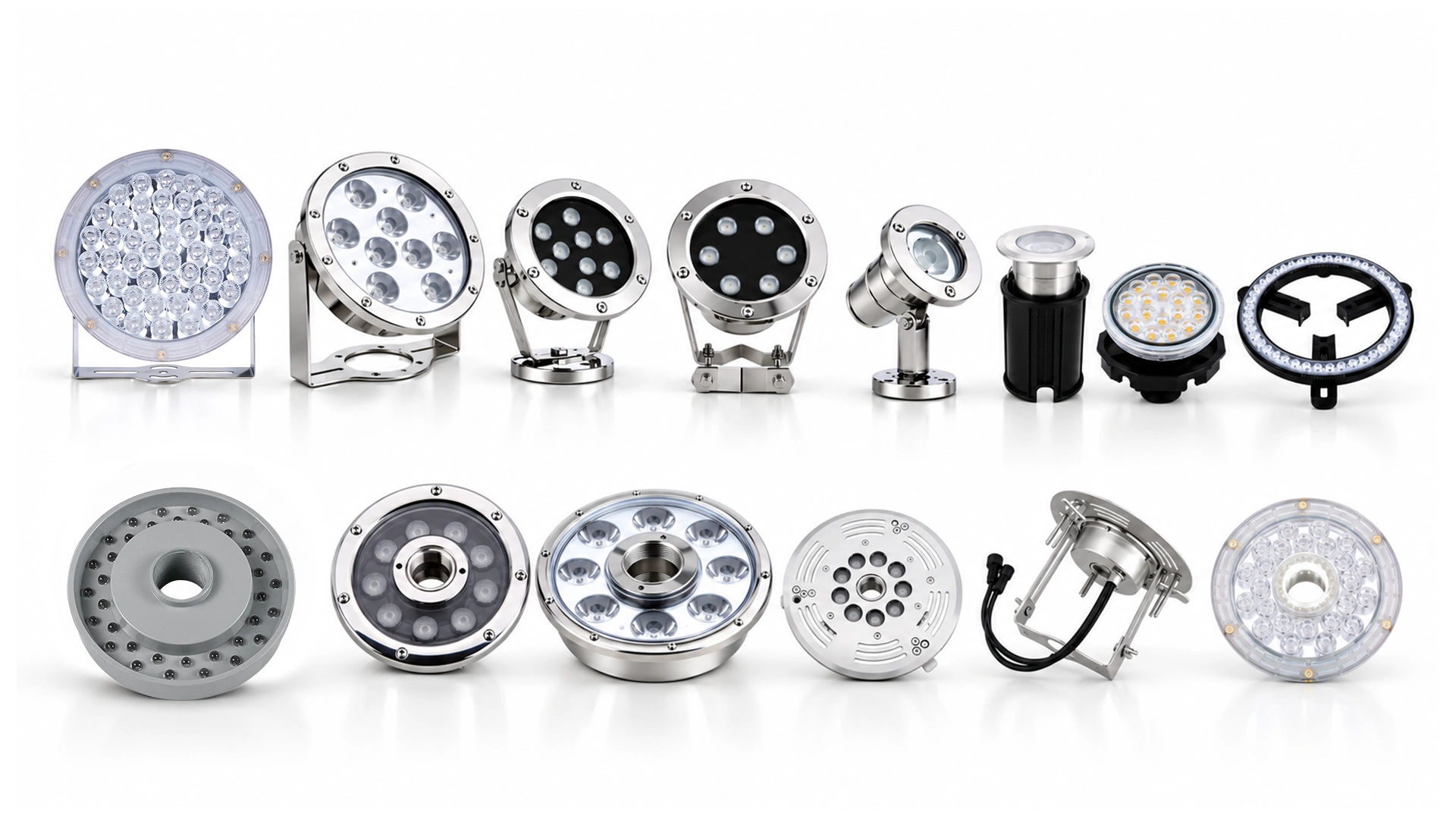
Underwater lights are classified by installation method and optical application. When selecting a model, first determine the installation conditions (recessed or surface-mounted), then define the desired lighting effect (illuminating the water column, washing the wall surface, or outlining the edges).
| Type | Features | Common Applications |
|---|---|---|
| Recessed Underwater Light | Recessed into the bottom or side walls of the pool, flush with the structural surface, for the cleanest look | Main Jets of the Musical Fountain, Mirror-Like Pool |
| Surface-Mounted Underwater Light | Secured with brackets, it offers flexible installation and is easy to maintain and replace. | Renovation Projects, Irregularly Shaped Pools |
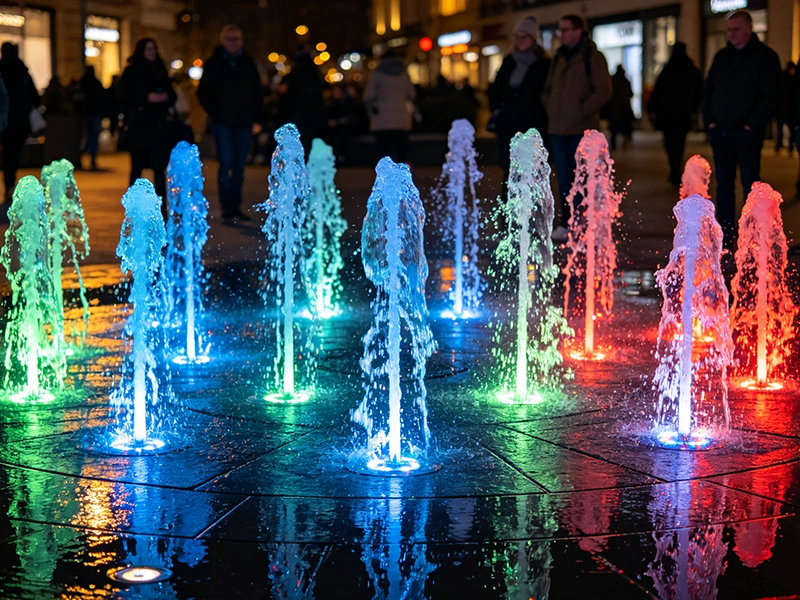
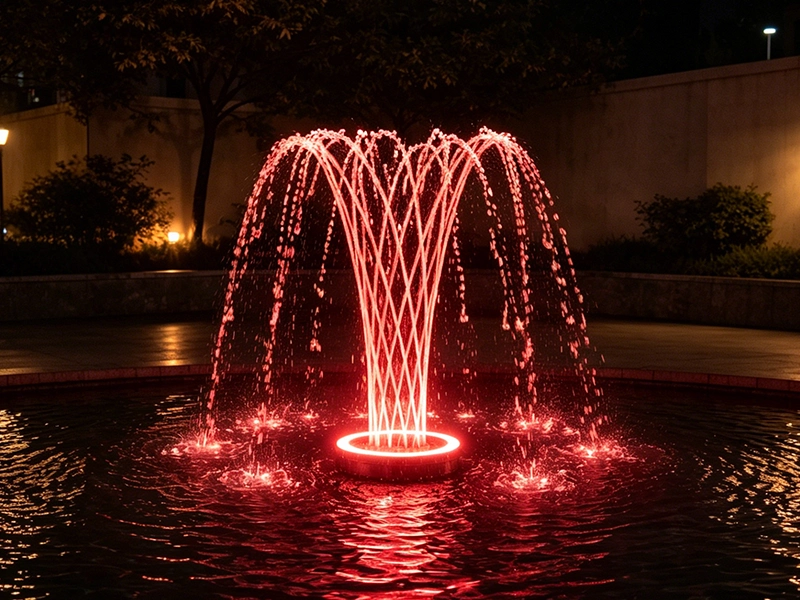
| Integrated Spray Head Light | The light fixture is integrated with the spray nozzle, and light is transmitted through the water jet. | Ripple Fountain, Light-Water Coupled Water Feature |
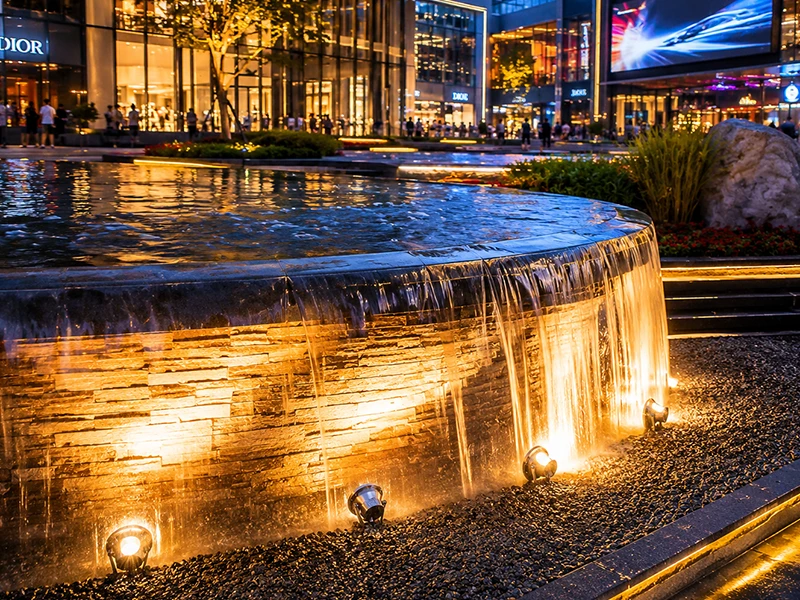
| Underwater Floodlights | Narrow-angle directional lighting that emphasizes form and depth | Water feature walls, cascading waterfalls, sculptures |
| Underwater Strip Lights | A continuous linear light pattern used to outline edges | Pool edges, steps, and dry spray areas |
| Underwater Fiber-Optic Lights | The light source is external; the underwater portion carries no electrical current. | Wet interactive areas, locations with strict safety requirements |
Key Considerations for Selecting Underwater Lights
The protection rating must be IP68.
IP68 is the minimum rating required for permanent submersion. Underwater lights are not ”splash-proof” devices; if their rating is insufficient, water will inevitably enter and cause them to fail.
Safety Voltage First
For bodies of water that people may come into contact with, 12V/24V safety voltage should be used whenever possible, along with ground-fault circuit interrupters (GFCIs), to reduce the risk of electric shock.
Power and quantity are calculated based on water surface area.
Lighting requirements vary depending on the water body’s surface area, depth, and turbidity. Insufficient lighting will make the area appear dark, while excessive lighting is wasteful and creates additional points of failure.
Color Temperature and Color Mixing Schemes
Compared to pure RGB, RGBW has an additional white light channel, producing a cleaner white and softer intermediate colors, making it suitable for high-end venues.
Heat Dissipation Determines Lifespan
Although heat dissipation conditions are better underwater than on land, heat buildup inside the sealed chamber remains the primary cause of failure. Attention should be paid to the lamp’s structural design and heat dissipation.
Maintenance Accessibility
Surface-mounted installations are easier to replace than pre-embedded ones, but pre-embedded installations look better. You should determine ”how to replace them if they break” during the design phase—don’t wait until after construction is complete to realize you’ll have to flush the system.
Key Technical Specifications
| Parameter Items | Standard Configuration |
|---|---|
| Protection Rating | IP68: Rated for continuous submersion |
| Operating Voltage | 12V / 24V safe voltage, or 220V with ground fault protection |
| Control Protocol | DMX512, supports dimming and full-color mixing |
| Light Source Lifespan | Typically around 50,000 hours [Check specific model] |
| Housing Material | 304 / 316L stainless steel or engineering plastics; select based on water quality |
| Beam Angle | 15°–120° (selectable); determine based on spray distance and desired effect [check specific model] |
For items marked [Verify], please replace them with the data from the product specifications.
Common Issues and Solutions
| Phenomenon | Possible Causes | Approach |
|---|---|---|
| Fogging and Water Penetration Inside the Lampshade | The seal has aged or was not properly seated during installation | Replace the seals, retighten to the specified torque, and check for air leaks. |
| The entire light won't turn on | Drive failure or open circuit | Check the circuit in sections and replace the driver |
| Color Inconsistencies | Batch color variation or decoding address conflict | Batch-Wide Calibration or Re-addressing Calibration |
| The lights are flickering | Voltage fluctuations, oxidized connectors, or signal interference | Check the power supply and connectors, and shield the signal cables |
| Corrosion and discoloration of the housing | The material grade does not match the water quality. | Replace with 316L or upgrade the material grade |
| A noticeable decrease in brightness | Light source aging or buildup of deposits on the lamp surface | Clean the lamp surface and replace the light source module if necessary. |
Related Water-Based Types
Supporting Equipment
Frequently Asked Questions
Further Reading
Need recommendations for underwater lighting setups?
Provide the dimensions of the water feature, your requirements for nighttime lighting effects, and the safety rating, and we can offer recommendations for lighting layout and configuration.
Get a Proposal and Quote Chinese
 English