
When selecting a fountain project, there are really only two factors to consider:Which water-based type should I use?, andWhere should it be placed?. The water feature design determines the visual impact and technical complexity, while the site determines safety standards, operational intensity, and maintenance requirements. Huiqi Fountains has separated and organized these two aspects, so you can either browse by the water feature designs that interest you or start directly with your site type—both paths will lead to the same practical, implementable solution.
Founded in 2007 · Nanhai, Foshan · Projects spanning more than 50 countries
I. Classification by Water Type: 8 Types of Fountains
The type of fountain determines its ”form of expression.” For the same plaza, the choice between a dry fountain and a musical fountain results in completely different costs, maintenance requirements, and the value they bring to the site.
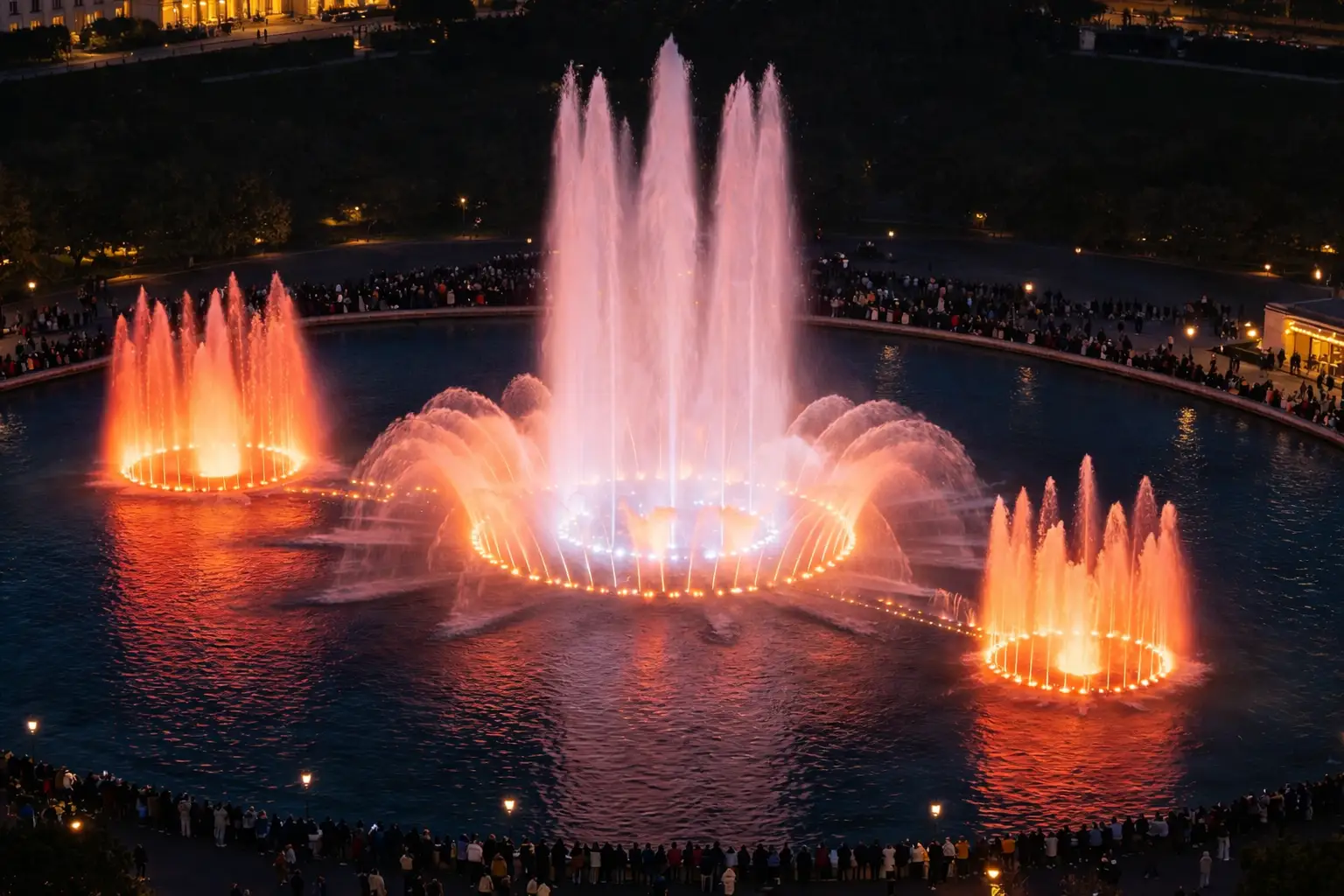
Water displays, lighting, and music are synchronized to the millisecond. Ideal for projects requiring a ”performance” element, it serves as a catalyst for events in public squares and scenic areas.
Images are projected onto a water curtain. This is well-suited for the nighttime tourism economy and brand content promotion, but it requires a very smooth surface and specific ambient lighting conditions.
There are no permanent fixtures on the water's surface; the spray nozzles and lights are concealed beneath the paving. When not in use for performances, the area can fully serve as a pedestrian walkway and event space, making it the most reliable and versatile choice for public spaces.
A row of individually controlled water outlets, each of which functions as a pixel, can be programmed to display text and patterns. Ideal for showcasing brand messages.
Slender, translucent water columns are arranged in groups, with light traveling through them to create an optical fiber effect. The effect is particularly striking at night, making them ideal for array-style installations.
Cascading waterfalls, tiered water features, and indoor water feature walls. These designs focus primarily on still water surfaces and sound design, operate year-round, and require relatively little maintenance.
Environmental decorative water features such as sculptural fountains, spouting fountains, and mirror-like pools. The harmony between their scale and the architectural style is more important than technical specifications.
Sensors detect people's locations, movements, or voices, and adjust the water display in real time. This feature strongly appeals to families and can significantly increase the length of time visitors spend at the attraction.
II. Selection by Scenario: 6 Types of Venues
The site dictates the design constraints. Even for the same type of musical fountain—whether it’s located in a municipal plaza, a hotel lobby, or a cultural and tourism attraction—the design priorities are entirely different.
High traffic volume, no user filtering, and maintenance handled by a third party. The top priorities are safety, durability, and ease of maintenance—not stunning visual effects.
Water features are business tools: they should attract foot traffic, encourage visitors to stay longer, and showcase brand content. Consider combining water curtains with interactive elements.
The goal is to create a sense of sophistication and a welcoming experience; the key requirements are quietness and reliability. Noise analysis and waterproofing reliability are the main focus of the design.
Cultural and Tourism Attractions
Water features are an integral part of the product: they should be capable of hosting performances, attracting crowds, and driving nighttime spending. The reliability of the performances and seasonal strategies are the most critical factors.
The project must simultaneously meet the goals of boosting sales, ensuring resident satisfaction, and remaining financially sustainable for property management. Child safety and operational costs are key considerations in the decision-making process.
When you're up close, both the details and the noise are magnified. The balance of scale, noise control, and water stain treatment determine the final experience.
III. How to Match Water Types with Scenarios
| Venue | Main Water-Based Type | Stackable | The Most Important Constraints to Keep in Mind |
|---|---|---|---|
| City Square | Dry Fountain | Musical Fountain、Interactive Fountain | Vandalism prevention and ease of maintenance. Many fountains that are later taken out of service aren’t because the equipment is broken, but because there’s no one who can easily repair it when it breaks. |
| Retail Complex | Digital Water Curtain | Waterfall Feature、Interactive Fountain | Waterproofing and moisture protection for indoor projects. If a water feature leaks, it affects the entire business space. |
| Hotel | Waterfall Feature | Landscape Fountains | Noise. Water features located near guest rooms and lounge areas—if noise levels do not meet standards—will directly impact the guest experience. |
| Cultural and Tourism Attractions | Musical Fountain | Water Screen Movie、Interactive Fountain | Performance Reliability and Crowd Management. Continuous performances during peak season place high demands on equipment redundancy and spare parts. |
| Residential Real Estate | Landscape Fountains | Interactive Fountain | Child safety and property maintenance costs. Whether the project can be sustainably maintained in the long term after handover is the criterion for evaluating the proposal. |
| Villa Garden | Landscape Fountains | Rippling Fountain | Scale and Noise. A water feature that is too large in the courtyard can overwhelm the architecture, and the sound of the pump becomes particularly noticeable at night. |
IV. Three Steps for Product Selection
| Steps | Questions to Answer | Note |
|---|---|---|
| 01 | What are the site conditions? | Indoor or outdoor; availability of existing water bodies; usable area; foot traffic volume; sensitivity to surrounding noise; and power, water supply, and drainage conditions. This step determines the scope of all subsequent options. |
| 02 | Do you want the performance or the backdrop? | Performance-style features (such as musical fountains and water-screen movies) attract large crowds but have high operating costs; permanent features (such as landscapes and waterfalls) are low-cost and require minimal maintenance, making them suitable as everyday backdrops; interactive features can significantly extend visitor dwell time. Most projects combine these two types. |
| 03 | Are the long-term costs affordable? | Estimate electricity and water consumption based on projected operating hours, and factor in maintenance frequency and spare parts availability. Long-term operating costs often exceed the initial price difference between equipment within a few years; selecting equipment based solely on the quoted price is the surest way to run into problems. |
V. Decision-Making Guide: From Construction Costs to Operations and Maintenance
Once the type of project and the scenario have been determined, the next step is typically to address four categories of questions: funding, processes, and standards. The following seven articles explore each of these topics in detail; you can read them in order or skip directly to the one that interests you.
How much does a fountain cost?
Three reference ranges based on scale, the breakdown of costs, cost differences across 8 types of water features and 6 scenarios, and six methods for controlling the budget.
The six phases and deliverables from site survey to construction drawings, the four types of mandatory checks, and six common design mistakes.
Construction, Installation, and Timeline
The cycle is divided into three phases—manufacturing, installation, and commissioning—comprising seven processes. Six on-site conditions must be prepared before work begins.
Acceptance Criteria and Checklist
Four acceptance checkpoints and 12 item-by-item checklists, including a list of common nonconformities and a list of delivery documents.
Maintenance and Troubleshooting
Maintenance Schedule by Day / Week / Month / Quarter / Year; Troubleshooting Approaches for 8 Common Faults; Replacement Intervals for Wear-and-Tear Parts; and Winterization Procedures.
For each phase, we list our responsibilities, the items requiring your cooperation, and the deliverables, including estimated timelines and the division of responsibilities beyond the standard scope of services.
30 frequently asked questions are organized into five categories—cost estimation, design, equipment, construction, and operations and maintenance—and answered in a structured manner, starting with an overview before delving into details.
VI. Equipment Components: What Parts Make Up a Fountain?
When taken apart, a fountain consists primarily of four types of core components plus a complete set of accessories: the nozzles determine the shape of the water, the pump provides flow and pressure, the submersible lights create the nighttime display, the control system synchronizes these three elements according to a programmed routine, and the piping, valves, and filtration components determine whether it can operate stably over the long term. The following five articles explore these topics in detail.
Water Pattern Characteristics and Suitable Applications for Eight Common Spray Nozzle Types, Material and Diameter Specifications, Six Key Points for Selection, and Common Clogging Solutions.
Features and Applications of Six Types of Underwater Lighting Fixtures: IP68 Water Resistance Rating, Safe Voltage, Six Key Considerations for Selection, and Measures to Address Water Ingress Failures.
Comparison of six pump types: submersible vs. dry-type, variable-frequency vs. fixed-speed; methods for calculating flow rate and head; and troubleshooting for issues such as cavitation and overheating.
Architectural Comparison of Programmable Control, Music Synchronization, Interactivity, and Pixel-Level Control; Troubleshooting DMX512 Parameters and Synchronization Offset Issues.
List of piping fittings, valves, filters, electrical accessories, and wear parts; key considerations for selection; and procedures for addressing leaks and blockages.
Frequently Asked Questions
Not sure which water-based type to choose?
Provide the project type, site conditions, and budget range, and we can provide a preliminary proposal and recommended water feature combinations.
Get a Proposal and Quote Chinese
 English