
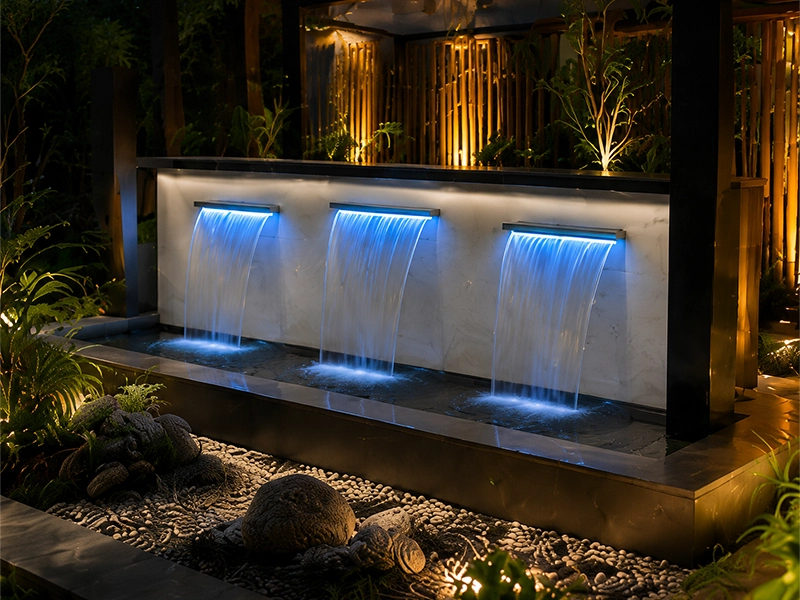
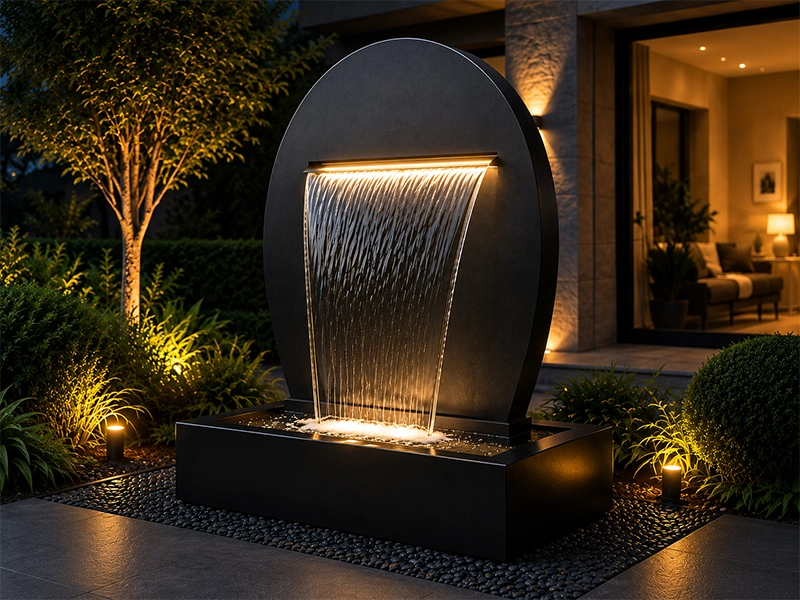
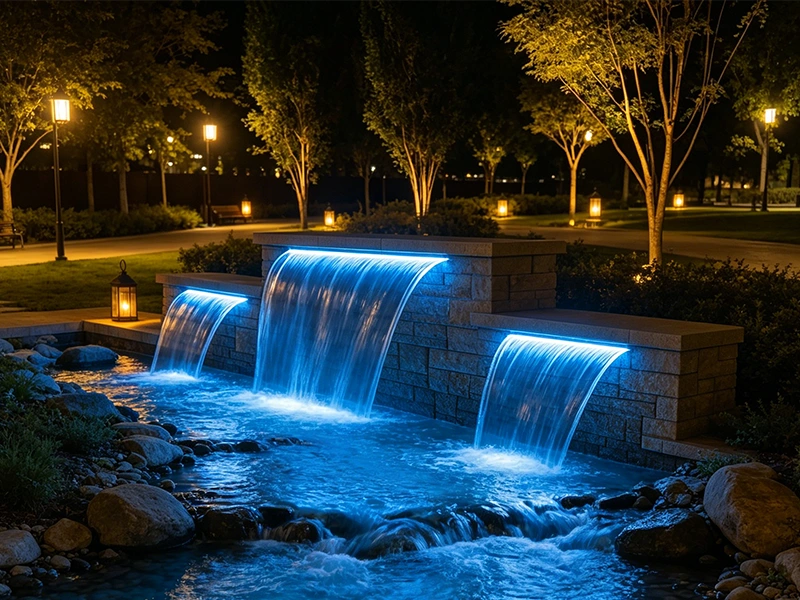
Waterfall features include cascading waterfalls, tiered waterfalls, curtain waterfalls, and indoor water feature walls. Rather than aiming for a theatrical effect, they serve as the backdrop and interface of a space—using the flow and sound of water to transform the atmosphere of the location. Though they may appear simple, factors such as the uniformity of water flow, noise control, and the reliability of waterproofing determine whether these features will be an asset or a source of trouble after long-term operation.
Founded in 2007 · Nanhai, Foshan · Projects spanning more than 50 countries
Three Common Approaches
| Comparison Items | Natural-Style Cascading Water | Geometric Waterfall Wall | Water-Curtain Type |
|---|---|---|---|
| Morphology | Modelled after natural streams, with irregular shapes | Neat, orderly plans or elevations with clean lines | Water cascades down from above like a curtain |
| Suitable Styles | Landscapes, Parks, and Gardens | Modern Buildings, Hotels, and Sales Offices | Interior Feature Walls and Partitions |
| Water Quality Requirements | Allow for some randomness | The weir opening must be perfectly level, and the water flow must be uniform. | The water flow must be continuous, with no interruptions. |
| Noise | Low to medium | Can be controlled via head and weir opening | Lower |
| Main Challenges | The Integration of Landscape and Water | Weir Mouth Smoothness and Waterproofing | Uniform Water Discharge and Splash Control |
The Five Most Common Problem Areas
Weir Mouth Flatness
The success or failure of a geometric waterfall wall hinges on the weir. If the weir is even slightly uneven, gaps or uneven water flow will appear, which is particularly noticeable during daytime backlighting. This is a critical measure of manufacturing and installation precision.
Waterproofing and Structure
If a leak occurs in an indoor water feature wall, the repair costs are extremely high. The waterproofing layer, structural joints, and access panels must be determined in coordination with the architectural team during the civil engineering phase; they cannot be added later.
Noise Control
The sound of water falling is amplified indoors. The sound pressure level is determined by the combination of the drop height, flow rate, and the material at the point where the water falls; this must be calculated during the design phase rather than addressing it with sound-absorbing measures after construction is complete.
Circulation Flow Rate
If the flow rate is too low, the water curtain will break; if it is too high, noise and water splashing will become uncontrollable. The pump unit should be selected based on calculations of the weir width and the desired water film thickness, with a margin for adjustment.
Splash Range
A splash zone will form around the water discharge point, which must be taken into account, especially for indoor projects. The flooring material, drainage slope, and clearance distances for walkways must all be determined based on the actual splash range.
Water Quality and Scale Formation
Scale and algae tend to build up on the surface of water curtains, which directly affects their appearance. In areas with hard water, water softening or algae control measures should be implemented, and cleaning access routes should be planned.
Key Technical Specifications
| Parameter Items | Standard Configuration |
|---|---|
| Circulation Pump Unit | Select the model based on the width of the weir and flow rate; frequency-convertible and adjustable |
| Weir Material | 304 / 316L stainless steel, precision-machined |
| Finish Materials | Stone, stainless steel, glass, etc., selected according to the design specifications |
| Lighting Setup | Underwater lights or wall-washing lights, IP68 rating for permanent submersion |
| Water Treatment | Filtration + Disinfection; add water softening measures in areas with hard water |
Applicable Scenarios
Hotels and Sales Offices
The lobby feature wall and reception area partition serve as the first point of contact.
Entrances to the Park and Factory Premises
Entrance plaza or reception area, designed to complement the signage and corporate identity.
Gardens and Parks
A natural-style cascading waterfall, integrated with landscaping and the terrain.
Frequently Asked Questions
Need a waterfall feature design and quote?
Please provide the installation surface dimensions, elevation differences, and noise requirements, and we will provide a preliminary proposal and material recommendations.
Get a Proposal and Quote Chinese
 English