
The annual electricity costs for plaza fountains are a cost item that many city administrators and scenic area operators severely underestimate when planning water feature projects. To put it in concrete terms: for a musical fountain in a medium-sized city square, with a total installed pump power ranging from 100 to 300 kW, assuming 4 hours of operation per day, 300 days per year, and a commercial electricity rate of 0.8 yuan per kilowatt-hour,Annual electricity bills range from 96,000 to 288,000 yuan. The annual electricity bill for a large lake fountain or a landmark plaza fountain can easily exceed 1 million yuan. This figure does not include electricity used for lighting, control systems, or water treatment—it covers only the electricity costs of the pump system itself. This article provides a detailed breakdown of the components of an annual electricity bill for a plaza fountain and offers practical energy-saving solutions.
How Annual Electricity Costs for a Plaza Fountain Are Calculated: From Installed Capacity to the Actual Bill
When calculating the annual electricity costs for a plaza fountain, the key variable is the total installed power of the pump system. The power consumption of other electrical equipment (LED lighting, control systems, and filter pumps) is relatively fixed, and together they typically account for 15–20% of the total electricity costs, while the main pump system accounts for 80–85%.
Basic Calculation Formulas:
Annual Electricity Cost = Total Installed Capacity (kW) × Daily Operating Hours (h) × Number of Operating Days per Year × Electricity Rate (yuan/kWh)
However, this formula yields the theoretical maximum value for ”full-power operation.” In practice, the pumps in a musical fountain adjust their power in real time as the water patterns change during a performance; the average load factor typically ranges from 50–75% of the rated power. Therefore, actual electricity costs are usually 50–75% of the theoretical maximum.
Annual Electricity Costs for Plaza Fountains: Actual Calculations for Three Size Categories
| Fountain Size | Typical Scenarios | Installed Power of the Main Pump | Daily operating hours | Number of operating days per year | Estimated Annual Electricity Bill | Actual Annual Electricity Cost (Including Speed Control) |
|---|---|---|---|---|---|---|
| Small Plaza Fountain | Community Plaza, Shopping Street | 30–60 kW | 4 hours | 300 days | 29,000–58,000 yuan | 15,000–40,000 yuan |
| Medium-Sized Plaza Fountain | City Square, Scenic Area Entrance | 100–300 kW | 4 hours | 300 days | 96,000–288,000 yuan | 50,000–200,000 yuan |
| Large-Scale Show Fountain | Lake Fountains, Landmark Plaza | 500–2,000 kW | 3–6 hours | 250–300 days | 300,000–1.92 million yuan | 180,000–1.3 million yuan |
Electricity rates are calculated at 0.8 yuan per kilowatt-hour (for commercial use; actual rates may vary by region). The figures above represent electricity costs for the main pump system only and do not include electricity used by lighting, control systems, or filtration systems.
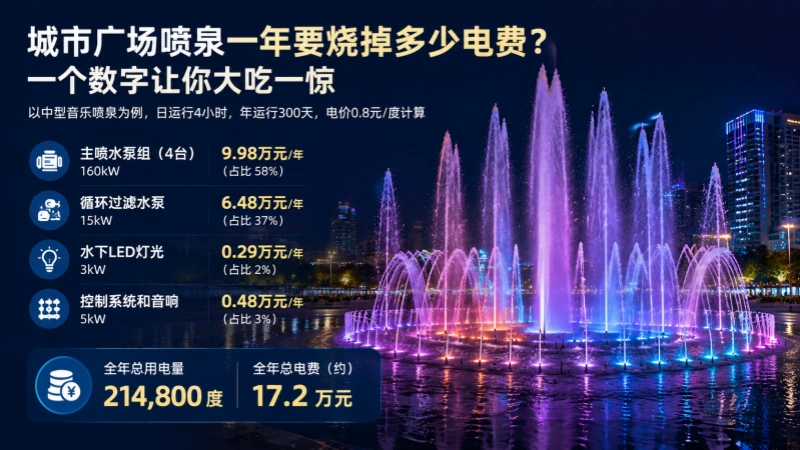
Detailed Calculation Example: A Typical Medium-Sized Municipal Plaza Fountain
Taking a musical fountain at a certain municipal plaza as an example, here is a complete breakdown of its annual electricity costs:
| Electrical Equipment | Installed Capacity | Daily operating hours | Number of operating days per year | Annual Electricity Consumption | Annual electricity bill (0.8 yuan/kWh) |
|---|---|---|---|---|---|
| Main Spray Pump Sets (4 units) | 160 kW | 4 hours | 300 days | 192,000 degrees | 153,600 yuan |
| Circulating Filter Pump | 15 kW | 18 hours | 300 days | 81,000 degrees | 64,800 yuan |
| Underwater LED Lights (60 RGBW Lights) | 3 kW | 4 hours | 300 days | 3,600 degrees | 2,880 yuan |
| Control Systems and Audio | 5 kW | 4 hours | 300 days | 6,000 degrees | 4,800 yuan |
The main pump unit is calculated based on an average load factor of 651 TP3T (VFD variable-frequency operation), with actual annual electricity consumption of approximately 124,800 kWh and annual electricity costs of approximately 99,840 yuan. Including the remaining equipment,The total annual electricity cost for this fountain is approximately 172,000 yuan.。
In particular, the recirculating filter pumps operate around the clock (18 hours per day), resulting in annual electricity costs of 65,000 yuan, accounting for 37% of total electricity costs—these are hidden, high-energy-consumption devices that many operators overlook. Optimizing the operating strategy for these filter pumps offers equally significant potential for electricity savings.
Three Fundamental Reasons for High Annual Electricity Bills for Plaza Fountains
Reason 1: Energy Waste Due to Throttling in Constant-Speed Pumps
Fixed-speed pumps without variable frequency drives (VFDs) always operate at full power and their rated speed, regardless of the actual head required. When the discharge height needs to be reduced, the system throttles the flow by partially closing the valve—the pump continues to consume its full power, but a large volume of water and pressure is blocked by the valve and wasted as heat and noise.
According to the similarity law for centrifugal pumps, power is proportional to the cube of the rotational speed. If the pump’s rotational speed is reduced to 70% of its rated speed, the power required is only 34.3% of the original value. This means that, for the same operating duration, a fountain equipped with VFD control consumes less power than a fountain operating at a constant speed.The energy savings range from 40 to 60%. For medium- to large-sized plaza fountains with annual electricity bills exceeding 100,000 yuan, this reduction in electricity consumption translates to annual savings of 40,000–60,000 yuan or more.
Reason 2: Lack of Detailed Management of Operating Hours
The operating schedules for many plaza fountains are set too broadly: they are either left on all day or operate at fixed times, without dynamic adjustments based on visitor traffic or visibility. When fountains operate between midnight and 8 a.m., there are virtually no spectators, so their aesthetic value is virtually zero, yet electricity costs continue to accumulate.
Reasonable operating schedule management strategy: During peak season (high passenger volume periods), operate 4–6 shifts daily, totaling 3–4 hours; during off-peak season, reduce to 2–3 shifts, totaling 2 hours; after 10:00 p.m., maintain only low-power decorative mode or shut down completely. Careful management of operating periods can reduce ineffective operating time by 20–30% without compromising the primary scenic value.
Reason 3: Inefficient Operation of the Filtration System
Circulating filtration pumps typically need to operate 24 hours a day, but the actual treatment demands of the filtration system are not uniform throughout the day: during the day, when visitor traffic is high and the pollution load is heavy, higher filtration efficiency is required; at night, when the facility is unoccupied, water pollution virtually ceases, and operating the filtration system at full capacity at that time is a waste of resources.
Solution: Equip the filtration pumps with variable-frequency drives as well. At night, reduce the filtration pumps’ speed to 60–70% of the rated value (to maintain basic water circulation), and during daytime peak visitor hours, increase it to 100%. The payback period for the variable-frequency drive retrofit of the filtration pumps is typically 18–30 months.
Annual Electricity Cost Savings Plan for Plaza Fountains: 4 Actionable Measures
| Energy-Saving Measures | Applicable Scenarios | Expected Electricity Savings | Renovation Cost Guidelines | Payback Period |
|---|---|---|---|---|
| VFD Retrofit for the Main Pump | All Constant-Speed Pump Fountains | 40–60% | 50,000–300,000 yuan | 1–3 years |
| Refined Management of Operating Hours | All Fountains | 20–30% | Near-zero cost (program adjustment) | Instant Results |
| Variable-Frequency Drive Retrofit for a Filter Pump | Fountains with Independent Filtration Systems | Filter Pump Energy Savings: 30–50% | 10,000–50,000 yuan | 18–30 months |
| Replacing Halogen Lights with LEDs | An old fountain that still uses halogen underwater lights | 70–851 TP3T in electricity savings for lighting | 30,000–150,000 yuan | 2–4 years |
Priority Recommendations
For existing public square fountains that are already in operation, the recommended priority order for energy-saving retrofits is as follows:
- First: Optimize operating hours (zero cost, immediate results)—Adjusting the operating schedule in the PLC control program and eliminating unnecessary operating periods is the most cost-effective energy-saving measure.
- Second: VFD retrofit for the main pump (high cost, high return)—For fountains with annual electricity costs exceeding 50,000 yuan, the return on investment for VFD retrofits is extremely significant, with the retrofit costs typically recouped within 1–3 years.
- Third: Variable-frequency retrofit of the filter pump (moderate cost, stable return)—Suitable for projects with high-power filtration pumps (7.5 kW or higher); the retrofit cost is lower than that of a VFD for the main pump, and the payback period is moderate.
- Finally: LED Lighting Upgrade (Applicable only to older fountains that still use halogen bulbs)—Newly constructed fountains now use LED lighting exclusively; while retrofitting older fountains offers significant value, the absolute amount saved is relatively limited.
Annual Electricity Costs and Aesthetic Value of Plaza Fountains: How to Calculate the Return on Investment
To assess whether the annual electricity costs for a plaza fountain are ”worth it,” one must evaluate them from two perspectives: landscape value and indirect economic benefits:
Regarding plaza fountains in commercial complexes, research data shows that shopping centers featuring iconic water features have 8–15% higher weekend foot traffic than shopping malls of comparable size without such features, and customers stay an average of 12–20 minutes longer. Based on standard retail industry calculations, the additional spending generated by these increases in foot traffic and dwell time is often 5–10 times greater than the fountain’s annual operating costs (electricity and maintenance).
For municipal plaza fountains, their landscape value is reflected in the city’s image, citizen satisfaction, and tourism appeal—factors that are difficult to quantify directly. However, tourism data from multiple cities show that iconic fountain attractions typically attract between 500,000 and 5 million visitors annually, and the spending each visitor generates in surrounding businesses (dining, lodging, and retail) far exceeds the fountain’s operating costs.
Therefore, the core management objective for the square’s fountain’s annual electricity costs is not to ”keep electricity costs as low as possible,” but rather to“Maximize energy savings without compromising the core scenic value or the attraction’s ability to draw visitors.”. Blindly cutting operating hours may do more harm than good.
Frequently Asked Questions (FAQ)
What is the most accurate way to calculate the annual electricity bill for a plaza fountain?
The most accurate method is to install a separate electricity meter (smart meter) on the fountain’s electrical panel to record actual electricity consumption in real time, then calculate the annual electricity bill by totaling the monthly readings. Theoretical calculations (installed power × operating time × electricity rate) will overestimate actual electricity costs because they do not account for the actual reduction in power consumption resulting from VFD speed control. If a separate electricity meter has not yet been installed, you can commission a professional organization to conduct actual power measurements over a period of 1–2 weeks and use the measured average power in place of the rated installed power for calculations; this will yield results that more closely reflect actual conditions.
The fountain is equipped with a variable-frequency drive, so why isn't the actual energy savings very noticeable?
If a variable frequency drive (VFD) has been installed but energy savings are not significant, there are typically several reasons: First, the VFD’s frequency adjustment range may have been set too narrowly, causing the actual operating frequency to remain close to the rated frequency over the long term—which is equivalent to full-speed operation; Second, the pump profile in the program is too simplistic, causing the pump to operate at full power most of the time and failing to fully utilize the energy-saving potential of variable-frequency speed control; third, the VFD is improperly matched to the pump—the VFD’s rated power exceeds the pump’s actual requirements, resulting in reduced efficiency during low-frequency operation. It is recommended that a professional optimize the VFD parameters and program settings to ensure that the speed control range and strategy align with actual operating requirements.
How much can you save on a fountain by using peak-off-peak electricity rates?
Peak-off-peak electricity pricing policies vary significantly across the country, but generally speaking, off-peak electricity rates (typically from 11:00 p.m. to 7:00 a.m. the following day) are 30–50% lower than peak-hour rates (9:00 a.m. to 9:00 p.m.). If the fountain’s filtration pumps need to operate 24 hours a day, scheduling the nighttime filtration operations to coincide with off-peak rates can reduce the electricity costs of the filtration system. Peak-shaving strategies for the main fountain pump are relatively limited, as the main fountain’s entertainment value must be showcased during peak visitor hours; it cannot be operated late at night solely to take advantage of off-peak rates. It is recommended to consult with the local power utility regarding peak-off-peak rate plans applicable to landscape facilities and to optimize operations based on actual operating schedules.
Is a solar-powered solution for a fountain feasible?
There are already mature solar-powered products available for small garden fountains and floating fountains. Using a combination of PV panels and lithium iron phosphate batteries, these systems can operate completely off-grid, making them suitable for park lakes or agricultural irrigation areas far from the power grid. However, for medium- to large-scale fountains in urban plazas, solar-powered solutions face two core challenges: First is the power gap. Peak power consumption for a medium-sized plaza fountain exceeds 100 kW, requiring a large area of PV panels and a high-capacity energy storage system, resulting in extremely high initial investment costs; Second is power supply stability. Show fountains require stable power quality, and the fluctuations in solar power generation can affect the precision of the variable-frequency control of the water pumps. Currently, the more feasible approach is a ”solar plus utility grid hybrid power supply” system, where solar power covers the electricity needs of the filtration and lighting systems, while the main spray pumps continue to use utility grid power.
Who pays the electricity bill for the plaza fountain? Is there a difference between government-owned plazas and commercial plazas?
The electricity costs for operating fountains in government squares are typically covered by the annual operating budget of municipal administrative departments (such as the Urban Management Bureau, Landscaping Bureau, or Public Affairs Bureau). In some cities, the operation of square fountains is outsourced to professional property management companies, and the electricity costs are included in the service fees specified in the outsourcing contract. Electricity costs for fountains in commercial complex plazas are typically borne by the property management company, accounted for as part of public utility costs, and covered through common area fees included in property management fees or tenant rent. Electricity costs for fountains in scenic areas are typically included in the scenic area’s operating costs and borne by the scenic area operator. Understanding who bears the electricity costs is crucial for the decision-making process regarding energy-saving retrofits—different budget sources entail different approval pathways and funding arrangements for retrofit plans.
Huiqi Fountains has been deeply involved in the fountain industry for 19 years. All new fountain projects come standard with VFD variable-frequency control systems, which, combined with precise operational scheduling, ensure that annual electricity costs for plaza fountains are kept at a reasonable level. For existing high-energy-consumption fountains, we provide VFD retrofit assessments and energy-saving solution design services, and issue a free energy-saving projection report prior to retrofitting. Our products are exported to over 50 countries. Please feel free to contact our engineering team at 18818738142.
 Chinese
  English