
Government and municipal fountain projects, with their large individual contract values and relatively secure payment terms, are a key business focus for many fountain contractors and suppliers. However, the bidding process for these projects involves high barriers to entry and strict procedures. Many well-established companies, due to incomplete qualifications or inadequate review of contract terms, either have their bids rejected outright or find themselves at a disadvantage after winning the bid.
This article provides a systematic checklist framework—covering both qualification preparation and contract terms—to help companies participating in government municipal fountain bidding processes avoid common pitfalls at critical stages.
What is the fundamental difference between government-sponsored municipal fountain tenders and commercial projects?
Procurement decisions for commercial projects are typically made directly by the owner or developer, allowing for a high degree of flexibility; procurement for government and municipal projects, however, must follow an open bidding process and is subject to the dual constraints of the Government Procurement Law and the Bidding and Tendering Law. There are several fundamental differences that need to be understood in advance:
- Mandatory Disclosure: Tender notices must be published on designated platforms (the China Government Procurement Network and public resource trading centers in various provinces and cities). The bidding period is typically only 15–20 business days, and missing the deadline cannot be remedied.
- Mandatory Qualification Requirements: Failure to meet any one of the qualification requirements will result in immediate disqualification of the bid, with no room for negotiation.
- The bid evaluation criteria are transparent but complex in detail: The comprehensive scoring method (technical score + commercial score + price score) is typically used, and the depth and format of the technical proposal directly affect the score.
- Unequal Contract Terms: The payment terms, warranty requirements, and liability for breach of contract in government contracts are typically more favorable to the contracting authority, leaving the contractor with very little room to negotiate; therefore, the contractor must carefully consider before bidding whether it can afford the terms.
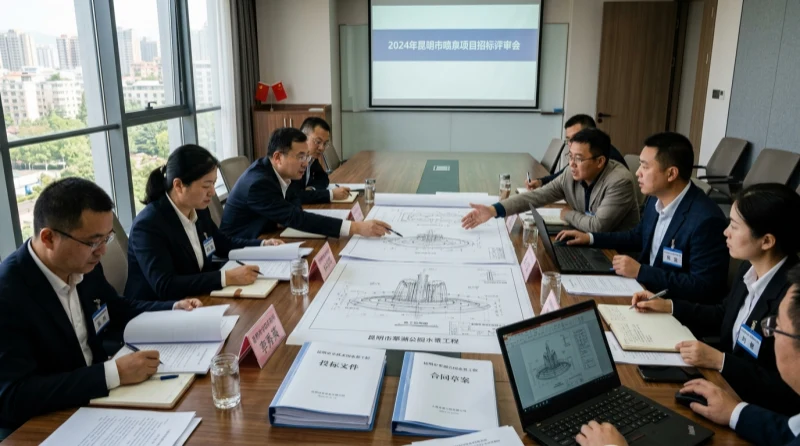
Five Types of Qualifications That Must Be Verified Before Bidding
I. Basic Corporate Qualifications
This is the most basic requirement; failure to meet even one of them will result in the bid being rejected outright:
- Business License: The scope of business must include either “manufacture of fountain equipment” or “landscape construction”; the “sales” category alone is not sufficient to meet the requirements for construction projects.
- Tax Registration Certificate/Unified Social Credit Code: The “Three Certificates in One” reform has already been implemented, but you must verify that the status of your business license is "Active/Normal"; any records of irregularities in the annual inspection will affect the qualification review.
- Bank Credit Certificate: Some projects require a credit rating certificate issued by a bank or a certificate from the account-holding bank; you must apply to your account-holding bank in advance, as it typically takes 3–5 business days to issue these documents.
II. Construction Qualification Certificates
Municipal fountain projects are typically classified as landscape engineering or municipal public works projects, and the corresponding qualification requirements are as follows:
- Qualifications for Urban Landscaping Companies: Issued by the housing and urban-rural development authorities, these certifications are classified into Level 1, Level 2, and Level 3. Large-scale municipal fountain projects typically require a Level 2 certification or higher.
- General Contracting Qualification for Municipal Public Works Construction: For projects involving the renovation of fountains in large plazas and public spaces, some tendering entities may require a municipal construction qualification of Level 3 or higher.
- Qualifications for Mechanical and Electrical Equipment Installation Projects: Fountain systems involve the installation of pumps, control cabinets, and electrical systems; some bid documents may specify this as a separate requirement.
Note: Qualification certificates must be valid, and the qualification level must correspond to the scale of the project. Prior to bidding, companies must self-check the status of their qualifications on the “National Construction Market Supervision Public Service Platform” (“Four Databases and One Platform”); the bid evaluation committee will verify this information online.
III. Work Safety Permit
For any municipal project involving construction work, a Work Safety Permit is mandatory. The permit is valid for 3 years; bids will be automatically rejected if the permit has not been renewed by the expiration date.
IV. Personnel Qualifications
Government projects have specific requirements regarding the qualifications of project managers and key personnel:
- Project Manager: Applicants are generally required to hold a Class I or Class II Construction Engineer license (in the field of municipal public works or mechanical and electrical engineering), and must have a continuous payment record in the social insurance system of the bidding company; individuals registered under another company’s name will not pass the verification process.
- Safety Officer: Must hold a Certificate of Qualification for Work Safety in Construction Enterprises (Class B).
- Operators of Specialized Equipment: Workers in specialized occupations, such as electricians and welders, must hold the corresponding specialized operations certificate; for some projects, these certificates must be listed in the bid documents and scanned copies must be provided.
V. Proof of Performance and Creditworthiness
This is the most important factor for earning bonus points in the technical scoring phase, and it also serves as the qualification threshold for some events:
- Similar Project Experience: Bidders must submit contracts, completion acceptance reports, or bid award notices for similar municipal fountain or landscape water feature projects completed within the past three years (five years for some projects). The minimum contract value and number of projects required vary by project, but all documents must be authentic and verifiable; the bid evaluation committee may verify them by telephone.
- Corporate Credit History: Records on the “Credit China” website or provincial credit platforms will be reviewed; companies with records of being defaulting debtors or administrative penalties typically fail to pass the qualification review.
These five types of clauses in the bidding documents must be reviewed word for word
After reviewing the tender notice and confirming that they meet the eligibility requirements, many companies begin preparing their bid documents; however, they often quickly skim over the contract terms section of the tender documents—which is the riskiest move during the bidding phase.
Article 1: Terms of Payment
The payment terms for government municipal projects are the clauses that offer the least room for contract negotiation but have the greatest impact on cash flow. A typical structure is as follows:
- Progress Payments: Payments are made according to construction milestones, typically amounting to 60–70% of the contract amount; payments are subject to confirmation following inspection and acceptance by the supervising engineer.
- Final Payment: Payment is made after final acceptance, typically 20–25% of the contract amount.
- Performance Bond: It is typically 5–10% of the contract amount and is refunded upon expiration of the warranty period, which is usually 2–3 years.
Risk areas requiring special attention:
- Does the performance bond earn interest? Government projects typically do not accrue interest, so the cost of tied-up funds must be factored into the bid in advance.
- How many days is the payment cycle for progress payments? From the time the supervising engineer approves the payment to when the funds are actually received, the actual cycle for some projects can be as long as 60–90 days.
- Is there an “audit settlement” clause? Some government projects require that final settlement be made only after the audit agency has completed the project audit, and the audit process may take more than one year.
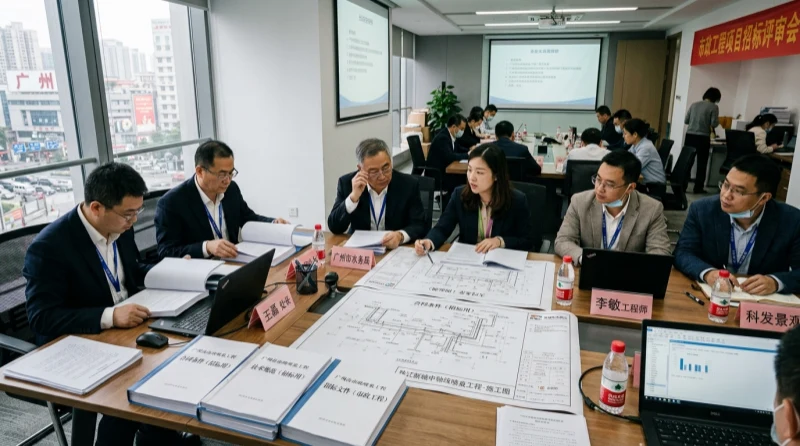
Article 2: Construction Schedule and Breach of Contract Provisions
- Is the contract duration reasonable? This must be evaluated in light of the scope of work and construction conditions; once signed, Party B shall bear full responsibility for any risks associated with a tight construction schedule.
- What is the maximum daily penalty? It is typically a certain percentage of the contract amount, but some contracts do not set an upper limit, resulting in excessive risk exposure.
- Is the scope of what constitutes force majeure reasonable? It needs to be clarified whether extreme weather, policy-mandated work stoppages, and other such events fall within the scope of the exemption.
Article 3: Provisions Regarding Materials and Equipment Brands
The brand requirements for major equipment and materials specified in the bidding documents directly determine your cost structure:
- Is there a “or equivalent product” clause? The absence of this clause means that the specified brand must be used, and it cannot be replaced with a product of equivalent performance.
- Is the specified brand within a reasonable price range? The brand requirements in some bidding documents have effectively locked market prices within a specific range; procurement costs must be verified before submitting a bid.
- Are the material standards clearly defined? For example, whether the material of the spray nozzles is explicitly required to be 316L stainless steel, or whether the lighting fixtures are explicitly required to have IP68 certification—vague material specifications can easily lead to disputes during the final acceptance inspection.
Article 4: Amendments and Visa Provisions
Engineering changes and site variances are key mechanisms for controlling construction costs, but the change control procedures for government projects are typically much more complex than those for commercial projects:
- What levels of approval must a change order go through before it takes effect? The longer the process, the more difficult it is to carry out on-site visa processing.
- Do changes that go beyond the scope specified in the contract require a new bidding process? Changes in the scope of work exceeding a certain amount may trigger a supplementary bidding process.
- Is the pricing method for the settlement change clearly defined? Is this calculated based on the comprehensive unit price, or will it be negotiated separately?
Article 5: Warranty Terms and After-Sales Responsibilities
- Can the response time requirements during the warranty period actually be met? Some government contracts require 24-hour on-site availability; for projects in other provinces, it is necessary to assess whether local service capabilities are available.
- How is human-caused damage defined during the warranty period? Equipment wear and tear is typically higher for public fountains than for commercial projects, so the scope of responsibility must be clearly defined in the contract.
- Is there an agreement regarding extended warranty service after the standard warranty period expires? Some projects include extended warranty terms in their contracts; it is necessary to confirm in advance who will bear the costs.
Three Common Mistakes That Cost Points When Preparing Bid Documents
Even when a company has all the required qualifications and the contract terms are generally in order, many still lose points during the bid evaluation process. The following three issues are the most common:
- Lack of depth in the technical solution: The bid evaluation committee will conduct a specialized evaluation of technical proposals; simply providing a product specifications sheet and renderings is not sufficient to earn a high score. Proposals that receive high scores typically include: hydraulic calculation reports, the basis for equipment selection, construction process descriptions, safety measures, and energy-saving measures. The number of pages in a technical proposal is not the key factor; rather, it is the level of technical depth.
- Incomplete financial reports: Submitting scanned copies of contracts without a completion acceptance report, or submitting a completion acceptance report with an amount that does not match the requirements, will result in the project not being recognized as part of your track record. It is essential to prepare a complete set of project records in advance; for each project, you must provide the “contract, completion acceptance report, and client contact information” as a basic requirement.
- The bid documents do not conform to the required format: Bidding documents typically contain specific requirements regarding the binding order, locations for signatures and seals, and page numbering. Formatting errors can result in point deductions or even disqualification of the bid. Before submission, assign a dedicated person to check each page against the formatting requirements in the bidding documents to avoid making basic mistakes at the last minute.
Frequently Asked Questions (FAQ)
Can a fountain equipment supplier without a landscaping construction license participate in bids for municipal projects?
For tenders involving the supply of equipment only, bidders may participate as equipment suppliers; however, projects involving installation and construction typically require bidders to possess the appropriate construction qualifications. In practice, equipment suppliers without construction qualifications may form a joint venture with a qualified construction contractor to submit a bid; however, the joint venture agreement must be clearly specified in the bid documents, and the qualifications of all parties to the joint venture must meet the requirements set forth in the tender documents.
Does the retention deposit for government projects have to be paid in cash?
Not necessarily. Many government projects allow bank letters of guarantee to be used in lieu of cash performance bonds. The handling fee for a bank letter of guarantee is typically 1–3% of the guarantee amount per year. Compared to the cost of tying up cash, using a bank letter of guarantee is usually more cost-effective for large-scale contracts. Before submitting a bid, you can check the bidding documents to confirm whether bank letters of guarantee are accepted.
How Should Bid Quotes Address Audit and Settlement Risks?
For projects with audit settlement clauses, the final settlement amount may be lower than the contract amount (due to audit reductions). To mitigate this risk, it is advisable to allow for sufficient room for audit reductions during cost accounting, while also maintaining detailed records of every change order and site certification during construction to ensure that changes in the scope of work are supported by complete written evidence.
How can you assess the payment risks associated with a government fountain project?
You can make a preliminary assessment by following these steps: Search for the name of the tendering entity on “Credit China” or “Judicial Documents Network” to check for any history of delinquent payments on construction projects; determine whether the project is funded by the general budget or special-purpose bonds—payments from the general budget are typically more stable than those from special-purpose bond projects; and consult industry peers who have worked with this client to assess its payment credibility.
With 19 years of experience in the fountain industry, we possess comprehensive capabilities for delivering government and municipal projects: from conceptual design and equipment manufacturing to on-site installation and final acceptance, we provide a full set of project documentation, including equipment inventory lists, material test reports, as-built drawings, and backup copies of all procedures. Our services span more than 50 countries worldwide.
If you are currently participating in a municipal fountain bidding process or would like to learn more about equipment configuration options and the basis for our quotes, please feel free to contact our project team.
Phone: 18818738142
 Chinese
  English