
The root cause of high electricity costs for fountains is the continuous full-load operation of fixed-speed pumps under inefficient conditions—the pumps run at full power, but the actual water flow is wasted due to throttling by valves. Variable-frequency pumps (equipped with VFDs) adjust their speed in real time to match actual demand, reducing operating electricity consumption by 40–60% while extending equipment lifespan and enabling dynamic control of water patterns in musical fountains.
Many fountain owners and property management companies encounter the same problem after six months of operation: the fountain’s monthly electricity bill is significantly higher than expected. For a medium-sized musical fountain with a main pump having a total installed power of 30–80 kW, electricity costs can easily reach 200,000–500,000 yuan if it operates year-round.
The number itself isn't the problem; the issue is that a significant portion of it consists of inefficient energy consumption that could be systematically reduced. Understanding the true logic behind a fountain's energy consumption is the first step in controlling operating costs.
Where does most of the electricity used to power fountains go?
A complete fountain system derives its power consumption from three sources:
- Pump System:Accounting for 75–85% of total energy consumption, they are by far the primary energy-consuming equipment. The power ratings of the main pumps range from several kilowatts to several hundred kilowatts, and the total installed power of the water pumps for large musical fountains is typically over 100 kW.
- LED Lighting System:accounts for 10–15% of total energy consumption. Compared to traditional halogen lamps, modern IP68 underwater LED fixtures have reduced lighting energy consumption by 70–85%; this aspect is not typically a priority for optimization.
- Control Systems (DMX controllers, PLCs, etc.):It accounts for no more than 5% of total energy consumption, with extremely low power consumption.
Therefore, the key to saving energy in fountains lies in the pumps. The root cause of high energy consumption in pump systems is not that the pumps themselves are too powerful, but rather thatInefficiencies in the Operating Model。
Why do constant-speed water pumps result in significant energy waste?
The operating principle of a traditional constant-speed water pump is as follows: The motor runs continuously at a fixed speed (typically 100% of the rated speed), delivering a constant flow rate and pressure. When you need to reduce the spray height or switch to a water pattern that requires a lower flow rate, the system uses a throttle valve (restrictor valve) to reduce the water output.
That's where the problem lies.The pump is still running at full power, but a large volume of water and pressure are being forced back by the valve.—This energy is simply dissipated as heat and vibration, without being converted into any useful water-based effects.
Here’s an easy-to-understand analogy: It’s like driving a car while keeping the accelerator fully depressed and using the brakes to control your speed. The engine is running at full power the whole time, but a lot of energy is lost as heat due to friction.
In fluid mechanics, this problem is described more precisely—the shaft power of a pump is proportional to the cube of its rotational speed (Similarity Laws for Centrifugal Pumps):
Flow rate Q is directly proportional to rotational speed n: Q₂/Q₁ = n₂/n₁
Head H is proportional to the square of the rotational speed: H₂/H₁ = (n₂/n₁)²
Power P is proportional to the cube of the rotational speed: P₂/P₁ = (n₂/n₁)³
This means that if throttle valve control can be replaced by reducing the speed, the resulting energy savings would be substantial. This is precisely the core value of variable-frequency water pumps.
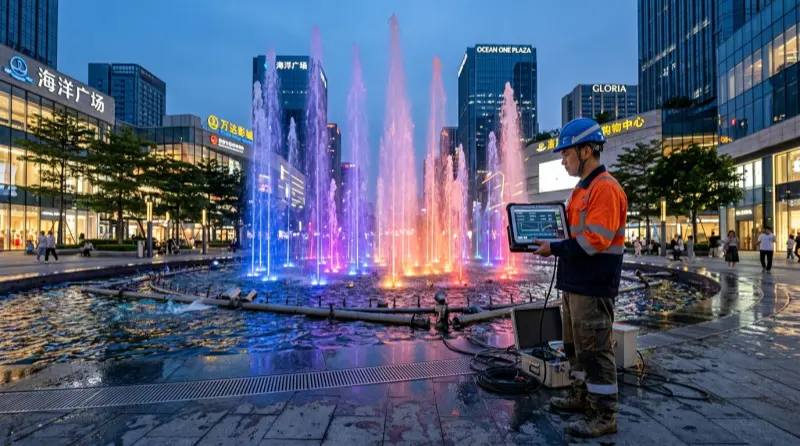
How does a variable-frequency drive (VFD) water pump work?
A VFD (Variable Frequency Drive) works by changing the motor’s rotational speed through adjustments to the frequency of the power supply. As the frequency decreases, the rotational speed decreases, and the pump’s flow rate and head decrease accordingly—this is entirely different from the pressure restriction forced by a throttle valve, as it reduces energy consumption at the source.
In a musical fountain system, the VFD works in conjunction with the DMX512 control system to adjust the speed of each pump in real time according to the requirements of the program, thereby achieving:
- Dynamic Changes in Water Column Height:Adjusts up or down in real time to the beat of the music, creating a visual effect that follows the music's rhythms
- Precise Switching for High-Water-Content Applications:The flow rates required for different water patterns vary greatly; a VFD can precisely deliver the operating point required for each water pattern.
- Soft Start and Soft Stop:Prevents current surges caused by direct start-up of the pump (direct start-up current is typically 5–8 times the rated current) and protects the motor windings and piping system
How Much Money Can a Variable-Frequency Water Pump Actually Save? Actual Calculations
Let’s use a musical fountain in a medium-sized plaza as an example for our calculations:
Total installed power of the main pump:60 kW
Daily operating hours:4 hours
Number of operating days per year:300 days
Electricity Rates:0.8 yuan per kilowatt-hour
─────────────────
Constant-Speed Water Pump Solution (Full-Power Operation):
Annual electricity consumption = 60 × 4 × 300 = 72,000 degrees
Annual electricity bill = 72,000 × 0.8 = 57,600 yuan
─────────────────
Variable-Frequency Drive (VFD) Water Pump Solution (average speed: approx. 75%, power: approx. 42%):
Annual electricity consumption ≈ 60 × 0.42 × 4 × 300 ≈ 30,240 degrees
Annual electricity bill ≈ 30,240 × 0.8 = 24,192 yuan
These are just the direct savings on electricity bills. Variable-frequency pumps also offer two indirect benefits: they extend the pump’s service life (by reducing the impact of frequent starts and stops, the lifespan of commercial submersible pumps is extended from 8 years to over 12 years) and reduce water hammer in the piping system, thereby lowering the risk of leaks at pipe joints.
Variable-frequency retrofit vs. installing it from the start in a new building—which is more cost-effective?
| Dimensions of Comparison | New projects are equipped with VFDs from the start | Retrofits of Existing Projects |
|---|---|---|
| Initial Cost | Higher (VFD equipment costs are included in the construction budget) | Retrofit costs are billed separately; the compatibility of the existing electrical system must be evaluated. |
| System Integration | Natively integrates with the DMX control system, providing high precision in water-based control | The control interface needs to be reconfigured, which involves a significant amount of work. |
| Energy-Saving Results | Effective immediately, with benefits throughout the entire lifecycle | After the retrofit, it will also achieve energy savings of 40–601 TP3T. |
| General Recommendations | It is strongly recommended that new projects be equipped with VFDs from the outset; retrofitting them later also offers significant economic benefits. | |
What other details should be considered when selecting a variable-frequency pump solution?
Harmonic Issues with VFDs
During operation, VFDs inject harmonic currents into the power grid, which can interfere with nearby precision equipment. Professional fountain VFD systems should be equipped with harmonic filters; in particular, when the fountain is powered by a commercial complex or a building containing precision instruments, harmonic mitigation must be incorporated into the design.
Matching Inverters and Motors
The rated power of the variable frequency drive should match the power of the pump motor, with a margin of 10–15%. Compatibility between the variable frequency drive brand and the motor brand must also be verified by the engineering team during the procurement phase, as control interfaces and protection parameters may differ between brands.
Control System Interlock Configuration
The VFD of a musical fountain must be fully integrated with the DMX512 control system; otherwise, the variable frequency drive will only provide energy-saving functionality and will be unable to dynamically adjust water patterns in sync with the music. The quality of this integration directly determines the smoothness and precision of the performance.
Daily Maintenance Requirements
The variable frequency drive (VFD) must be installed in a well-ventilated control cabinet, where the ambient temperature typically does not exceed 40°C. Regularly cleaning the cooling fans and air filters and checking that the control wire connections are secure are basic maintenance tasks that help extend the VFD’s service life.
Frequently Asked Questions (FAQ)
How much would it cost to retrofit a fountain pump with a variable-frequency drive?
The purchase cost of the variable frequency drive (VFD) unit itself varies significantly depending on its power rating. Typically, an 11-kW VFD costs approximately 3,000–6,000 yuan, while a 55-kW unit costs approximately 15,000–25,000 yuan (imported brands are more expensive). The retrofit also involves engineering costs such as electrical cabinet modifications, reconfiguration of control interfaces, and commissioning. Overall, the total investment for a VFD retrofit of a medium-sized fountain typically ranges from 50,000 to 200,000 yuan. Taking into account the annual savings on electricity bills, the payback period is generally between 2 and 4 years.
For a standard fountain without music synchronization, is it worth installing a variable-frequency drive?
It makes sense—and sometimes offers even greater value. Standard fountains without a programmed sequence typically operate at a fixed water pattern for extended periods, but in practice, full-power output isn’t always necessary around the clock—they can run at reduced power during the morning when visitor traffic is light, then ramp up during peak hours. A VFD can be flexibly adjusted according to operating periods to achieve time-of-use energy savings. At the same time, the soft-start function also helps extend the service life of the pumps.
What is the difference between variable-speed and fixed-speed water pumps in terms of water flow patterns?
This is a concern for many people. A well-configured variable-frequency drive system not only matches the visual appeal of a fixed-speed pump but also achieves dynamic water patterns that fixed-speed pumps cannot—the height of the water column can change in real time to the rhythm of the music, rather than simply switching on and off. The only point to note is that under extremely low-speed operating conditions (below 30% of the rated speed), the variable-frequency system may experience unstable flow rates; therefore, a reasonable minimum frequency limit must be set during the program-setting phase.
If the variable-frequency drive breaks down, will the fountain stop running completely?
This depends on the system design. Professional fountain control systems typically feature a ”line-frequency bypass” circuit—in the event of a VFD failure, the system can switch to line-frequency direct-drive mode, allowing the pump to operate at a fixed speed and ensuring that the fountain’s basic effects remain uninterrupted. Routine maintenance of the VFD and maintaining a stock of spare parts are equally important; it is recommended to verify the manufacturer’s local service capabilities and spare parts lead times at the time of purchase.
Is there room for energy-saving improvements in the fountain's lighting system?
Yes, but the potential is relatively limited. If a project is still using traditional halogen or metal halide underwater fixtures, replacing them with IP68-certified LED fixtures can reduce lighting energy consumption by 70–85%. However, in modern, newly constructed fountains, LED fixtures are already standard equipment, and lighting energy consumption typically accounts for only 10–15% of total energy consumption, making it a lower priority than retrofitting pumps with variable-frequency drives.
With 19 years of deep expertise in the fountain industry, all our musical fountain projects come standard with VFD variable-frequency control systems that are fully integrated with the DMX512 control protocol, achieving a balance between dynamic water pattern control and energy-efficient operation. Our pumps can reach a maximum jet height of 30 meters, and our equipment is exported to more than 50 countries.
If you are planning the equipment configuration for a new fountain project or would like to evaluate the feasibility of retrofitting an existing fountain with variable-frequency drives, please feel free to contact our engineering team.
Phone: 18818738142
 Chinese
  English