
◆ Direct Answer
316L stainless steel nozzles, with the addition of 2–31 TP3T molybdenum and a low-carbon design, offer approximately 3–5 times greater resistance to chloride ion corrosion than 304 stainless steel (data may vary slightly under different testing conditions), making them suitable for long-term use in chlorinated environments such as fountains and swimming pools; Standard 304 stainless steel, brass, or engineering plastic nozzles are less expensive but have a significantly shorter service life in corrosive environments.
Introduction
Nozzles are the core components of a fountain system that are constantly submerged in water and directly exposed to changes in water quality; the choice of material directly determines the equipment’s service life and long-term maintenance costs. In fields such as industrial fluid control, environmental dust removal, and high-pressure cleaning, 316L stainless steel nozzles differ fundamentally from 304 stainless steel, brass, or engineering plastic nozzles in terms of chemical composition, corrosion resistance, mechanical properties, and applicable scenarios. For projects such as fountains and swimming pool landscapes that involve long-term exposure to chlorinated water, incorrect selection of nozzle materials is often the primary cause of frequent repairs and premature failure.
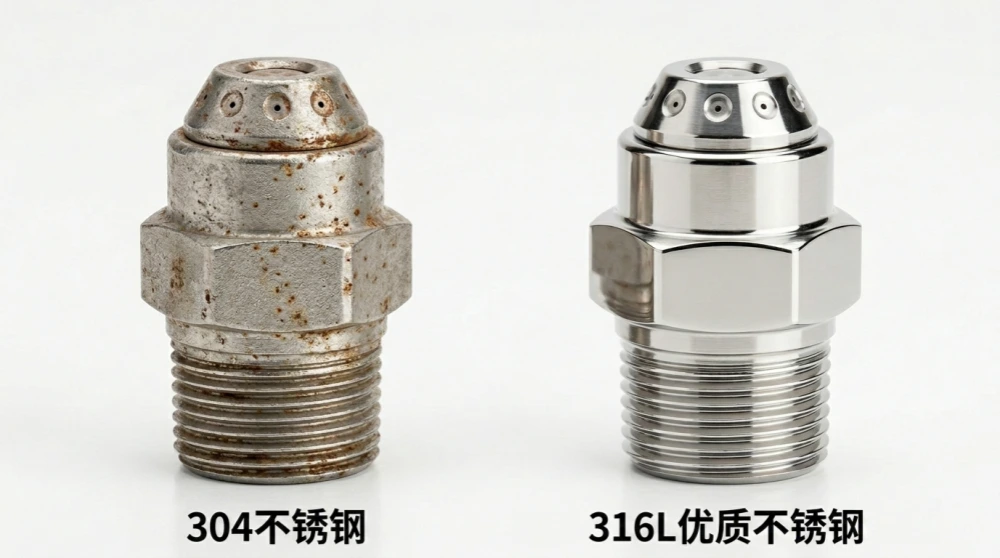
What is the key difference between 316L and standard stainless steel nozzles?
The most fundamental difference between the two lies in the addition of the element molybdenum (Mo) and the low-carbon (L) design.
- Molybdenum: 316L stainless steel contains 2–3% of molybdenum, which significantly enhances the material’s resistance to pitting and crevice corrosion, particularly in environments containing chloride ions (such as seawater, chlorine-based disinfectants, and human body fluids). and this is the most critical chemical difference that distinguishes it from 304.
- Low-Carbon Design: “L” stands for low carbon (carbon content ≤ 0.03%), which effectively reduces the precipitation of carbides during the welding process and prevents intergranular corrosion in the weld zone, allowing the weld to retain high corrosion resistance even after welding. This is particularly important for large-scale fountain projects that require on-site welding and installation.
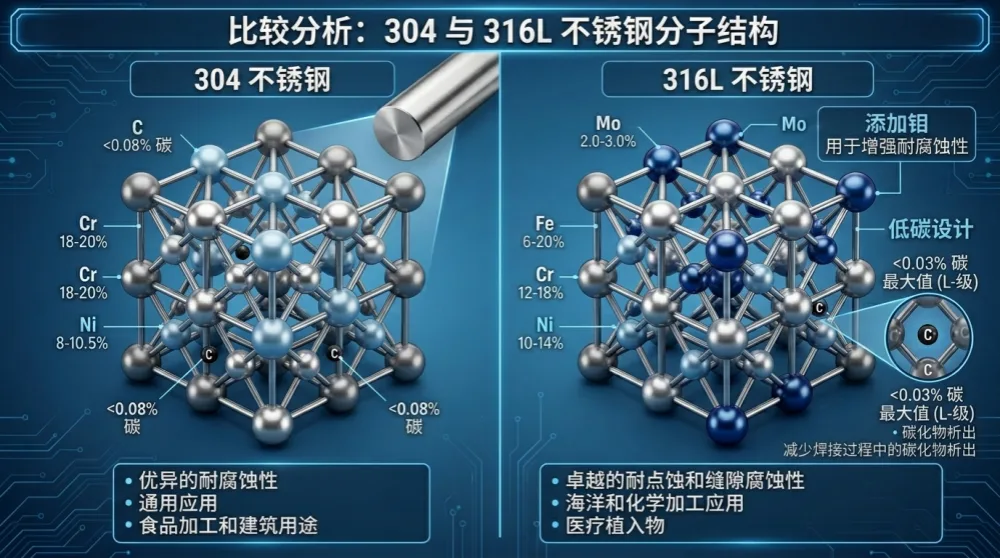
What exactly makes 316L spray nozzles so corrosion-resistant?
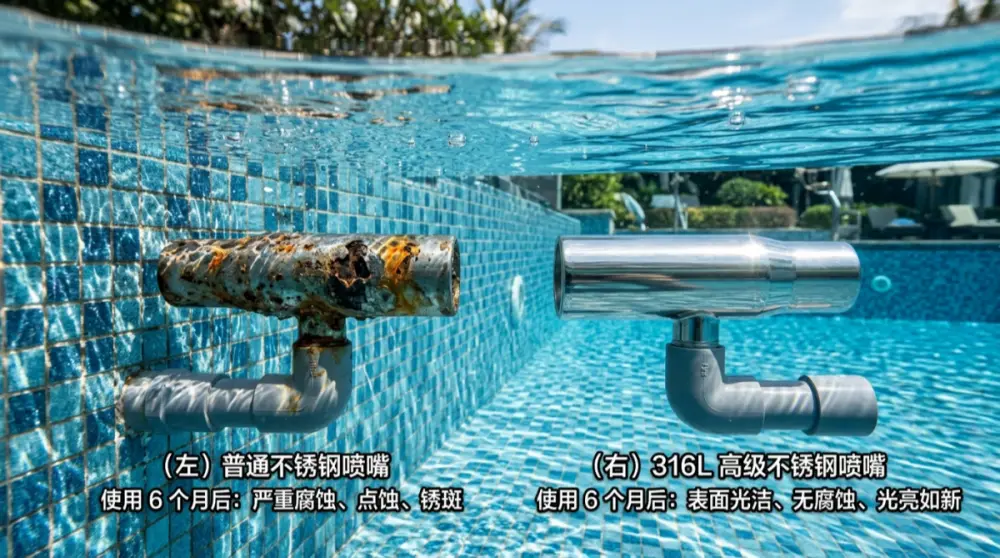
Differences in corrosion resistance are clearly evident in actual operating conditions; they are not merely theoretical advantages.
- Resistance to chloride ion corrosion: 316L stainless steel is approximately 3 to 5 times more resistant to chloride ion corrosion than 304 stainless steel (data may vary slightly depending on testing conditions), standard 304 stainless steel is prone to pitting corrosion in environments where chloride ion concentrations exceed 200–500 ppm, and water environments treated with chlorine—such as fountains and swimming pools—often exceed this threshold for extended periods.
- Limitations of Other Materials: Brass nozzles are inexpensive and easy to machine, but they are highly susceptible to corrosion by acidic media; engineering plastics (such as PP), while resistant to acids and alkalis, are prone to deformation and aging under high-temperature and high-pressure conditions, and are less stable than metal materials when used outdoors over the long term.
- Performance in Highly Corrosive Environments: In desulfurization and denitrification scrubbers or strong acid-base neutralization systems, 316L nozzles can effectively withstand chemical corrosion, preventing the pitting or cracking that occurs in ordinary metal nozzles within a short period of time. The differences in material performance are most evident when comparing them under these extreme conditions.
What are the mechanical properties and service life of 316L spray nozzles?
- Mechanical Properties: 316L stainless steel offers excellent tensile strength and high-temperature resistance. It can typically operate at temperatures of around 400°C and maintains structural stability even under harsh operating conditions, making it resistant to deformation.
- Hygiene and Safety: 316L offers excellent biocompatibility, does not leach harmful substances, and reduces the risk of scaling on internal walls; as a result, it is widely used in high-end food processing, medical equipment, and other fields with extremely stringent cleanliness requirements; Ordinary brass or 304 stainless steel, when in contact with these media, may affect water quality due to the leaching of trace metal ions or the rupture of the passivation film.
- Additional Notes on Wear Resistance: In solid-liquid mixtures containing particulates (such as high-pressure water jets and sandblasting), tungsten carbide or ceramic nozzles offer superior wear resistance. However, 316L stainless steel still provides better overall impact resistance and corrosion resistance than standard stainless steel and brass, making it suitable for most fountain applications.
In which situations must 316L nozzles be used? In which situations are standard-grade nozzles sufficient?
When selecting a product, one should follow the principle that “the environment determines the material,” rather than blindly pursuing the highest specifications across the board.
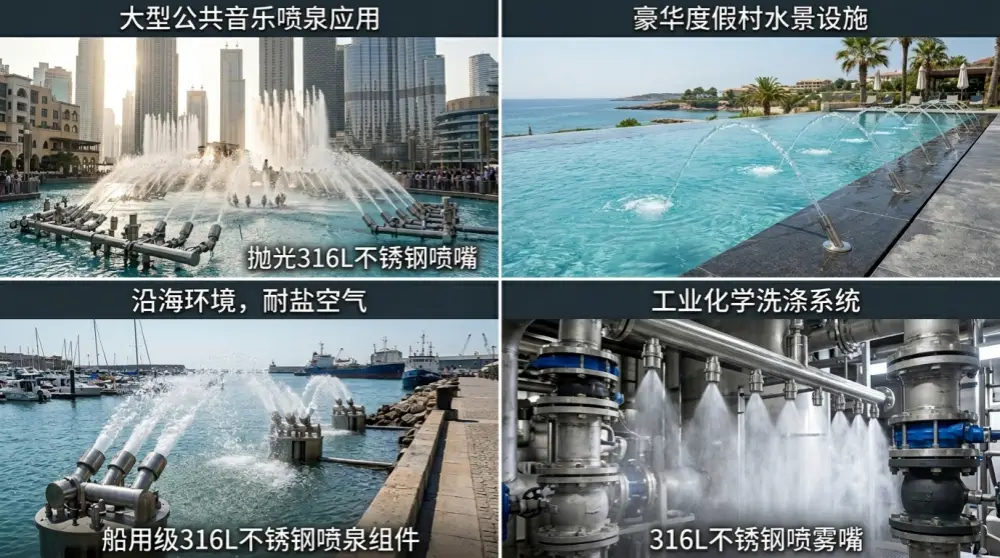
- Situations where 316L must be used: when the medium contains chloride ions, strong acids, or strong alkalis; or when welding is required and the environment is corrosive—these are precisely the actual operating conditions found in the vast majority of public fountains, swimming pool landscapes, and coastal projects. Water that is continuously disinfected with chlorine over the long term will constantly test the corrosion resistance limits of the nozzles.
- Situations where standard materials can be used: If the application is limited to dry indoor environments, mildly corrosive media, or low-pressure agricultural irrigation, you can opt for lower-cost 304 stainless steel, brass, or engineering plastic nozzles; there is no need to pay a premium for applications with low corrosion risks.
Just how much more expensive are 316L nozzles? Are they worth it?
The price difference between materials is not the sole basis for selection decisions; total life-cycle cost is a more reasonable evaluation criterion.
- Initial Costs: The price of raw materials for 316L stainless steel is approximately 20–30% higher than that of 304, and because it contains molybdenum, it exhibits slightly greater work hardening, resulting in slightly higher processing costs.
- Long-Term Costs: In corrosive environments, choosing standard materials to save on initial material costs often results in frequent nozzle clogging, wear, or corrosion-induced perforation. The subsequent costs of downtime for replacement and repair will far exceed the difference in material prices. This is why the industry considers 316L the “standard” rather than an “upgrade option” for chlorine-containing environments.
Frequently Asked Questions (FAQ)
Q1: Do fountain nozzles have to be made of 316L stainless steel?
While not strictly necessary, 316L is the industry standard for public fountains and swimming pool landscape projects that are exposed to chlorinated water over the long term. In less corrosive environments, such as dry indoor settings or low-pressure irrigation systems, standard 304 stainless steel or engineering plastic nozzles can also meet the requirements.
Q2: Can 304 stainless steel nozzles be used in fountains?
It can be used for short periods, but 304 stainless steel is prone to pitting corrosion in environments where chloride ion concentrations exceed 200–500 ppm. Since the circulating water in fountains is continuously disinfected with chlorine, 304 nozzles typically develop corrosion-induced perforations or clogs sooner than 316L nozzles, resulting in higher maintenance costs over the long term.
Q3: What is the difference between 316L and 316 stainless steel?
The chemical compositions of the two are essentially the same; the key difference lies in their carbon content: the “L” in 316L stands for low carbon (carbon content ≤ 0.031 TP3T), which effectively reduces carbide precipitation after welding and prevents intergranular corrosion in the weld zone, making it more suitable for fountain equipment that requires on-site welding and installation.
Q4: Which is better suited for fountains—brass nozzles or 316L nozzles?
Brass nozzles are inexpensive and easy to machine, but they are highly susceptible to corrosion by acidic media. When exposed to chlorinated water or outdoor environments over the long term, their durability is significantly inferior to that of 316L stainless steel; therefore, 316L is recommended for public fountains and long-term outdoor projects.
Q5: How many years will a 316L spray nozzle last, approximately?
The specific service life depends on water quality conditions and maintenance frequency; however, thanks to its excellent corrosion resistance, 316L has a significantly longer service life in environments with chlorinated water than common materials such as 304 stainless steel and brass, which can significantly reduce the frequency of medium- and long-term replacements and repairs for fountain equipment.
Huiqi Fountain
The company’s musical fountains, laminar flow fountains, and various water feature equipment all utilize 316L stainless steel nozzles, which are specifically designed for water environments subject to long-term chlorine disinfection, ensuring the equipment’s durability and operational stability.
If you are evaluating material options for nozzles in a fountain or water feature project, please feel free to contact our engineering team for product selection recommendations and a quote.
Phone: 18818738142
 Chinese
 English