
Interactive fountains use sensors to detect people’s locations, movements, or voices, adjusting the water patterns and lighting in real time—transforming the experience from simply ”watching the water” to ”playing with the water.” They are particularly well-suited for families with children and younger visitors, and can turn an ordinary space into a destination where people want to linger. However, because the equipment for these interactive attractions is exposed in public settings, the requirements for reliability and safety are higher than those for conventional fountains.
Founded in 2007 · Nanhai, Foshan · Projects spanning more than 50 countries
Differences from Ordinary Dry Fountains
| Comparison Items | Interactive Fountain | Standard Dry-Land Fountain |
|---|---|---|
| Control Logic | Respond in real time to external inputs | Run according to the preset program |
| Sensing Devices | Various types of sensors and recognition units are required. | Not necessary |
| Respond to the Request | Low latency; otherwise, the user experience will be disrupted | No real-time requirements |
| Intensity of Use | High—the device keeps triggering | Run by Session |
| Maintenance Priorities | Sensor Calibration and Water Resistance | Spray Heads and Piping |
Five Key Design Principles
Selecting a Sensing Method
Common types include infrared beams, ground-mounted sensors, pressure sensors, sound detection, and image recognition. When selecting a system, consider on-site sources of interference, the target audience, and maintenance capabilities—more advanced isn’t necessarily better.
Response Delay
The delay between the user’s interaction and the water flowing out directly determines the user experience. If the delay is too long—so that the user has already walked away by the time the water starts flowing—the sense of interaction is immediately lost. This is a core metric for debugging interactive projects.
Security Perimeter
The water discharge height, water temperature, and pedestrian flow should all be designed with potential contact scenarios in mind. In areas where children are present, additional consideration must be given to slip resistance and floor levelness.
Preventing Accidental Activation
Small animals, fallen leaves, and bright light can all cause false triggers. Measures must be taken to mitigate these issues through algorithm adjustments and careful placement; otherwise, both the device’s lifespan and the user experience will be affected.
Weather Resistance of Equipment
Sensors are exposed to the elements outdoors for extended periods, and are subject to the wear and tear of sun, rain, and human contact. Installation location, protective measures, and replaceability must be considered during the design phase.
Failure-Grade Downgrade
In the event of a sensor malfunction, the system should automatically fall back to standard operation rather than causing the entire scene to go dark. This ensures that the venue does not lose functionality entirely.
Key Technical Specifications
| Parameter Items | Standard Configuration |
|---|---|
| Control Protocol | DMX512 / Art-Net, supports real-time signal input |
| Sensing Method | Infrared, ground-sensing, pressure, sound, or image recognition—select the appropriate model based on your application. |
| Actuator | Solenoid valves or CNC valves, used in conjunction with variable-frequency pump units |
| Electrical Protection | IP68 for underwater components; IP65 or higher for the surface control box |
| Safety Design | The water discharge height and range are limited based on accessible areas, and the unit is equipped with a ground-fault circuit interrupter (GFCI). |
Applicable Scenarios
Family Plaza
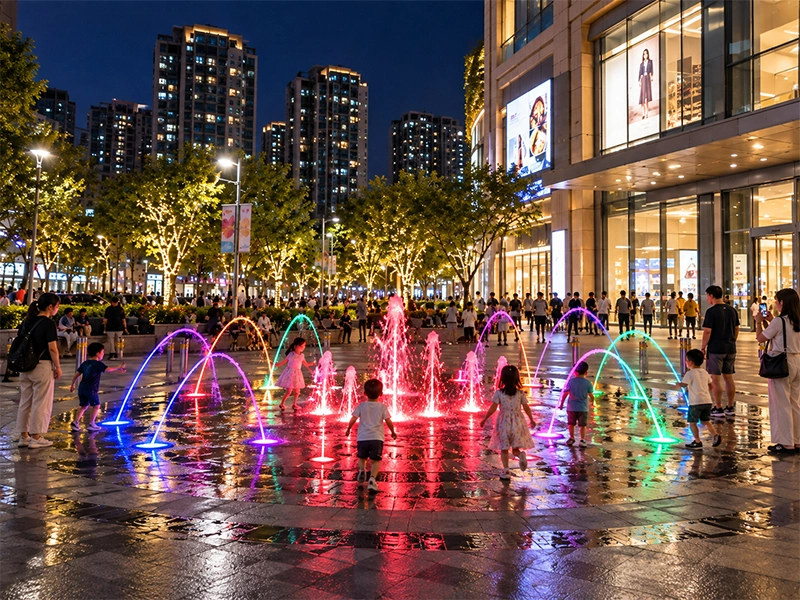
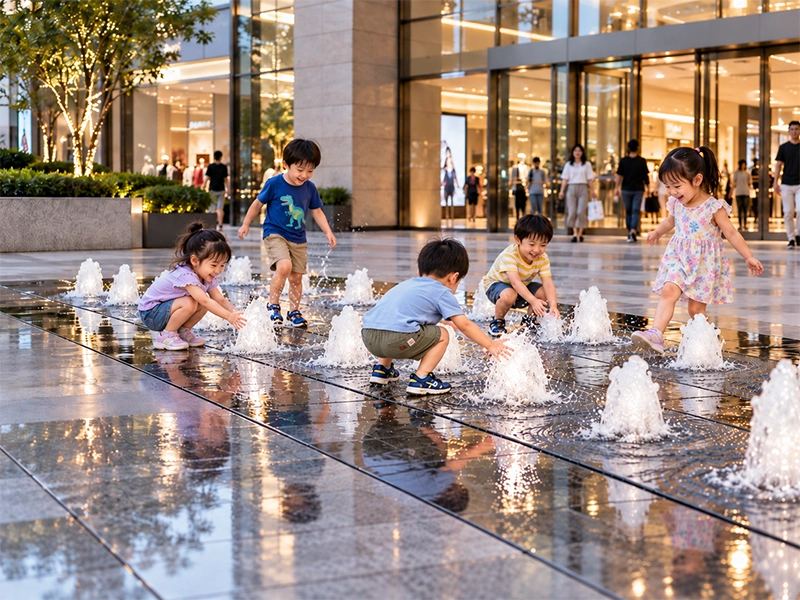
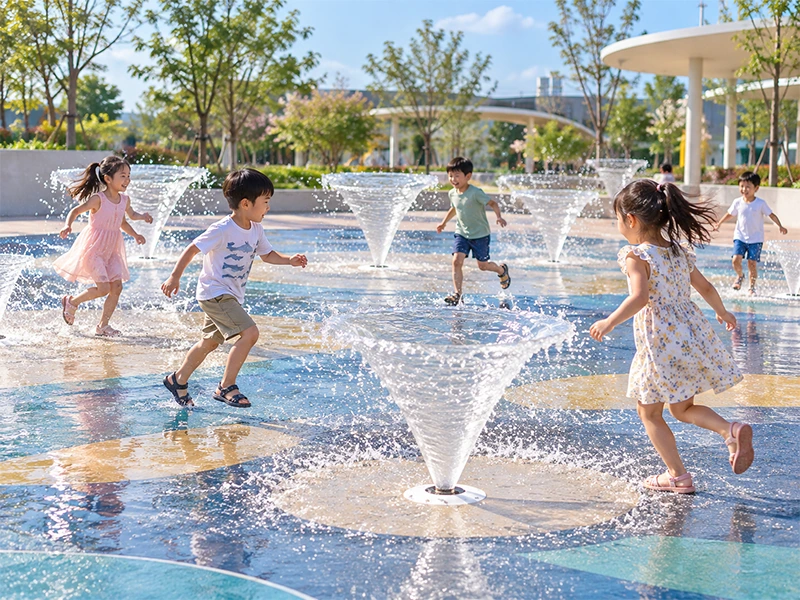
Children's play areas in communities and shopping centers see long dwell times and high repeat visit rates.
Commercial District
Pedestrian street nodes use interactivity to drive the gathering and flow of people.
Cultural and Tourism Attractions
Experience points in amusement parks and scenic areas serve as locations for photo opportunities and as platforms for sharing content.
Frequently Asked Questions
Need a proposal and quote for an interactive fountain?
Provide details on the venue, target audience, and preferred interaction methods, and we can provide a preliminary proposal and equipment configuration.
Get a Proposal and Quote Chinese
 English