
Water features in municipal plazas are exposed to the most open and demanding conditions: high foot traffic, an unselected user base, maintenance handled by third parties, and the need to withstand years of public use. The top priority for such projects is not stunning visual impact, but rather safety, durability, and ease of maintenance—a fountain that begins to leak, short-circuit, or simply stops working after three years does far more harm to a public space than the initial benefits it provided.
Founded in 2007 · Nanhai, Foshan · Projects spanning more than 50 countries
Three Distinctive Features of the Municipal Plaza
Users cannot filter
Elderly people, children, and people with limited mobility will all use this facility. Safety designs must be based on the most conservative usage scenarios and must not assume that ”people will use it as intended.”
The maintenance provider is not the property owner.
Once completed, facilities are typically handed over to municipal authorities or property management for maintenance. When selecting equipment, it is important to consider the capabilities of maintenance personnel and the frequency of maintenance; systems that require more specialized commissioning are more likely to be neglected after handover.
Underestimated usage intensity
Public spaces are open year-round and experience high foot traffic during festivals. Equipment operating hours often far exceed initial estimates, so durability and the availability of replacement parts must be considered in advance.
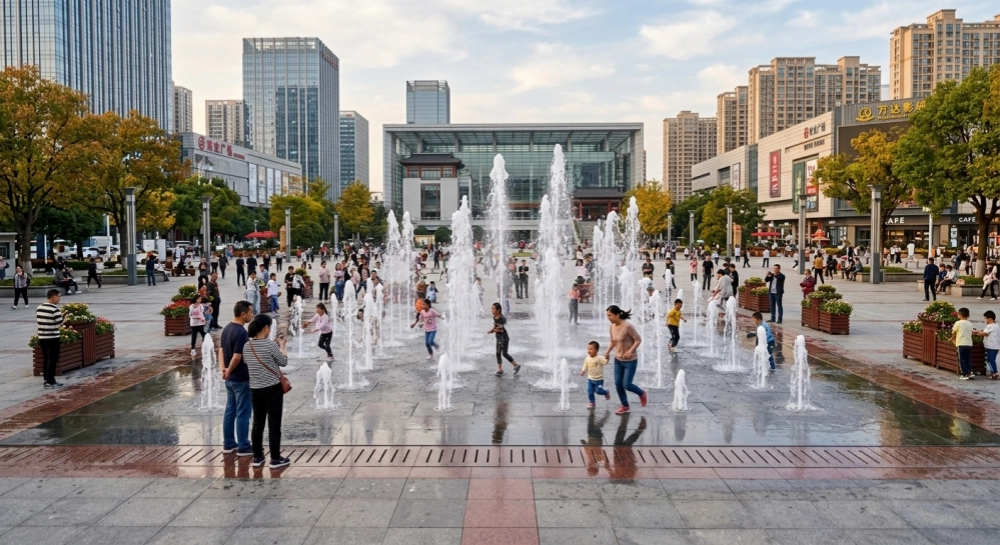
Recommended Water-Based Combinations
| Water-based | Why Is It Suitable for Municipal Squares? | Hours of Operation |
|---|---|---|
| Dry Fountain | Since there is no permanent water feature, the plaza can fully serve as a pedestrian and event space outside of performance hours, thereby resolving the ”conflict between the water feature and the plaza’s functional use.” This is the most reliable primary option for a municipal plaza. | Everyday + Holidays |
| Musical Fountain | Festivals and weekend gatherings draw crowds and serve as the plaza’s ”event generators.” They are typically combined with dry-sprinkler zones to avoid high-load operation year-round. | Holidays and Weekends |
| Interactive Fountain | This area has a strong family-oriented focus and can significantly increase dwell time. It is best to designate a separate area for this, away from the main traffic flow. | Daily Life |
| Landscape Fountains | Static water features that operate year-round are low-cost and require minimal maintenance, making them ideal as everyday backdrops for plazas. | Year-round |
Six Design Principles
Safety First
Water depth, slip-resistant pool edges, electrical isolation, and ground fault protection must all be designed with potential contact scenarios in mind. In the event of an accident in an open area, the impact extends far beyond the project itself.
Vandal-resistant design
Light fixtures, sprinkler heads, and control boxes must be designed to withstand vandalism and accidental impacts. Installation locations, protective covers, and mounting methods should be specifically tailored for this purpose, and the design should allow for easy replacement.
Ease of Operation and Maintenance
Provide access hatches, drain openings, and access passages to equipment pits. Many fountains that are later taken out of service aren’t due to equipment failure, but because no one can easily repair them once they break down.
Noise and Time Periods
When residential areas are located nearby, the operating hours and pump noise levels must be evaluated. Noise complaints regarding fountains are among the most common post-construction issues in municipal projects.
Energy Efficiency and Operating Costs
Estimate electricity and water consumption based on the projected operating hours. Long-term operating costs often exceed the initial difference in equipment prices within a few years, so pricing alone should not be the sole consideration when selecting equipment.
Impact During the Construction Period
Construction in public spaces involves erecting barriers, managing traffic flow, and controlling the construction schedule. It is essential to coordinate the construction timeline with the relevant authorities as early as the planning stage to avoid disrupting public access.
Key Technical Specifications
| Parameter Items | Standard Configuration |
|---|---|
| Control Protocol | DMX512 / Art-Net, supports timing and synchronization with music |
| Underwater Light Protection | IP68: Rated for continuous submersion |
| Electrical Safety | Ground Fault Circuit Interrupter (GFCI) + Equipotential Bonding; Control Box: IP65 or higher |
| Nozzle Material | 316L / 304 Stainless Steel |
| Operational Strategy | Time-based schedule that can be switched between weekdays, weekends, and holidays |
Frequently Asked Questions
Need a water feature design for a municipal plaza?
Please provide the square's area, pedestrian flow patterns, and approval status, and we can provide a preliminary layout plan and equipment list.
Get a Proposal and Quote Chinese
 English