
Water features in residential communities must satisfy three parties simultaneously: they must enhance the appeal of the model homes during the sales phase, provide residents with a sense of value after move-in, and be affordable for the property management company to maintain. These three objectives are often at odds with one another—sales require an attractive appearance, residents demand safety, and property management seeks to keep costs down. Therefore, the key to a residential project is not how spectacular the water features are, but rather finding a balance among these three factors and ensuring they do not become a burden after handover.
Founded in 2007 · Nanhai, Foshan · Projects spanning more than 50 countries
Three Distinctive Features of Residential Projects
Children are the primary users
Children most often come into contact with water features in residential communities. Safety standards should be based on the assumption that ”children will play there,” rather than on the assumption that ”no one should go in the water.”
Operating and maintenance costs are borne by the property management company.
After delivery, electricity, water, and maintenance costs for the water feature will be covered by the property management fees. Since costs are a major consideration, it’s better to choose a cost-effective option rather than an expensive one, and a reliable option rather than a complicated one.
Must Pass Delivery Acceptance
There is often a discrepancy between the planned appearance of the demonstration area and the actual delivery standards. The water feature design must be viable during both the sales and delivery phases to avoid requests for corrections at the time of delivery.
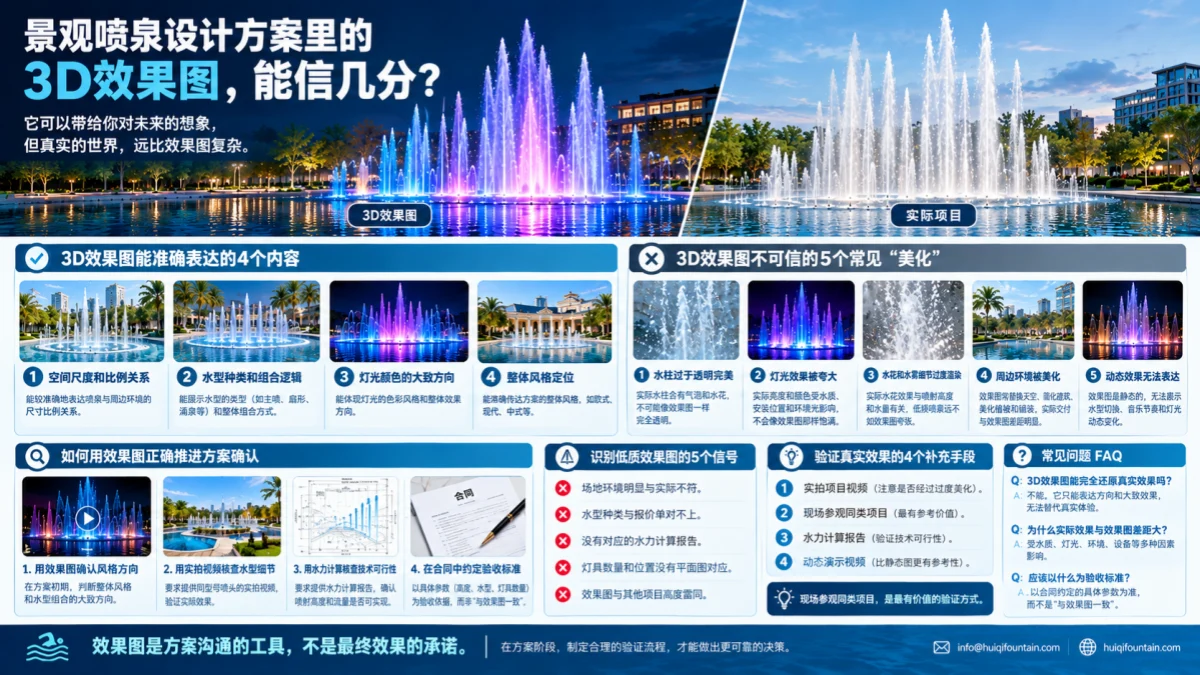
Recommended Water-Based Combinations
| Water-based | Why Is It Suitable for Residential Communities? | Suggested Location |
|---|---|---|
| Landscape Fountains | The primary feature of the central landscape has low year-round operating costs, is easy to maintain, and integrates well with the landscaping and topography. | Community Center, Entrance |
| Interactive Fountain | A top choice for children’s play areas, it can significantly improve resident satisfaction and community vitality. A separate area must be designated, and proper safety measures must be implemented. | Children's Play Area |
| Dry Fountain | There is no permanent body of water, so the plaza can be used normally during periods when there is no water, resulting in improved safety and better utilization of the space. | Central Plaza |
| Waterfall Feature | Cascading water features and accent walls are ideal for entryways and clubhouses, enhancing the sophistication of the model community. | Entrance, Clubhouse |
Six Design Principles
Child Safety
Water depth control, slip-resistant pool edges, and electrical isolation. The height and extent of water in wading areas must be limited, and nighttime lighting and visibility must not be overlooked. This is the top priority for residential projects.
Operating and Maintenance Costs
Estimate annual electricity and water consumption based on year-round operation, and prioritize high-efficiency pump sets and easy-to-maintain filtration systems. Since property management fees are a long-term consideration, do not base your selection solely on the initial quote.
Noise and Residents
Noise levels from water features near residential buildings must be assessed, especially at night. The sound of flowing water and the noise from water pumps can both lead to complaints and must be addressed during the design phase.
Delivery Consistency
The master plan for the demonstration area must be implemented exactly as designed during the handover phase. This will prevent a situation where the plan looks impressive during the sales period but is scaled back at handover—a common source of disputes in residential projects.
Maintenance and Handover
Delivery must include a complete maintenance manual, a list of spare parts, and training. Many water features in residential communities are taken out of service not because they’re broken, but because property management doesn’t know how to maintain them.
Winter and Vacancy
In cold regions, plans for winter drainage must be made. For pre-sale projects with low occupancy rates, maintenance strategies for long-term vacancies must also be considered.
Key Technical Specifications
| Parameter Items | Standard Configuration |
|---|---|
| Control Methods | Time-based or simple program control, configurable as needed |
| Nozzle Material | 304 / 316L stainless steel, copper alloys |
| Underwater Lights | IP68: Rated for continuous submersion |
| Electrical Safety | Ground Fault Circuit Interrupter (GFCI) + Equipotential Bonding |
| Circulatory System | Filtration + Disinfection; Select Model Based on Water Volume |
Frequently Asked Questions
Need a water feature design for a residential community?
Provide the size of the residential complex, the landscape design concept, and your budget range, and we can provide a preliminary proposal and maintenance recommendations.
Get a Proposal and Quote Chinese
 English