
The water pump is the power source for a fountain, and it determines two key factors: how high the water jets can rise and how many nozzles can operate simultaneously. The most common mistake made during selection is estimating based solely on the number of nozzles while ignoring pipeline pressure loss and the simultaneous operation factor. As a result, the actual water jet height often falls short of the design specifications upon completion. Huiqi Fountains has been manufacturing fountain equipment since 2007 and selects pumps based on system hydraulic calculations.
Founded in 2007 · Nanhai, Foshan · Projects spanning more than 50 countries
The Location of the Pump in a Fountain System
The pump is located in the fountain system'sPower Train...with the water supply and filtration system connected at the front, and the piping, valves, and nozzles connected at the back. It is the equipment with the highest energy consumption in the entire system and the primary source of operating costs. Choosing the right model directly affects three key factors: spray performance, electricity costs, and equipment failure rates.
| Segment | Major Equipment | Relationship with the Water Pump |
|---|---|---|
| Water Source End | Ponds, Water Replenishment, and Filtration Systems | Water quality determines the pump housing material and the filtration precision of the pre-filter. |
| Power Train | Pumps, variable-frequency drives, control cabinets | Specify the flow rate and head to determine the maximum height and number of water arcs. |
| Feed End | Pipes, Valves, Check Valves | Pipe diameter and layout determine frictional losses, which in turn affect the selection of head. |
| End | Nozzle | The total flow rate of the nozzles must fall within the pump's high-efficiency range. |
Common Types of Water Pumps
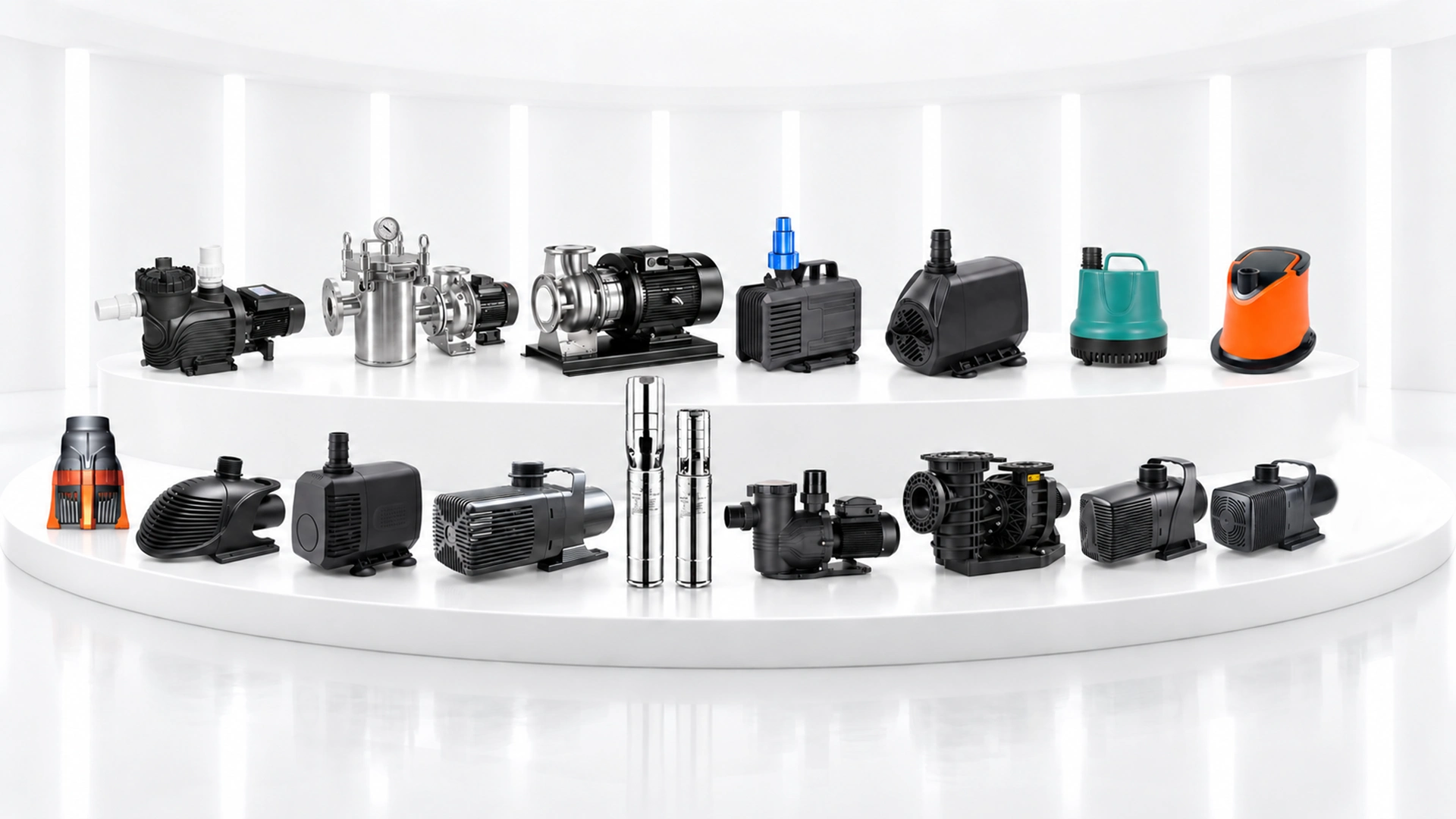
Fountain pumps are classified into two main categories based on installation type: submersible and dry-type; and based on drive method: fixed-speed and variable-speed. The combination of these two factors results in different applications. When selecting a model, first determine the installation conditions, then decide whether speed control is required.
| Type | Features | Common Applications |
|---|---|---|
| Submersible Fountain Pump | The entire unit is submerged, eliminating the need for a pump house and preventing noise from escaping | Landscape Ponds, Lake Fountains, Renovation Projects |
| Dry-type Centrifugal Pump | Installed in the pump room; easy to maintain; has specific civil engineering requirements. | Large-scale musical fountains; projects requiring centralized management |
| Variable-Frequency Pump Sets | Adjustable rotational speed; programmable water jet height and velocity | Musical fountains, projects requiring choreographed performances |
| Constant-Displacement Pump | Simple structure, relatively low cost; water-based, fixed, and non-adjustable | Landscape Fountains, Continuous-Flow Water Features |
| Stainless Steel Multistage Pump | High head and compact size, suitable for high-pressure spraying and long-distance delivery | Main Fountain, High-Pressure Fountain, Cascading Waterfall |
| Circulation Filter Pump | Combines water circulation and filtration, with high flow rate and low head | Landscape water bodies requiring water quality maintenance |
Key Considerations for Pump Selection
First calculate the total flow rate, then calculate the total head.
Total flow rate = Number of simultaneously open nozzles × Flow rate per nozzle. Note that this is calculated based on the simultaneous operation factor; not all nozzles are fully open.
The head must include piping losses.
Required head = geometric head + nozzle operating pressure + frictional and local losses. Calculating only the geometric head will inevitably result in an insufficient spray height.
Variable-speed or fixed-speed
Variable-frequency drives are necessary for water features that require changes in water patterns and choreography; fixed-speed drives are more economical for permanently operating water features.
Preventing Cavitation and Air Ingestion
Check the required net positive suction head (NPSH) and installation height; if the water level in the suction sump is too low, it can cause cavitation and damage the impeller.
Redundancy and Standby
For critical projects, it is recommended to use an active-standby or grouped configuration so that a single pump failure does not cause the entire fountain to shut down.
Noise levels must be calculated in advance.
Both the noise from dry-type pumps in pump rooms and the underwater noise from submersible pumps must be assessed; this is particularly important for hotel and residential projects.
Key Technical Specifications
| Parameter Items | Standard Configuration |
|---|---|
| Drive Type | Variable-frequency drive (VFD) or fixed speed—determined by whether the water flow rate needs to vary |
| Installation Methods | Submerged or dry type; determined based on civil engineering conditions and noise requirements |
| Pump Body Material | 304 / 316L stainless steel; a higher grade is required for seawater environments |
| Flow Range | Select a model based on project size; typical range is 5–500 m³/h [Check specific model] |
| Head Range | Select the model based on the water head; typically 5–80 m [Check the specific model] |
| Protection Rating | Submersible Pump IP68; dry-type pumps are selected based on the conditions of the pump room. |
For items marked [Verify], please replace them with the data from the product specifications.
Common Issues and Solutions
| Phenomenon | Possible Causes | Approach |
|---|---|---|
| Insufficient water column height | The selected head is too low, or the piping losses are too high | Review the hydraulic calculations and, if necessary, increase the pipe diameter or replace the pump model. |
| Pump Overheating Trip | Prolonged operation at low flow rates or inadequate heat dissipation | Check for restricted flow and calculate the minimum flow rate |
| Noises and Vibrations | Cavitation, bearing wear, or loose mounting | Check the liquid level and suction inlet; tighten the foundation or replace the bearings. |
| Frequent starts and stops | Abnormal liquid level control or improper pressure switch settings | Check the level gauge and the control system setpoints |
| Shaft Seal Leakage | Seal Wear | Replace the mechanical seal and check the sand content in the water |
| Operating energy consumption is relatively high | The unit was oversized, resulting in long-term operation outside the high-efficiency range. | Recalculate the operating points and switch to variable-frequency control. |
Related Water-Based Types
Supporting Equipment
Frequently Asked Questions
Further Reading
Do you need help selecting and sizing a pump?
Provide the water system requirements, the number of spray heads, and the piping conditions, and we can provide flow rate and head calculations along with recommendations for pump set configurations.
Get a Proposal and Quote Chinese
 English