
Keeping fish and plants in fountains is one of the most common questions asked by owners of courtyards and landscape water features. To put it simply: You can keep fish and grow aquatic plants in fountains, but not all fountains are suitable, and not all fish and plants can survive in a fountain environment. The water flow, residual disinfectant levels, water depth, and lighting conditions in a fountain differ fundamentally from those in a standard still-water aquarium or lotus pond. Only by understanding these differences can you ensure that the fountain, fish, and plants coexist harmoniously rather than harming one another.
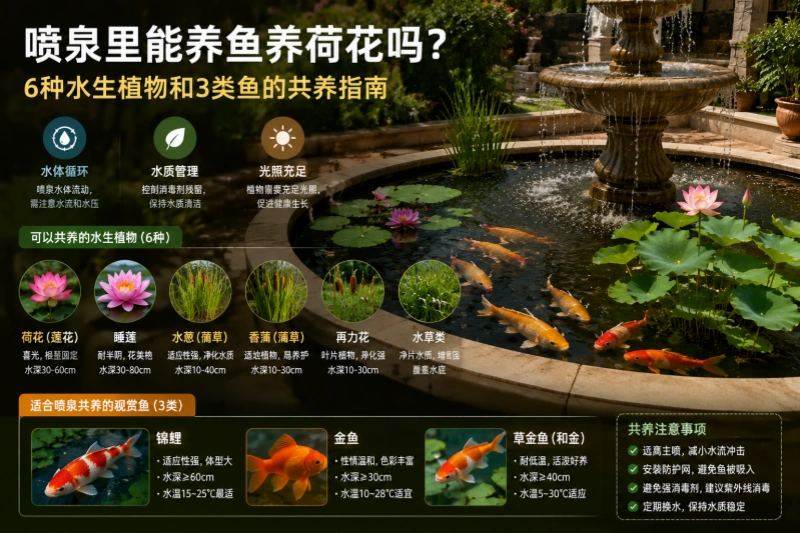
Before keeping fish or plants in a fountain, make sure you understand the three specific conditions of the fountain’s water.
The key differences between fountain water bodies and ordinary fish ponds or lotus ponds determine which organisms can survive in them:
Special Condition 1: Water Flow and Water Pressure
The fountain pump operates continuously, keeping the water in constant circulation. The submersible pump’s intake creates a certain degree of suction, and small fish (less than 3 centimeters in length) and aquatic plants with shallow root systems may be drawn into the pump housing by the water flow, resulting in injury. At the same time, the impact force generated when the main water jet strikes the water’s surface exerts continuous mechanical pressure on fish and plants near the center of the jet.
Solution: Install a protective screen (with a mesh size of 1–2 centimeters) over the pump’s intake, and place fish and plants along the edges, away from the pump and the main waterfall area.
Special Condition 2: The Impact of Disinfectants
To maintain water quality, public landscape fountains typically require the addition of disinfectants to keep residual chlorine levels between 1.0 and 3.0 mg/L. This concentration is safe for human contact, but the toxicity threshold for most fish is far lower—koi have a safe tolerance limit for residual chlorine of approximately 0.05 mg/L, and levels exceeding 0.1 mg/L cause noticeable stress reactions, while levels above 0.3 mg/L result in death within a short period of time.
This means:Fountains intended for fish must abandon conventional chlorine disinfection methods.... and switch to water quality management methods that are more fish-friendly (such as UV disinfection, ozone disinfection, or purely biological filtration), while significantly reducing the amount of disinfectant added—or even eliminating it entirely. The trade-off for this choice is that water quality management becomes significantly more challenging, requiring more frequent water changes and a more sophisticated filtration system.
Special Condition 3: Water Depth and Light Intensity
Most garden fountains have pools with depths ranging from 30 to 80 centimeters. While this depth is generally acceptable for medium-sized ornamental fish such as koi, it may not be sufficient for fish that need to overwinter—in northern regions, where water temperatures drop significantly in winter, fish require a depth of more than 60 centimeters to overwinter at the bottom of the pool. Regarding lighting, the light emitted by underwater LED fixtures is harmless to most ornamental fish, but prolonged exposure to intense light may disrupt the fish’s circadian rhythm; it is recommended to set specific times when the lights are turned off.
Fish and Plants in Fountains: The 3 Most Common Choices for Ornamental Fish
| Fish | Suitable for water depths | Tolerance to Water Flow | Water Temperature Requirements | Compatibility with Fountains |
|---|---|---|---|---|
| Koi | ≥60 cm | Medium (avoid the main spray area) | Optimal temperature: 15–25°C; can tolerate temperatures ranging from 5–30°C | ★★★★☆ (Top Pick) |
| Goldfish | ≥30 cm | Weaker (requires areas with low flow velocity) | 10–28°C; highly adaptable | ★★★☆☆ (Small fountain available) |
| Grass Goldfish (and Gold) | ≥40 cm | Strong (streamlined build) | 5–30°C; good cold tolerance | ★★★★☆ (High weather resistance) |
Koi: The Top Choice for Fountain Fish
Koi are the most common choice for fountain fish because they can tolerate a wide range of water currents, temperatures, and water quality; they are relatively large (adults measure 30–80 centimeters in length); they are unlikely to be sucked into the pump’s intake; and their vibrant colors make them a stunning sight in clear water.
Key Considerations for Koi Farming:
- Stocking Density:Do not exceed 2–3 medium-sized koi (20–30 centimeters) per square meter of water surface. Excessive stocking density can lead to rapid deterioration of water quality and increase the load on the filtration system.
- Water Depth Requirements:The pond should be at least 60 centimeters deep; in northern regions, a depth of at least 80 centimeters is required for overwintering to prevent the water temperature from dropping too low in winter.
- Water Quality Management:Koi are sensitive to ammonia-nitrogen, so a biological filtration system is required to keep ammonia-nitrogen levels below 0.1 mg/L and nitrite levels below 0.01 mg/L.
- Do not store with strong disinfectants:It is strictly prohibited to add chlorine-based disinfectants to fountains containing koi; ultraviolet disinfection lamps may be used as an alternative to chemical disinfection.
Goldfish: An Option for Small Fountains
Goldfish are best suited for small fountains with a gentle current and a water depth of at least 30 centimeters. It is important to note that long-tailed varieties (such as butterfly-tailed and peacock-tailed goldfish) have poor swimming ability in strong currents and are prone to death from excessive physical exertion; therefore, it is recommended to choose short-tailed, standard goldfish varieties. Goldfish have good tolerance for water temperature fluctuations, but poor water quality can lead to white spot disease and bacterial infections, so regular water quality checks are necessary.
Fish Not Recommended for Fountains
Tropical fish (such as guppies and angelfish) have strict water temperature requirements (22–28°C) and cannot survive the winter in outdoor fountains; carnivorous fish (such as bass) will prey on other organisms in the same pond; Fish that are too small (less than 3 cm in length) are at risk of being sucked into the pump; copper fish (whose copper ions are toxic to plants) are not recommended for keeping with aquatic plants.
Fish and Plants in Fountains: 6 Aquatic Plants Best Suited for Living in Fountains
When selecting aquatic plants, it is important to consider the fountain’s water depth, flow rate, and lighting conditions. The following six types of aquatic plants are the most commonly used by owners of garden fountains:
Plant 1: Water Lily (Lotus)
Water lilies are the most visually appealing aquatic plants in fountains, but they have specific growing requirements. Water lilies need still water or an environment with extremely low water flow; strong currents can damage the structure of their stems and leaves, preventing them from growing normally. When planting lotus flowers in a fountain, they should be placed in a separate planting basket located far from the pump and the main spray area. The water depth should be maintained between 30 and 60 centimeters (as the stems and leaves grow above the water surface), and care must be taken to ensure that the water flow in the planting area is extremely slow.
Lotus flowers require ample sunlight and need at least 6 hours of direct sunlight each day; they will not bloom properly in shaded environments. Excessively high concentrations of copper ions in the water are toxic to lotus flowers, so extra care must be taken to monitor water quality when using fountains with copper nozzles.
Plant #2: Water Lily
Water lilies are better suited to fountain environments than lotus plants; they tolerate water currents slightly better than lotus plants. Their root systems can be secured in planting containers sunk to the bottom, while their leaves float on the water’s surface, shielded from direct impact by the current. Water lilies are suitable for ponds with a water depth of 30–80 centimeters and require 4–6 hours of direct sunlight per day. In terms of variety selection, cold-hardy water lilies (temperate varieties) can overwinter outdoors in northern regions, while tropical varieties need to be moved indoors during the winter to maintain warmth.
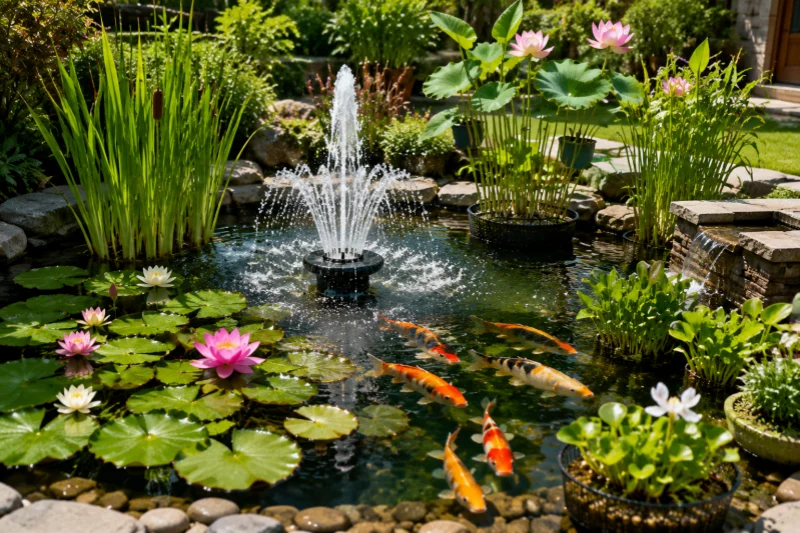
Water lilies and koi are the most classic combination in a fountain—koi help control excessive algae growth in the water, while the leaves of the water lilies provide shade and shelter for the fish, creating a harmonious ecological balance between the two.
Plant 3: Water Reed (Sedge)
Water rush is one of the most adaptable emergent plants, with a much higher tolerance for changes in water flow and water quality than lotus and water lilies. Water sedge has erect stems that can reach 60–150 centimeters in height; when planted along the edge of a fountain, it creates a striking vertical line that visually complements the fountain’s water jets. Water rush has strong water-purifying capabilities; it absorbs nutrients such as nitrogen and phosphorus that contribute to eutrophication, thereby reducing algae growth, making it a natural auxiliary plant for fountain water quality management.
Plant 4: Cattail (Typha)
Cattail is a common wetland plant with a well-developed root system that provides excellent soil stabilization; it is well-suited for planting in the shallow water areas (10–30 centimeters deep) along the edges of fountain ponds. The cattail’s spike-like inflorescence is a distinctive landscape feature; when it matures in the fall, it turns a deep brown, creating an interesting natural contrast with the modern aesthetic of the fountain. Cattails reproduce vigorously, so their spread must be controlled regularly to prevent them from overgrowing and taking over the water surface.
Plant 5: Zaili Flower (Water Bamboo)
Water hyacinth is an emergent aquatic plant that has seen a rapid rise in popularity in landscape water features in recent years. With its broad, vibrant green leaves and elegant, swaying stems and foliage, it offers high ornamental value. Water hyacinth is suitable for planting in shallow water areas with a depth of 20–40 centimeters. It has a certain tolerance for water flow and is effective at purifying water. However, water hyacinth is not cold-hardy; in northern regions, the rhizomes must be brought indoors or covered with insulation during winter, otherwise they will freeze to death.
Plant 6: Aquatic Plants (Bitterweed, Water Celery)
Submerged plants such as hornwort and water celery can grow entirely below the water’s surface, where they are not directly impacted by the fountain’s water flow, while also providing visual depth underwater and shelter for fish. Bitter grass has low light requirements and is suitable for fountain pools with greater water depth or limited light conditions. Water celery has some edible value, making it a choice that combines aesthetic and practical functions.
Comparison Table of Key Parameters for Keeping Fish and Plants in Fountains
| Aquatic Plants | Suitable for water depths | Light Requirements | Tolerant to water flow | Purify Water Quality | Wintering in the North |
|---|---|---|---|---|---|
| Water Lilies | 30–60 cm | Strong (≥6 hours of direct sunlight) | Weak (requires a still water area) | 中 | Yes (overwinters via underground stems) |
| Water Lilies (Temperate Varieties) | 30–80 cm | Medium (≥4 hours) | Weaker | 中 | 可 |
| Water Leek | 10–30 cm | 中 | 强 | 强 | 可 |
| Cattail | 10–30 cm | 中 | 中 | 强 | 可 |
| Zaili Flower | 20–40 cm | 中 | 中 | 强 | Not allowed (must be moved indoors) |
| Bitterweed (Submerged) | 30–100 cm | Weak (diffuse light) | 强 | 强 | 可 |
5 Practical Tips for Keeping Fish and Plants in a Fountain
- Establish ecological balance first, then stock the pond with fish:When a new fountain is first filled with water, the population of beneficial bacteria (nitrifying bacteria) is extremely low, making it impossible to effectively break down the ammonia nitrogen excreted by fish. It is recommended to run the filtration system for 2–4 weeks first to allow the nitrifying bacteria to establish themselves before introducing fish; otherwise, the accumulation of ammonia nitrogen will cause fish to become poisoned and die (New Tank Syndrome).
- Specialized Containers for Plant Cultivation:Plant aquatic plants in perforated planting baskets or terracotta pots. Line the bottom with a substrate specifically designed for aquatic plants (lotus soil or aquatic plant mud), then cover it with a layer of coarse sand to prevent the substrate from spreading. Do not plant the plants directly on the bottom of the pond, as their roots may spread into the pump area and interfere with the equipment’s operation.
- The filtration system must include biological filtration:For fountains containing both fish and plants, physical filtration (which traps particulate matter) alone is insufficient; they must be equipped with biological filtration modules (such as bio-sponge and ceramic rings) to allow nitrifying bacteria to convert toxic ammonia nitrogen into harmless nitrate, thereby maintaining the biological stability of the water.
- Coordinating Fountain Operating Hours with Animal Activity Patterns:Fish need a quiet environment to rest at night; strong water currents and underwater lighting can disrupt their circadian rhythms. We recommend setting the fountain to night mode, reducing the pump power after 10:00 p.m., and turning off the underwater lights or dimming their brightness to provide the fish with appropriate resting conditions.
- Seasonal Water Quality Management:In summer, water temperatures are high, fish metabolism is vigorous, and ammonia-nitrogen production accelerates, so it is necessary to increase the frequency of water changes (10–15% per week); Summer is also the peak season for algal blooms; increasing the shade provided by aquatic plants to an appropriate extent can effectively suppress algae; in northern regions during winter, fish should be transferred to indoor aquariums for overwintering before the fountain is shut down, or ensure that the pond has a sufficiently deep, ice-free area.
Frequently Asked Questions (FAQ)
If I keep fish and plants in a fountain, can I still use disinfectant in the water?
In fountains containing fish and plants, the use of chlorine disinfectants must be significantly restricted or completely discontinued. Koi have a maximum safe tolerance for residual chlorine of approximately 0.05 mg/L, whereas the residual chlorine concentrations required for routine fountain disinfection (1.0–3.0 mg/L) are lethal to fish. Alternative solutions include: using ultraviolet (UV) disinfection lamps to disinfect the recirculating water; UV lamps do not introduce chemicals into the water and are harmless to fish and plants; and using a comprehensive biological filtration system to control the concentration of harmful bacteria in the water; Perform regular (monthly) partial water changes (10–20% to 3%) to dilute the harmful substances that have accumulated in the water. The trade-off for eliminating chemical disinfection is that water quality management becomes more challenging, requiring more frequent monitoring of water quality parameters.
Why don't the lotus flowers in the fountain bloom?
There are three most common reasons why lotus plants fail to bloom: First, insufficient sunlight. Lotus plants need at least 6 hours of direct sunlight each day; in shaded environments, they will only grow leaves and fail to bloom; Second, the water level is too deep. The stems and leaves of lotus plants need to grow above the water surface; the top of the planting container should be kept 5–10 centimeters above the water level, as water that is too deep will inhibit normal growth; Third, insufficient fertilizer. Lotus plants are heavy feeders; in nutrient-poor fountain water, they often fail to bloom due to a lack of phosphorus. It is recommended to add a controlled-release fertilizer specifically formulated for lotus plants to the growing medium.
Can koi and water lilies be kept together?
Yes, and koi and water lilies are the most classic combination for mixed-species keeping in fountains. However, it’s important to note that koi have a tendency to dig up the bottom substrate and nibble on plants, which can damage the water lilies’ roots and tender leaves. The solution is to plant the water lilies in heavy clay pots (to prevent the koi from overturning them), cover the rim of the pot with large gravel (to prevent the koi from digging up the soil), and plant mature, established plants rather than young seedlings (mature plants are more resistant to nibbling). The koi’s waste provides natural fertilizer for the water lilies, while the water lilies’ leaves provide shade and cool the water for the koi, creating a harmonious ecological relationship between the two.
How should a green algae bloom in a fountain be handled?
Green algae blooms are the most common water quality problem in fountain aquaculture, typically triggered by a combination of three factors: excessive light, high water temperature, and excessive levels of nitrogen and phosphorus nutrients in the water. The use of chemical algaecides is not recommended in fountains containing fish and plants (as they are toxic to both fish and plants). Recommended treatment methods include: increasing the shading provided by aquatic plants (water lily leaves covering 30–40% of the water surface can effectively suppress algae); increasing the wattage of UV disinfection lamps; appropriately reducing feeding amounts (to reduce sources of nitrogen and phosphorus in the water); performing partial water changes to dilute the concentration of nutrients in the water; and introducing an appropriate number of snails or benthic shellfish into the water (which feed on algae, providing biological algae control).
What should be done with the fish and plants when the fountain is shut down for maintenance?
Short-term shutdowns (1–3 days) generally do not require the transfer of fish and plants, but it is necessary to ensure that the water has sufficient dissolved oxygen during the shutdown—a separate aeration pump can be temporarily installed to maintain dissolved oxygen levels. Long-term shutdowns (more than one week, such as winter shutdowns or major equipment overhauls) require transferring fish to temporary tanks equipped with filtration and aeration systems. Cold-hardy aquatic plants (lotus, temperate water lily varieties, water onion, cattail, and eelgrass) can be left in place to overwinter, while non-cold-hardy varieties (water hyacinth, tropical water lilies) require their rhizomes to be dug up and stored indoors at a low temperature for the winter.
With 19 years of experience in the fountain industry, Huiqi Fountains can customize filtration system solutions during the design phase of garden fountains and landscape water features based on the client’s aquaculture needs. These solutions include UV disinfection, biological filtration module configurations, and designated planting zones for aquatic plants, ensuring the long-term coexistence of fountains, fish, and aquatic plants. Please feel free to contact our project team for design recommendations at 18818738142.
 Chinese
  English