
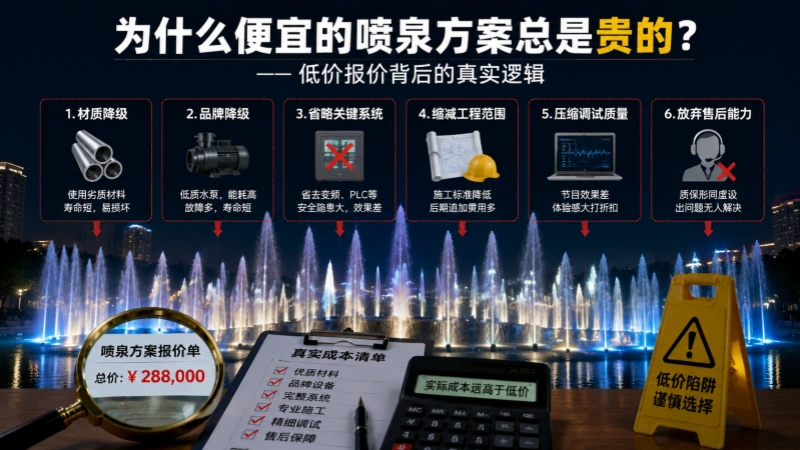
Low-ball quotes for fountain projects are a long-standing phenomenon in the industry and one of the most common pitfalls clients face during project procurement. The bottom line: Low prices for fountain proposals never come out of thin air. Behind every quote that falls below market price lies a corresponding cost-cutting measure—and those cut costs will ultimately come back to haunt the client in the form of substandard materials, frequent repairs, compromised performance, or the inability to seek redress. This article systematically breaks down the six methods used to generate low-price fountain quotes, helping clients see the true cost behind these low prices.
The Reality Behind Low-Priced Fountain Quotes: Cost Shifting, Not Cost Elimination
The cost structure of fountain projects is relatively fixed: equipment and materials account for 40–60%, labor and installation account for 20–30%, design and commissioning account for 10–15%, and warranty and after-sales service account for 5–10%. Under normal market prices, each cost item has a reasonable lower limit—below this limit, the corresponding engineering quality or service cannot be guaranteed.
There are only two ways to achieve a low bid: either the supplier has a genuine competitive advantage in a specific cost category (such as reduced material costs due to large-scale production or lower transportation costs due to local construction), or the low price is achieved by cutting costs in a specific area, with the resulting cost savings ultimately borne by the client during subsequent operations.
There is only one key question when determining whether a low price is reasonable:How was this price achieved?If a seller gives a clear answer to this question, they’re worth considering; if they give a vague answer or deliberately avoid the question, there’s definitely something wrong with them.
Option 1 for Low-Cost Fountain Quotes: Downgrading Materials
This is the most common and subtle way to keep prices low. 316L stainless steel nozzles and 304 stainless steel nozzles look exactly the same, but the price difference ranges from 30 to 601 TP3T; 8mm tempered glass lamp lenses and PC acrylic lenses are also indistinguishable to the naked eye, yet the price difference is equally significant.
| Components | Standard Materials | Downgraded Materials | Price difference | Consequences of Demotion | Party A's Subsequent Costs |
|---|---|---|---|---|---|
| Nozzle | 316L Stainless Steel | 304 Stainless Steel | 30–60% | Pitting and perforation in 1–2 years in chlorine-containing water bodies | Cost of a complete replacement × 1.5 |
| Light Fixture Body | 316L Stainless Steel | 304 or aluminum alloy | 25–50% | Corrosion caused the seal to fail, resulting in water ingress. | Light Fixture Replacement + Downtime Losses |
| Lighting Lenses | 8mm tempered glass | PC Acrylic | 20–40% | Yellowing and reduced light transmittance within 6–18 months | Replacement of the lens or the entire light fixture |
| Sealing Ring | Silicone Rubber | Standard Nitrile Rubber | 10–30% | Hardening failure occurs within 12–18 months in chlorinated water bodies | Frequent replacements + labor costs |
| Pipeline | 304 Stainless Steel | Galvanized Steel Pipe | 40–60% | Corrosion of the galvanized coating, deterioration in water quality, and clogged spray nozzles | Pipe Replacement + Water Treatment |
The insidious nature of substandard materials lies in the fact that the problem does not come to light during the acceptance phase but typically becomes apparent gradually after 6–18 months of operation. By the time the client discovers the issue, the warranty period may have already expired, and the contractor may have been paid in full, making it extremely costly to seek redress.
Option 2 for Low-Priced Fountain Quotes: Switching to a Lower-Tier Brand
Water pumps are the single-item equipment with the highest cost proportion in a fountain system, and they are also the component where switching to a lower-tier brand can most easily result in a significant price difference. The price difference between pumps from well-known commercial brands (Grundfos, Xinji, and Nanfang Pump Industry) and those from unbranded or small-manufacturer brands can range from 50 to 200% for pumps with the same power specifications.
The cost of switching to a lower-tier brand goes beyond just the price difference:
- Reduced service life:The rated service life of commercial submersible pumps from well-known brands is typically 8–12 years; the actual service life of pumps from small, unbranded manufacturers is usually 2–4 years, requiring more frequent replacement.
- High energy consumption:Low-quality water pumps typically have lower hydraulic efficiency than those from well-known brands, consuming 10–20% more energy at the same flow rate and head. Over the long term, the difference in electricity costs can be significant.
- Difficulty in Obtaining Replacement Parts:When small manufacturers discontinue production, spare parts become unavailable, leaving users with no choice but to replace the entire unit; well-known brands, on the other hand, have well-established spare parts systems, resulting in lower repair costs.
- Poor compatibility with variable-frequency drives:Low-quality water pumps may exhibit abnormal efficiency curves or vibration issues when operating in variable-frequency mode, which can affect energy-saving performance and equipment lifespan.
Option 3 for Low-Priced Fountain Quotes: Omitting Key Systems
This is the most direct way to cut costs in a low-price quote—removing systems that should be included from the proposal without proactively informing the client. The following systems are the most commonly omitted:
- Variable Frequency Drive (VFD):By eliminating the VFD and switching the pump to fixed-speed operation, equipment costs are reduced by 15,000–60,000 yuan (depending on the pump’s power rating); however, energy savings are reduced by 40–60%, the musical fountain’s visual impact is significantly diminished, and the water patterns are limited to only two states: on and off.
- PLC Safety Control System:By eliminating the PLC and using a simple timer for control instead, costs are reduced by 5,000–20,000 yuan; however, safety features such as water level protection, wind protection interlocks, and ground fault alarms are all missing, significantly increasing risks to both equipment and personal safety.
- Recirculating Filtration System:By eliminating the filtration equipment, you can save 3,000–15,000 yuan; however, water quality will deteriorate rapidly in the summer, and the monthly costs for water replacement and labor will far exceed the cost of the filtration system itself.
- Automatic Water-Filling Device:By omitting the float valve or solenoid makeup valve, you can save 500–2,000 yuan; however, this requires manual water refilling on a regular basis, and the risk of the pump running dry when the water level is low increases significantly.
When these systems are omitted, it is not apparent from the quotation at first glance—the quotation only lists ”× pumps, × spray heads, × lights,” with no mention of variable-frequency drives or PLCs, and the quotation does not explicitly state ”excludes.” The Client can only discover these omissions by cross-referencing the quotation with industry-standard configurations and verifying each item individually.
Path 4 to Low-Cost Fountain Quotes: Reducing the Scope of Work
A common tactic used by low-cost contractors is to specify in the contract that the scope of work covers only equipment installation, while excluding civil engineering, cable laying, control room finishing, and other items from the contract scope; once the project begins, they add these items one by one as ”additional work.”
Typical scenarios involving scope reduction:
- Lower Standards for Waterproofing Layers:The contract specified ”waterproofing,” but did not specify the brand of materials, the number of coats, or the dry film thickness. In practice, only one coat of low-quality waterproofing paint was applied. Two to three years later, the pool began to leak, and the repair costs far exceeded the initial savings on waterproofing materials.
- Direct Burial of Cables Instead of Conduit Installation:The standard practice is to run cables through PVC conduits before burying them, but direct burial without conduits can save on labor and material costs. After 5–8 years, the insulation on directly buried cables will deteriorate, requiring the ground to be excavated again for replacement; the construction costs for this are 3–5 times higher than those for the conduit method.
- Pipe Mounting and Vibration Damping (Omitted):If vibration-damping supports are not installed on the pipes, this saves on materials and labor costs; however, pipe vibrations will be transmitted to the building structure, causing noise, and remedial work later on will require re-excavation and the installation of supports.
Path 5 to Low-Priced Fountain Quotes: Compromising on Commissioning and Programming Quality
Debugging and programming are labor-intensive tasks in fountain projects, and they are also the most difficult aspects to verify for quality during acceptance inspections. Common ways that low-cost contractors cut corners in this phase include:
- Reduction in the Number of Programs:The contract did not specify the number of programs; in reality, only 1–2 pieces were arranged—or even just a single pattern played on a loop—so there were no ”programs” to speak of.
- Low programming accuracy:The synchronization error between the water display and the music beat exceeds 1–2 seconds, resulting in a visually noticeable ”out-of-sync” effect; however, since the debugging fees have already been paid in full, the Client has no grounds to hold the contractor liable.
- Reduced debugging cycle:Normal system commissioning takes 3–7 days, but low-cost contractors typically wrap up in just one day. As a result, many parameters are not fully optimized, and issues such as uneven water spray height and misaligned sprinklers gradually become apparent during operation.
Path 6 to Low-Priced Fountain Quotes: Sacrificing After-Sales Support
The final way to achieve low prices is when contractors do not factor in the cost of services during the warranty period at all during the bidding stage—because they have no intention of seriously fulfilling their warranty obligations.
Typical characteristics of this type of contractor: Project managers become less responsive after project acceptance; it becomes increasingly difficult to reach them by phone during the warranty period; on-site repairs are repeatedly delayed; and eventually, they cut off contact entirely, citing ”business restructuring” or ”staff changes” as the reason. At this point, the client is left facing the following situation: when equipment malfunctions, they cannot contact anyone; there are no spare parts, no blueprints, and no control programs. They have no choice but to hire a third party at a high cost to resolve the issue, and the quote from a third party to take over this ”abandoned fountain project” is typically 30–60% of the original contract amount.
How to Use a Single Table to Determine Whether a Quote Is Reasonable
After receiving a quote, use the following framework to quickly determine whether it falls within a reasonable range:
| Verification Items | What a Reasonable Quote Should Include | Common Shortcomings of Low-Priced Quotes |
|---|---|---|
| Material Specifications | Specify specific grades such as 316L, 304, tempered glass, etc. | Just write ”stainless steel” and ”waterproof light” |
| Equipment Brand | List the specific brands and models of the water pumps, variable-frequency drives, and controllers. | “Well-known brand” ”Brand to be determined” |
| Variable Frequency Drive | Clearly list the VFD brand, model, and quantity | The quote does not include a line item for variable-frequency drives. |
| PLC Safety Control | List of PLC Brands, Models, and Descriptions of Safety Interlock Functions | The quote does not include a PLC; it only mentions a ”control cabinet.” |
| Filtration System | List the brands, models, and water treatment capacities of the filtration equipment | The quote does not include a filtration system. |
| Debugging and Programming | List the number of shows, debugging hours, and days on-site | The quote does not include a commissioning fee, or it simply states ”commissioning included.” |
| As-Built Documentation | List the as-built drawings, program backups, and operating manuals | The quotation does not mention any documentation. |
Frequently Asked Questions (FAQ)
How can you tell if a low quote for a fountain represents a genuine competitive advantage or is the result of cutting corners?
The way to assess this is to ask the other party to explain the source of the low price. Suppliers with a genuine competitive advantage can clearly explain the source of their price advantage—for example, by owning their own factories to reduce intermediaries, conducting on-site construction locally to lower travel costs, or purchasing materials in bulk to reduce material costs. If the other party only says, ”We’re highly efficient” or ”We have the right channels” without providing specific details, it’s highly likely that the low price is achieved by using lower-grade materials or omitting certain system components. Another way to assess this is to request a written commitment from the supplier regarding material specifications, brands, and models. If they are willing to commit, it indicates that the price is genuinely justified; if they refuse to commit or evade specific details, it is highly likely that there is a reduction in material quality or configuration.
Why is there such a big difference in prices for products from the same brand but from different suppliers?
There are typically several reasons for significant price variations among products of the same brand: First, product specifications may differ. A single brand may offer multiple series of water pumps, with price differences between high-end and low-end series ranging from 2 to 5 times; it is important to verify that the specific models are identical. Second, price differences arise from varying distribution tiers—prices increase progressively from manufacturer direct sales to first-tier agents to second-tier dealers, with direct sales offering the lowest prices; Third, differences in the scope of included accessories and services: some quotes include installation and commissioning, while others cover only the equipment itself. When comparing prices, it is recommended to request that all suppliers quote for exactly the same product model before making a side-by-side comparison, to avoid invalid comparisons based on products with different specifications.
I’ve already chosen the lower-priced plan but discovered a problem—is there any way to fix this?
The timing of corrective actions determines the scope of available options: During the phase when equipment has been delivered but not yet installed, you may request third-party material testing of the delivered equipment; if any non-compliance with the contract is discovered, immediately demand a return or replacement. During the phase when installation is complete but acceptance testing has not yet taken place, you may request material verification and functional testing during the acceptance process; if the equipment fails acceptance, refuse payment on the grounds of non-compliance and demand corrective action. If issues are discovered after acceptance and payment have been made, evidence must be preserved (photographs of equipment nameplates, test reports, and fault logs). Within the warranty period, notify the contractor in writing to request repairs, while simultaneously assessing whether legal action is necessary to protect your rights. In the worst-case scenario, where the contractor is unreachable, it is recommended to engage a third-party company with experience in fountain operation and maintenance to conduct a comprehensive assessment and develop a cost-effective repair plan to avoid having to completely tear down and rebuild the system.
I'm on a tight budget but don't want to settle for cheap, low-quality stuff. Is there a middle ground?
Yes, and this is the wiser choice. When working with a limited budget, the right approach is to scale back the project rather than lower material standards. Specifically: reduce the number of nozzles (from 20 to 12), simplify the water patterns (from 8 types to 4), reduce the number of light fixtures (from 30 to 16). Ensuring that every component meets standard specifications within a limited budget results in lower long-term total costs and more reliable performance than creating a large-scale but subpar design using low-cost materials. When communicating with reputable manufacturers, clearly state the budget ceiling and ask them to provide the best possible solution within that budget; a suitable solution can usually be found.
Huiqi Fountains has been deeply involved in the fountain industry for 19 years. All our quotes itemize the material grades and equipment brand models, and include costs for VFD variable-frequency systems, PLC safety controls, circulation and filtration systems, and complete commissioning and programming. Upon project completion, we provide a full set of documentation. If you are comparing quotes from multiple vendors, please feel free to bring your quotes to us for consultation; we will help you analyze the differences in specifications item by item. www.huiqi-china.com, Phone: 13826128838.
 Chinese
  English