
◆ Direct Answer
Fountains have experienced frequent malfunctions over the past two years, and the root cause usually lies in four specific instances of substandard materials: 304 stainless steel used instead of 316L for the nozzles; falsely labeled IP ratings for the lighting fixtures (labeled as IP68 but actually IP65); the use of low-performance, no-name brand motors in the pumps; and the omission of variable-frequency drives in the control systems to cut costs. These four issues are indistinguishable by appearance initially, but problems tend to erupt en masse after one or two years.
Introduction
Many buyers are pleased when they inspect a fountain project—the water jets reach the required height, the lighting effects are dazzling, and the music is perfectly synchronized. Once they sign off and make the payment, everyone is happy. But after one or two years, problems begin to surface in droves: nozzles corrode and develop holes, and water jets become misaligned or distorted; underwater lights take on a yellowish tint from water ingress, and some simply stop working; pumps become increasingly noisy, and some burn out entirely; control systems respond sluggishly, and show programs become inexplicably chaotic.
While these malfunctions may appear to be normal wear and tear due to prolonged use, they are actually often the delayed manifestation of cost-cutting measures taken during the initial equipment configuration. In the industry, fountains that are built in full compliance—using 316L nozzles, IP68-rated lighting fixtures, brand-name pumps, and a complete variable-frequency control system—typically have a service life far exceeding two years. This article dissects the four material details most prone to tampering, helping buyers identify risks before signing a contract.
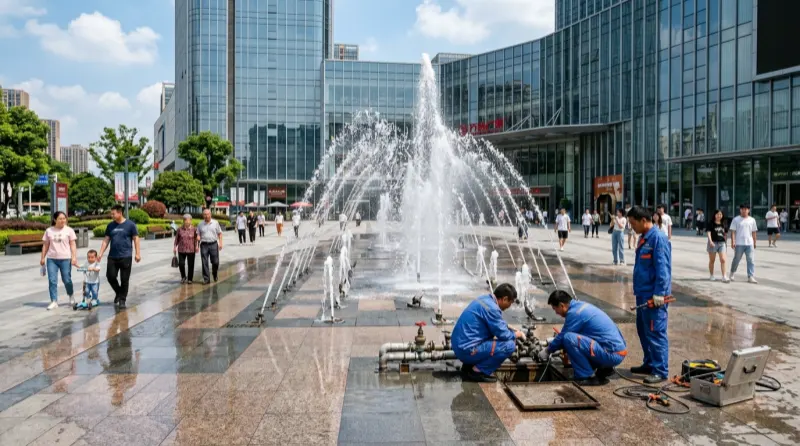
Why do fountain malfunctions, which occur frequently, tend to surface all at once after two years?
This timing is no coincidence; rather, it represents the typical failure cycle of substandard materials under specific operating conditions.
- Corrosion is a slow process:The circulating water in fountains contains residual chlorine (public fountains typically maintain a level of 1.0–3.0 mg/L). The pitting corrosion caused by chloride ions on 304 stainless steel does not occur immediately; rather, it builds up gradually through continuous exposure, and visible perforations or rust spots typically do not appear until one to two years later.
- Waterproofing failure occurs in cycles:Light fixtures with falsely labeled IP ratings often cut corners on the material of the sealing gaskets or the encapsulation process. While they may withstand initial exposure to water without issues, the sealing performance deteriorates rapidly under the combined effects of temperature fluctuations and repeated water pressure, and significant water ingress typically begins after one or two cycles of summer and winter.
- Motor losses are cumulative:Generic water pumps designed for low-load conditions operate normally at first, but due to poor-quality windings and inadequate heat dissipation design, they experience wear and tear at a much faster rate than brand-name pumps during high-intensity continuous operation, and are significantly more likely to burn out within two years.
- The warranty period ends right around this time:Most manufacturers offer a one-year warranty, while some provide a two-year warranty. It is no coincidence that the failure of substandard materials often coincides with the expiration of the warranty; this means that by the time problems arise, the purchaser has already lost the opportunity to seek free repairs.

Material Detail Pitfall 1: Using 304 stainless steel instead of 316L for the nozzle—corrosion and perforation are only a matter of time.
316L and 304 stainless steel nozzles look, feel, and are colored almost exactly the same; they cannot be distinguished by sight without material testing.
316L stainless steel contains 2–3% more molybdenum than 304; it is precisely this composition that makes its corrosion resistance to chloride ions approximately 3–5 times that of 304 (with slight variations depending on testing conditions). The chlorinated water used for disinfection in public fountains creates a long-term, stable corrosive environment, and 304 nozzles fail much faster in this environment than 316L nozzles.
The practice of cutting corners involves promising 316L in bids or quotes but actually delivering 304—the price difference is approximately 20–30%. This results in significant savings on the entire batch of nozzles, but the purchaser has no way of detecting it until corrosion-induced perforations or distorted spray angles appear more than a year later.
- The contract must specify:The contract’s equipment list must explicitly state that the nozzles are made of 316L stainless steel, rather than vaguely referring to ”stainless steel” or ”high-quality stainless steel.”
- Request for Material Report:Prior to signing the contract, please provide a 316L material test report or a third-party certification report (such as SGS) to verify that the molybdenum (Mo) content falls within the range of 2–31 TP3T.
- Random inspections during acceptance:Upon delivery of the equipment, a rapid test of the nozzles using an alloy analyzer is required. This type of instrument provides results on-site, eliminating the need to send samples for testing.
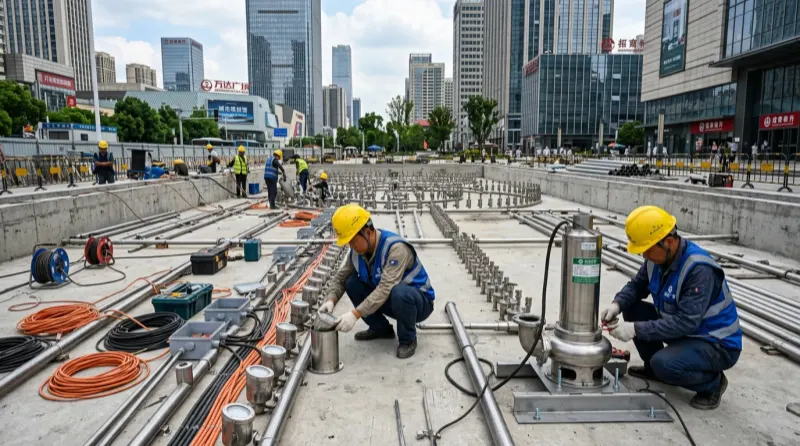
Material Detail Pitfall #2: Misrepresented IP Ratings on Light Fixtures; Water Resistance Is Far Lower Than Promised
The designs of IP65 and IP68 luminaire housings are very similar; they can only be distinguished through actual submersion testing or by disassembling them to inspect the sealing structure.
For fountain lights intended for long-term underwater use, the standard requires an IP68 rating (permanent submersion to a depth of more than 1 meter). This means that the material of the light’s sealing rings, the encapsulation process, and the waterproofing of the wiring connections must all meet higher standards. An IP65 rating only provides protection against low-pressure water jets and is completely unsuitable for environments involving continuous submersion.
Some manufacturers purchase low-end lighting fixtures rated IP65—or even those without any rating—and list them as IP68 on product pages or quotes, resulting in significant cost savings. While these lights may function without issues during the initial few months of submersion, exposure to thermal expansion in the summer and contraction in the winter accelerates the aging of the sealant. Within one to two years, the likelihood of water ingress becomes extremely high, resulting in yellowing of the light in mild cases and short circuits that pose safety hazards in severe cases.
Compliant LED lighting fixtures should have a true lifespan of approximately 50,000 hours (about 17 years, based on 8 hours of use per day), but the light output of substandard fixtures declines much faster than this; typically, their brightness has already decreased significantly after two or three years.
- The contract specifies the IP rating and brand:The contract must clearly specify the IP68 certification, brand, and specific model of the LED fixtures; entries such as ”waterproof lights” or ”underwater fixtures” alone will not be accepted.
- Required IP certification documents:Genuine IP68 products should come with corresponding certification test reports; manufacturers should be required to provide these, and the credibility of the certification bodies should be verified.
- Operating Voltage Verification:Safety standards for public waters require that underwater lights operate at 12V or 24V DC. If a manufacturer provides underwater lights designed for direct 220V operation, this is both unsafe and non-compliant with regulations, and such products must be explicitly rejected.
Material Detail Pitfall #3: The water pump uses a low-performance, no-name brand motor—it’s only a matter of time before it burns out.
No-name water pumps typically feature inferior copper windings, bearings, and heat dissipation designs; as a result, they wear out much faster than brand-name products under continuous, high-intensity operation.
The fountain pump is the component in the entire system that consumes the most energy and operates under the heaviest load. Under normal conditions, submersible pumps have a service life of approximately 8–12 years (10–15 years for dry-installed pumps); these are reference values based on the proper configuration of brand-name pumps.
The core issues with low-quality, low-performance motors of unknown brands center on three areas: copper wire windings are replaced with aluminum wire or copper-clad aluminum, resulting in poor heat dissipation and rapid insulation aging; bearing materials are of inferior quality, leading to faster wear when operating in water for extended periods; and inadequate heat dissipation design causes the motor to overheat during continuous, high-intensity operation, accelerating insulation aging. When these three issues combine, the probability of a motor burning out increases significantly after one or two years of continuous operation.
Another often-overlooked issue is this: if a water pump is not equipped with a variable frequency drive (VFD) and instead operates at a fixed speed, not only is its energy consumption 40–60% higher than that of a variable-frequency pump, but the pump will also wear out more quickly and experience a higher failure rate when operating at full load for extended periods.
- Required brand and model:The brand and specific model of the pumps must be clearly specified in the quotation and contract, and the nameplates must be verified against the inventory list upon delivery of the equipment.
- Check the variable-frequency configuration:Verify whether the water pump is equipped with a VFD (variable frequency drive). This not only serves as an energy-saving measure (typically reducing energy consumption by 40–60%) but is also a critical component for protecting the motor.
- No-Load Test:After installation is complete, conduct a no-load test before filling the unit with water to verify that noise, vibration, and current are within normal ranges.
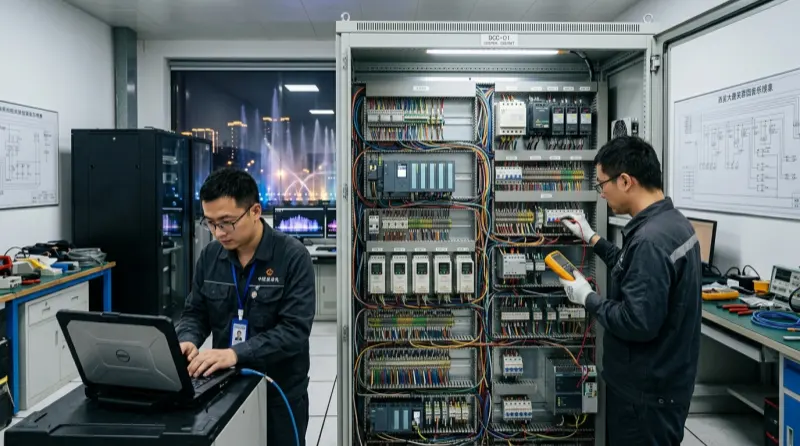
Material Detail Pitfall #4: Downgraded Control System—What’s Sacrificed Is Performance Quality and Equipment Protection
Downgraded PLC brands, a reduced number of DMX channels, and the absence of safety interlock modules may not have a noticeable impact in the short term, but after prolonged operation, the failure rate and safety risks will gradually become apparent.
The control system for a professional musical fountain consists of two systems—a PLC (Programmable Logic Controller) and the DMX512 lighting control protocol—that work in tandem. The PLC is responsible for the logical control and safety interlocks of the water pumps and solenoid valves, while DMX handles the synchronization of lighting color, brightness, and rhythm. The configuration level of these two systems directly determines the upper limit of precision in performance effects and the comprehensiveness of equipment protection capabilities.
Common cost-cutting measures include: replacing mainstream-brand PLCs with low-end or no-name models, resulting in a significant decline in stability and interference resistance; reducing the number of DMX channels, which limits the complexity of lighting effects; omitting safety interlock modules such as water level sensors and wind protection, resulting in a lack of automatic protection capabilities in the event of abnormal operating conditions; and omitting backup control links, which means there is no redundant failover in the event of a main link failure.
- List of Required Control Systems:The contract must specify the brand and model of the PLC (major brands such as Siemens, Mitsubishi, and Omron) as well as the brand and number of channels of the DMX controller.
- Confirm the Safety Interlock Module:Request that the manufacturer specify whether the control system includes safety interlock features such as water level protection, wind protection interlock, and ground fault protection; these are standard features of a professional system and not optional.
- Perform integrated testing during acceptance:During the acceptance testing phase, a comprehensive safety interlock test must be conducted to simulate abnormal water levels or equipment failures and verify that the protective mechanisms activate properly.
Frequently Asked Questions (FAQ)
The fountain broke after only two years—does that mean they skimped on the materials?
This isn’t necessarily the case—inadequate water quality management (such as chronic excess residual chlorine or uncontrolled pH levels) and insufficient maintenance frequency can also accelerate equipment aging. However, if malfunctions are concentrated in typical issues such as corrosion of nozzles, water ingress into lighting fixtures, and burned-out pumps, it is usually necessary to investigate whether the initial material specifications met the required standards.
How can you quickly determine if a nozzle is made of 316L when receiving a shipment?
The fastest method is to use an alloy analyzer (XRF fluorescence analyzer) for on-site testing, which provides an immediate reading of the molybdenum content and confirms whether it falls within the 2–3% range specified by the 316L standard. Such equipment can be rented, or you can engage a third-party testing agency to provide on-site services.
Are there any differences in the appearance of IP68 and IP65 luminaires? How can you tell them apart?
There is virtually no difference in appearance; they cannot be distinguished by the naked eye. The most reliable approach is to request that the manufacturer provide the corresponding IP certification test report and verify the accreditation of the certification body. The next best option is to explicitly state “IP68” in the contract and stipulate that any deviation from the specified configuration constitutes a breach of contract, entitling you to request a replacement.
Does equipping a fountain pump with a variable-frequency drive make a big difference in the user experience?
The difference is significant. Pumps equipped with VFD (variable frequency drive) systems can adjust their speed in real time, not only reducing energy consumption by 40–60% compared to fixed-speed pumps but also enabling a wider range of water flow patterns. At the same time, they reduce motor losses during full-load operation and extend the equipment’s service life.
If I discover that the manufacturer has cut corners, can I still hold them accountable after I’ve already accepted the work and made payment?
Whether liability can be established depends on whether the material specifications in the contract are clear. If the contract’s equipment list explicitly specifies terms such as 316L, IP68, or specific brand and model numbers, and the actual configuration does not match the agreement, this constitutes a breach of contract, and a claim can be pursued based on the contract; If the material specifications are vague, it becomes significantly more difficult to assert your rights—which is precisely why it is essential to clearly define material terms before signing the contract.
All projects come standard with 316L stainless steel nozzles, IP68-certified underwater LED lights, and brand-name pumps paired with VFD frequency converters. The contract equipment list provides detailed brand and model specifications and supports third-party material verification. With 18 years of engineering experience, we have served fountain projects in more than 50 countries worldwide.
If you are sourcing a fountain project or have questions about your existing equipment configuration, please feel free to contact our engineering team.
Phone: 18818738142
 Chinese
  English