
Feng shui considerations for garden fountains are among the most frequently asked questions by private homeowners during the renovation process. To put it simply: there are specific guidelines to follow, and while opinions vary among different schools of thought, several core principles are generally consistent across traditional feng shui theory—water should gather rather than disperse, the direction of water flow matters, and placing water features in certain directions may have adverse effects. This article compiles the five most commonly cited directional taboos regarding garden fountains in Feng Shui, as well as practical guidelines for selecting a location, to help homeowners plan effectively before construction begins.
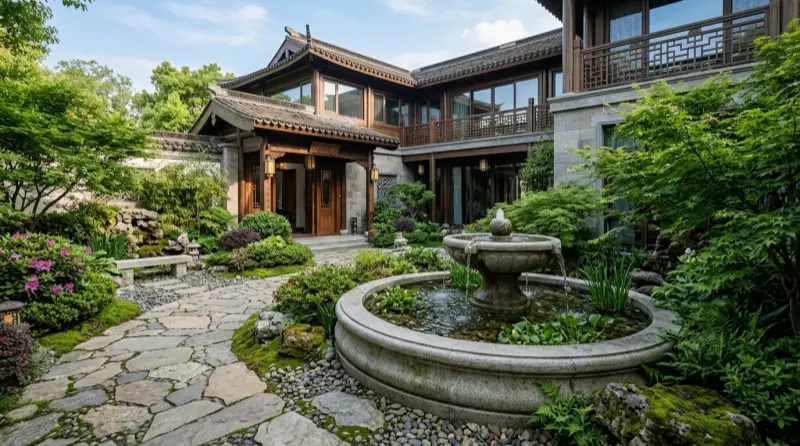
The Basic Logic of Feng Shui for Garden Fountains: What Does Water Represent in Feng Shui?
In traditional Feng Shui theory, water is considered the carrier of wealth and vital energy. The saying ”Mountains represent family prosperity, while water represents wealth” encapsulates the fundamental nature of water in Feng Shui—when water features are arranged properly, they are intended to attract wealth and gather positive energy; when arranged improperly, they may cause wealth to leak away or generate negative energy.
As a feature of moving water, fountains have different characteristics in Feng Shui than still water (such as mirror-like ponds or reflective water features):
- Hydrodynamics:Flowing water is believed to activate the energy field and bring good fortune, making it suitable for areas that need to ”boost wealth”; however, if the flow is too strong, it can easily create a ”water煞” and have negative effects.
- Still Water:Calm water surfaces are believed to gather energy and stabilize the energy field; they are suitable for areas where one needs to ”retain wealth” and have relatively mild feng shui properties.
Because fountains feature water jets that continuously shoot upward and produce a distinct splashing sound, they are considered a type of “moving water” with strong energy. The impact of their location and orientation is relatively more significant; therefore, feng shui considerations for garden fountains must be approached with greater caution.
5 Feng Shui Taboos for Garden Fountains: Avoid These Locations at All Costs
Taboo 1: Facing the Front Door Head-On (Directly Opposite the Door)
This is the most common taboo in feng shui regarding garden fountains. Placing a fountain directly facing the front door is known in feng shui as ”water rushing toward the door,” which is believed to prevent wealth energy from accumulating inside the home, causing it to flow directly out through the front door.
From a practical standpoint, having a fountain directly in front of the main entrance also presents practical problems: the mist and sound of the water directly affect the experience of entering and exiting; on windy days, the water jets can veer off course and easily wet the area near the entrance; and the flow of foot traffic interferes with the fountain’s water display.
Best practice: The fountain should be offset from the central axis of the main gate or placed in a suitable location within the courtyard so that the water feature ”welcomes visitors without confronting the gate,” creating a visually welcoming effect rather than a direct confrontation.
Taboo 2: Behind the Main House (Xuanwu Position)
In traditional Feng Shui, the area behind a residence is called the ”Xuanwu position,” which corresponds to a ”backing mountain” and symbolizes stability and support. Placing a water feature in the Xuanwu position is believed to “disperse the backing mountain,” thereby affecting family stability and the foundation of one’s career.
This belief is reflected in various schools of feng shui and is one of the most widely accepted taboos regarding orientation in the context of garden fountains.
Best practice: If you want to create a scenic view at the back of your home, it’s better to plant tall trees or install a solid decorative wall rather than a water feature. Water features are better suited for the front or sides of the home.
Taboo 3: A location directly opposite the bedroom window
In Feng Shui, the bedroom is associated with tranquility and serves as a place for rest and rejuvenation. The constant sound of a fountain and its dynamic energy field conflict with the serene environment required in a bedroom; according to Feng Shui theory, this is believed to disrupt sleep quality and affect the health of family members.
There is also a very practical reason for this taboo: the sound of water flowing from a fountain—even if it is not noticeable during the day—can be clearly heard in the bedroom at night when it is quiet, affecting sleep quality.
Best practice: Maintain a sufficient distance between the fountain and the bedroom window, or use a green belt or a wall to block sound. If the yard is small and the bedroom faces the yard, it is recommended to choose a fountain with low power consumption and a low water jet, and set up a timer to turn it off at night.
Taboo 4: The Direction the Stove Faces in the Kitchen
In the Five Elements theory, the combination of the kitchen’s orientation and water represents a ”water-fire conflict.” It is believed that water vapor from a fountain directly facing the kitchen can adversely affect the family’s dietary health and the housewife’s fortune. In Ba Zhai Feng Shui, each house type has a corresponding wealth direction; recommendations for arranging the wealth direction should be determined based on the specific house type under the guidance of a professional Feng Shui master.
Best practice: The kitchen window should not face a fountain directly. If yard space is limited, there should be at least a row of plants or a decorative wall between the fountain and the kitchen window to prevent moisture from blowing directly into the kitchen.
Taboo 5: The Center of the Courtyard
In traditional feng shui, the center of a courtyard corresponds to the ”Central Palace,” which is associated with the Earth element; according to the Five Elements theory, Earth is incompatible with Water. Digging a pond or installing a large fountain in the exact center of the courtyard is believed to ”harm the Central Palace” and disrupt the stability of the family’s overall energy field.
From a practical standpoint, placing a fountain in the center of the courtyard can also disrupt the overall flow of the space, as people must go around it to enter, exit, and move about, which affects the courtyard’s usability.
Best practice: Large water features are best placed near one side of the yard (usually the left or right side of the front yard), rather than in the center. For small decorative fountains—provided they are compact and do not require excavation—the taboo against placing them in the center has relatively little impact.
3 Auspicious Locations for Garden Fountains According to Feng Shui
In addition to taboos, there are several generally accepted auspicious locations for traditional garden fountains in feng shui:
- On the left side of the front yard (the Azure Dragon position):In Feng Shui, the left side of a residence is known as the ”Green Dragon position,” which governs the presence of benefactors and career fortune. Placing a water feature in the Green Dragon position is believed to help enhance relationships with benefactors and promote career growth, making it the most common auspicious location for a garden fountain.
- Diagonally across from the main gate (facing the water):The fountain is positioned diagonally across from the main gate rather than directly in front of it, with the water flowing toward the interior of the residence. In Feng Shui, this is known as ”water flowing toward the courtyard” and is believed to have the effect of attracting wealth and positive energy.
- The Ming Tang Area in Front of the House:The open area in front of a residence is called the ”Mingtang,” which is the core area in feng shui for harnessing wind and gathering energy. Creating a modest water feature in the Mingtang area is the most classic water feature layout in traditional feng shui.

4 Practical Factors to Consider When Choosing a Location for a Garden Fountain
In addition to feng shui directions, the actual placement of a garden fountain should also take into account the following four practical factors, which directly affect the fountain’s performance and ease of maintenance:
- Sunlight Conditions:Since fountain water is constantly exposed to strong sunlight, rising water temperatures can significantly accelerate algae growth, making water quality maintenance more difficult and costly. It is best to place a garden fountain in a location that receives partial shade in the morning or afternoon to avoid full-day exposure to the sun, which helps control water temperature and maintain stable water quality.
- Water Supply and Drainage Conditions:Fountains must be connected to water supply lines (for refilling) and drainage lines (for water replacement and maintenance). When selecting a location, it is important to confirm the distance to the nearest water supply and drainage connection points, as excessively long pipeline runs can significantly increase installation costs.
- Power Requirements:Fountain pumps and underwater lights must be connected to a power source using a waterproof outdoor power connection equipped with a residual current device (RCD). When selecting a location, verify that there is a suitable power connection point nearby and a route for laying the cables.
- Impact of Fallen Leaves and Debris:Near deciduous trees, large amounts of fallen leaves in the fall can clog the filtration system and increase the frequency of maintenance. When selecting a location for a garden fountain, avoid placing it directly beneath trees that shed a lot of leaves or downwind of them.
Frequently Asked Questions (FAQ) About Feng Shui for Garden Fountains
Are there any feng shui considerations regarding the direction of water flow in a garden fountain? Should the water flow inward or outward?
In traditional courtyard fountain feng shui, the direction of water flow is very important. The basic principle is that ”water should flow inward, not outward”—water feature designs should visually direct the flow toward the interior of the residence, rather than away toward the main gate or courtyard walls. Since water from a fountain shoots upward and then falls back into the basin, the direction of the water flow is relatively neutral. The key lies in the position and orientation of the basin, ensuring that the visual center of gravity of the entire water feature lies on the side facing the interior of the residence.
Are there any feng shui considerations regarding the size of a garden fountain?
Yes. In Feng Shui, there is a saying that ”excessive water oppresses the home,” meaning that if the size of a water feature far exceeds that of the residence, it will have an oppressive and negative effect on the residents. It is generally believed that the area of a courtyard water feature should not exceed one-third of the total courtyard area, and the height of a fountain should not exceed the height of the eaves. Pairing a large fountain with a small courtyard—aside from feng shui considerations—can also create a sense of spatial confinement and cause noise disturbances.
Round Fountains vs. Square Fountains: Which Is Better for Feng Shui in a Garden?
In Feng Shui, circular shapes symbolize completeness and the gathering of energy, while square shapes symbolize stability and the preservation of what has been achieved. Neither shape is inherently superior to the other; the choice depends largely on how well it harmonizes with the overall layout of the courtyard and the style of the residence. From a practical standpoint, circular ponds lack sharp corners and are less likely to create ”corner煞” in a courtyard space. For small courtyards with limited space, circular or oval shapes are the safer choice.
The fountain that’s already been built is in a bad location. How can this be remedied?
If a fountain has already been built but its orientation poses feng shui issues, common remedies include: reducing the adverse effects by adjusting the fountain’s operating hours (such as turning it off during specific times); adding greenery or decorative rocks between the fountain and the problematic direction to ”block negative energy”; or placing specific objects designed to dispel negative energy under the guidance of a feng shui master. If the issue is severe and modifications are feasible, adjusting the shape of the pool or altering the visual direction of the water flow through landscaping changes is a more fundamental solution. For specific remedies, it is recommended to consult an experienced feng shui master, who can make a judgment based on the specific layout of the property and actual conditions.
Can I put a fountain in the yard of a rented house? Does feng shui affect the tenant or the landlord?
According to mainstream Feng Shui beliefs, Feng Shui affects the actual residents rather than the property owners; therefore, when tenants install water features in the courtyard, the Feng Shui effects primarily apply to the tenants themselves. However, from a practical standpoint, making significant changes to the yard—including installing a fountain—typically requires the landlord’s consent, and the area may need to be restored to its original condition upon moving out. It is recommended to choose a small, portable fountain to avoid permanent installation.
Huiqi Fountains has been deeply rooted in the fountain industry for 19 years, providing comprehensive services for garden fountains—from selection and design to installation and commissioning. Whether it’s a customized site selection plan that aligns with feng shui orientation requirements or equipment configuration for small garden fountains, we offer professional advice. Our product line ranges from small decorative garden fountains to large-scale landscape water features, and our products are exported to over 50 countries, complete with comprehensive installation and maintenance manuals. Please feel free to contact our project team at 18818738142.
 Chinese
  English