
◆ Direct Answer
Price differences in fountain projects primarily stem from four key factors: the quality grade of equipment materials (nozzles, pumps, lighting), the complexity of the control system, the scope of civil engineering work, and brand reputation and service guarantees. Even for proposals with the same spray height that appear similar at first glance, quotes can vary by a factor of several times. When comparing prices, it’s important not to focus solely on the total price but to break down the components.
Introduction
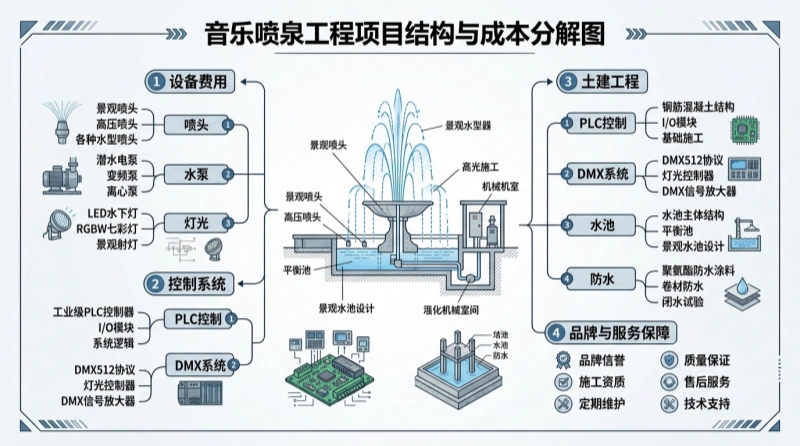
Many buyers encountering a fountain project for the first time face the same dilemma: after requesting quotes from three or four manufacturers, the prices for a musical fountain just over ten meters tall can range from several hundred thousand to over a million—a gap so wide that it raises suspicions of price gouging or cutting corners. In fact, such vast differences in fountain quotes are a common occurrence in the industry. This isn’t simply a matter of “fair pricing” versus “exorbitant pricing,” but rather a genuine difference in costs resulting from the combined factors of equipment grade, control system complexity, the scope of civil engineering work, and service guarantees.
Only by understanding these points can you truly assess the reasonableness of a quote, rather than making decisions based solely on the total price.
Why do fountain quotes sometimes vary by several times for the same effect?
Solutions that appear to have similar results on the surface may actually have configurations that are in completely different leagues.
- Similar effects do not mean identical configurations: Both manufacturers can produce a demonstration featuring a 10-meter-high water column accompanied by lights and music, but one uses 316L stainless steel nozzles and an imported water pump, while the other uses standard 304 nozzles and a generic water pump. Although the short-term results may appear similar, there is a world of difference in durability and failure rates.
- Differences in the level of detail in quotes: Some manufacturers offer a “fixed price,” bundling all costs together, making it difficult to break down the figures; others provide a detailed list of equipment and a breakdown of unit prices. While these quotes may appear higher at first glance, they actually lay out upfront costs that are often hidden in later stages. The level of detail in a quote is, in itself, an indicator of a manufacturer’s professionalism.
How do differences in equipment material grades account for the variation in quotes?
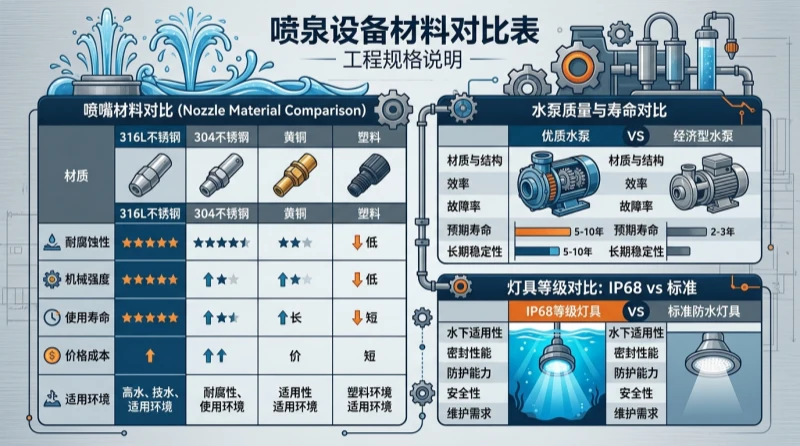
Equipment accounts for the largest portion of a fountain quote, and the choice of material grade directly determines the price range.
- Nozzle Material: 316L stainless steel nozzles contain molybdenum, which gives them greater resistance to chloride ion corrosion; and the raw material cost is approximately 20%-30% higher than that of 304 stainless steel; however, in public fountain applications involving long-term exposure to chlorinated disinfected water, they have a significantly longer service life; Standard 304, brass, or engineering plastic nozzles have lower initial prices but exhibit higher failure rates in corrosive environments.
- Lighting Fixture Waterproof Rating: Truly meets the IP68 waterproof rating (suitable for permanent submersion in water deeper than 1 meter), and a lifespan of up to 50,000 hours (approximately 17 years), are significantly more expensive than ordinary waterproof lights. However, ordinary lights often develop issues such as water ingress, yellowing, and brightness degradation within one or two years, resulting in higher replacement costs in the long run.
- Pump Brands and Specifications: A pump’s head, flow rate, noise level, and service life directly affect the quoted price. Brand-name pumps typically come with more comprehensive overload protection and warranty services, while unbranded pumps may have a lower initial price but often have higher failure rates and poorer energy efficiency.
How much does the complexity of the control system affect the quote?
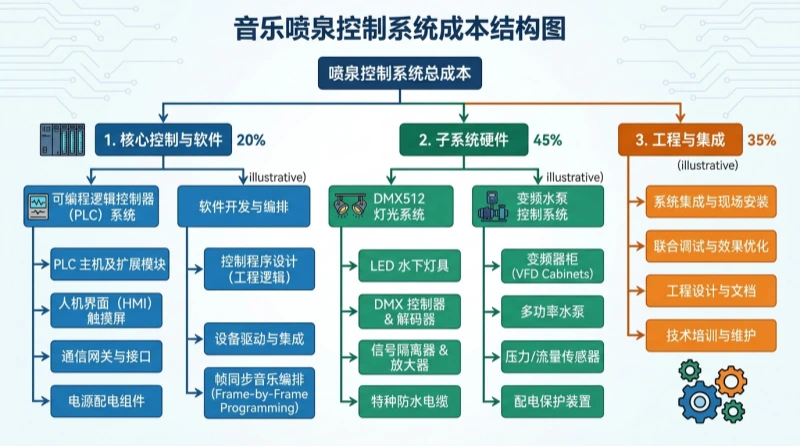
Many buyers tend to underestimate the proportion of the control system in the overall quote, but this is often the most technically complex and labor-intensive component of a musical fountain project.
- Simple Running Fountains vs. Musical Fountains: Running fountains, which require only fixed settings or simple variations, are relatively inexpensive to build; whereas musical fountains require the coordinated operation of dual control systems—PLC and DMX512. Variable-frequency speed control of the pumps, changes in lighting color and brightness, and the opening and closing of solenoid valves must all be precisely synchronized with the musical rhythm, and the investment in this hardware and programming will significantly increase the quote.
- Programming Labor Costs: Programming the control sequences for a musical fountain requires programmers to analyze each frame of the music tracks and precisely synchronize the water patterns, lighting, and rhythm. This work is highly dependent on experience and the amount of time invested; as the number of tracks increases and the effects become more complex, the proportion of programming costs will rise accordingly.
How does an underestimation of civil engineering quantities affect the final quote?
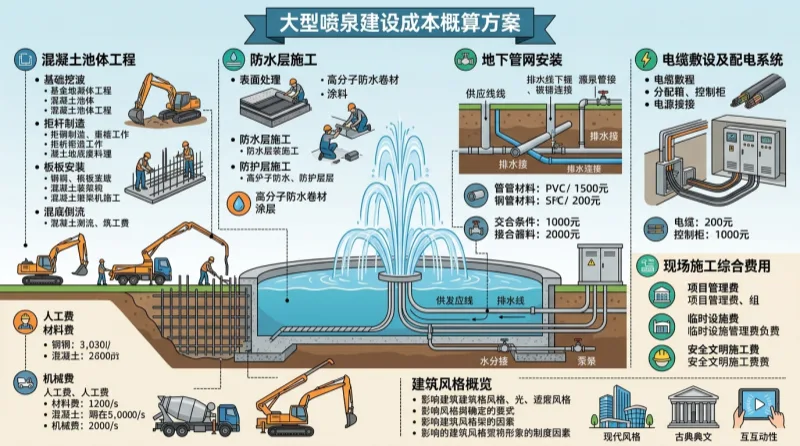
The root cause of many quotation discrepancies lies not in the equipment, but in the on-site civil engineering conditions, which are often overlooked by the purchasing party.
- Foundation and Waterproofing: The reinforced concrete construction of the pool structure, along with waterproofing and leak-proofing tests, are the cornerstone of ensuring the fountain’s long-term, stable operation. If on-site geological conditions are complex or existing infrastructure is inadequate, civil engineering costs will rise significantly, and it is difficult to accurately estimate these variations during the preliminary quotation stage.
- Utility Line and Water/Electricity Infrastructure Upgrades: Whether the capacity of existing water and electricity infrastructure meets the project’s needs directly determines whether additional utility lines need to be laid or electrical upgrades are required. These hidden costs are often the primary source of “add-ons” in later quotes; conducting a site survey in advance can help avoid such disputes.
Is it worth paying extra for brand reputation and after-sales service?
Service guarantees that aren't listed on the quote are often the key factors that determine the long-term user experience.
- Warranty Period and Response Time: Manufacturers that offer longer warranty periods and promise faster on-site response times typically factor these service costs into their quotes; however, this can significantly reduce downtime losses and repair wait times caused by equipment failures down the line.
- Spare Parts Availability: The annual maintenance cost for a fountain is typically around 5%–10% of the equipment’s purchase price. If a manufacturer has poor spare parts availability or relies on long lead times for custom-made components, the actual maintenance costs and downtime often far exceed the budget; this risk is more likely to be hidden in low-cost proposals.
How can you avoid falling into "low-price traps" when comparing prices?
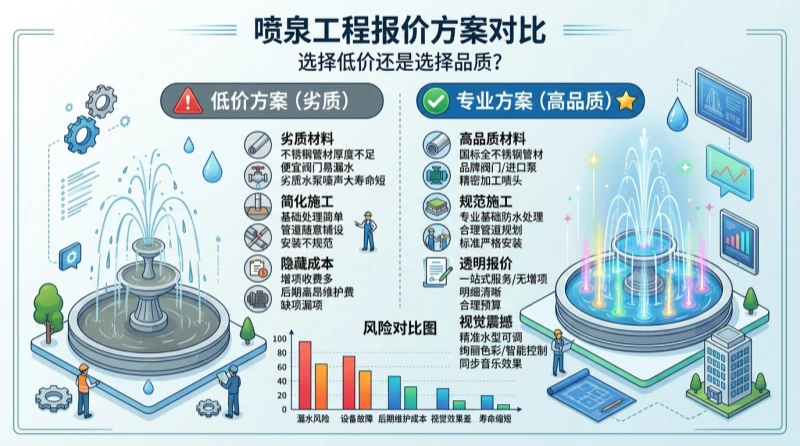
The ability to analyze quotes is the most critical judgment skill that buyers need to develop during the price comparison phase.
- Focus on the breakdown of unit prices rather than the total price: Ask the manufacturer to provide a list of equipment and a detailed breakdown of unit prices, and verify the brands and models of each item—such as spray heads, pumps, lighting fixtures, and control systems—item by item, rather than simply looking at a vague total price figure.
- Beware of “ultra-low” quotes that lead to price increases later on: Quotes that are significantly below market rates often result in additional charges during the construction or acceptance phase, citing reasons such as “changes in on-site conditions” or “equipment upgrades.” Before signing the contract, make sure to clarify whether the quoted price includes all civil engineering, commissioning, and acceptance work.
- Verify Past Projects and Qualifications: Request to see actual examples of similar projects and customer feedback; if necessary, conduct on-site inspections of completed projects to assess their operational status. This provides more valuable insight than simply relying on verbal promises from the manufacturer.
Frequently Asked Questions (FAQ)
Q1: Which item typically accounts for the largest portion of a fountain quote?
Equipment procurement costs (nozzles, pumps, lighting, control systems) typically account for the largest portion of a quote, followed by civil engineering costs. While the costs associated with service and warranty support account for a relatively small portion, they have a significant impact on the long-term user experience.
Q2: Why do some manufacturers offer very low quotes, only to charge extra later on?
Some manufacturers may downplay equipment specifications or intentionally omit certain items (such as civil engineering or commissioning costs) in their initial quotes to attract customers with low prices; they then charge additional fees later under the pretext of “changes in on-site conditions.” Clarifying the scope of the quote and what it includes before signing the contract is key to avoiding such issues.
Q3: For fountains of the same size, how much does the price differ between domestically manufactured and imported equipment?
There is no single figure for the price difference; it depends primarily on the specific equipment category and brand positioning. Imported high-end pumps, lighting fixtures, or control systems are typically significantly more expensive than their domestic counterparts. However, in recent years, the performance and warranty standards of domestic equipment in the mid-to-high-end market have improved significantly. A comprehensive evaluation should be conducted based on the project budget and desired outcomes.
Q4: Which terms in the quote should be verified most carefully?
Pay close attention to the list of equipment brands and models, whether civil engineering and commissioning costs are included, the warranty period and scope, the method of spare parts supply, and the acceptance criteria. The clarity of these terms directly reflects the professionalism of the manufacturer’s quote and the reliability of its future performance.
Q5: What services are typically included in a quote for a fountain project? Are installation and warranty charged separately?
A standard quote typically includes equipment procurement, transportation, installation, commissioning, and a warranty for a specified period; however, the specific scope varies by manufacturer. Some manufacturers offer extended warranties or periodic inspection and maintenance as value-added services subject to separate charges, so it is important to confirm each item before signing the contract.
Huiqi Fountain
We provide transparent equipment lists and itemized quotes with unit prices; the brands and models of nozzles, pumps, lighting, and control systems can all be verified item by item. With 19 years of engineering experience, we have served fountain projects in more than 50 countries worldwide.
If you are comparing quotes for fountain projects and want to understand the actual breakdown behind the quotes, please feel free to contact our engineering team for professional advice.
Phone number:18818738142
 Chinese
  English